





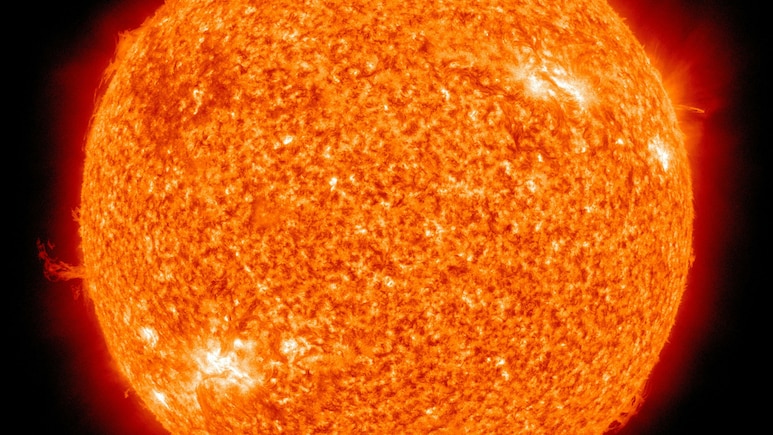
- A sunspot over 10 times Earth's size appeared on the sun's surface recently
- NASA observed the largest sunspot in 10 years on December 1, 2025
- A strong X1.9 solar flare caused a 30-minute radio blackout in Australia
A huge sunspot that is more than 10 times bigger than Earth has appeared on the surface of the sun, and scientists say it could lead to several strong solar flares in the coming weeks. These flares may produce bright auroras, the colourful northern lights, that could stretch far beyond their usual locations, giving people in many southern regions a rare chance to see them, reported Newsweek.
On December 1, 2025, NASA's Solar Dynamics Observatory observed a large spot on the Sun, known as Active Region (AR) 4294-96. This is the largest sunspot recorded in the past ten years and is believed to produce more solar flares in the coming days.
On the same day, satellites recorded an extremely powerful X1.9-magnitude solar flare. Although this flare was quite strong, according to SpaceWeather.com, it originated not from the large spot but from the smaller sunspot AR 4295.
Solar flares are extremely intense bursts of electromagnetic energy. X-class flares are the most powerful and can disrupt high-frequency radio communications by affecting the Earth's ionosphere.
The X1.9-class flare on December 1st caused a major radio blackout in Australia for about 30 minutes, affecting aviation and maritime communications.
According to NASA, the intensity of solar flares is classified as A, B, C, M, and X. Each higher category is 10 times more powerful than the previous one. For example, an X-class flare is 10 times more powerful than an M-class flare and 100 times more powerful than a C-class flare.
Solar flares do not directly cause auroras, but they indicate an increased likelihood of coronal mass ejections (CMEs). CMEs are huge clouds of highly charged particles and magnetic fields emanating from the Sun. If a CME moves toward Earth after a strong flare, it can create a geomagnetic storm, causing brighter auroras even in areas much southern than normal.
If solar activity remains strong in the coming days, auroras may be visible in places like Illinois, Oregon, Northern California, and even Alabama, which is extremely rare.
As of December 1st, experts have not determined whether any CMEs associated with this event are heading toward Earth, but monitoring is ongoing.
This activity comes after a very active November. On November 11th, the year's most powerful X5.1-class flare was recorded, accompanied by several CMEs. This created a severe geomagnetic storm and widespread auroras across parts of the United States and Europe.
In the coming days, scientists will continue to monitor this giant sunspot and potential CMEs, while skywatchers are hoping that the light may once again shine further south than usual.
Track Latest News Live on NDTV.com and get news updates from India and around the world

