





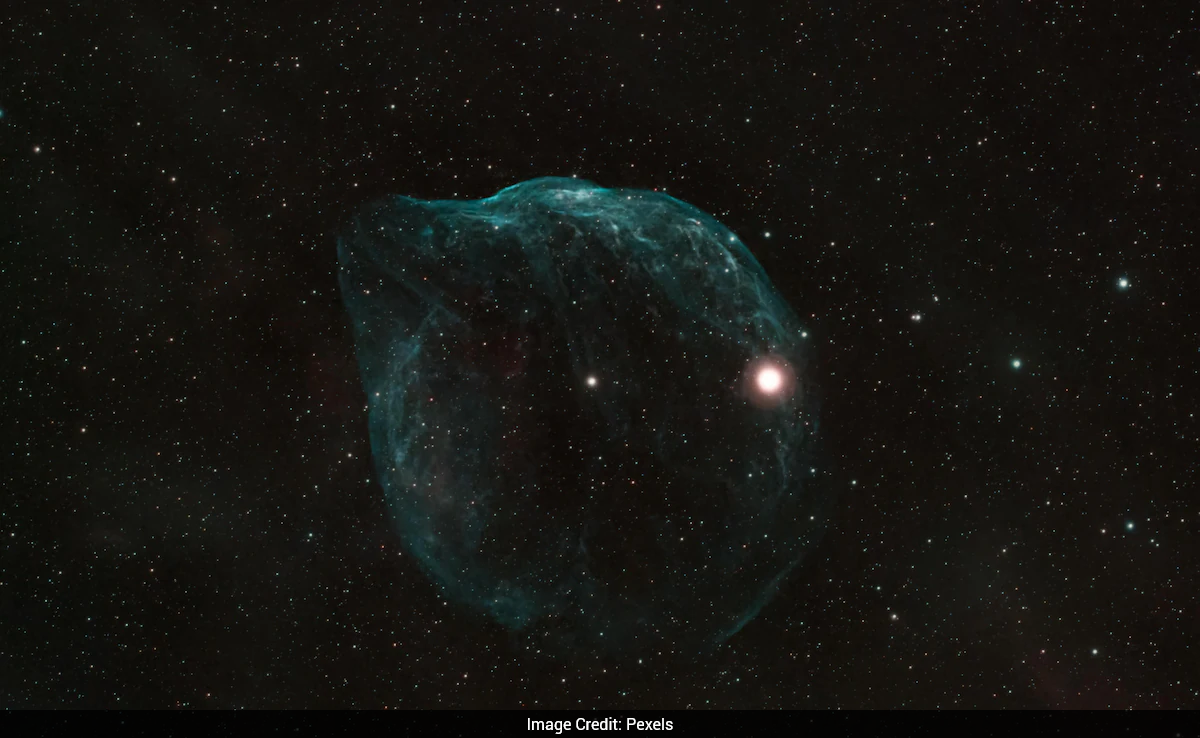
- Astronomers using JWST found signs of giant stars from shortly after the Big Bang
- These stars weighed up to 10,000 times more than the Sun and no longer exist
- A distant galaxy GS 3073 showed unusual nitrogen to oxygen ratios in its composition
Using the James Webb Space Telescope, astronomers may have found the first real signs of giant, dinosaur-like stars that lived shortly after the Big Bang. These stars were not like the ones we see today. Scientists believe they were extremely massive, with some weighing up to 10,000 times more than our sun. Just like dinosaurs on Earth, these stars no longer exist. However, they left behind clues that scientists can still detect today, reported Space.com.
These ancient stars are special because they help us understand how supermassive black holes formed so quickly in the early universe. At that time, when the universe was less than a billion years old, some black holes were already millions of times the mass of the Sun. For a long time, scientists remained a mystery as to how this process happened so quickly.
Investigating A Distant Galaxy
The strongest evidence for this discovery comes from a galaxy called GS 3073. This galaxy is located about 12.7 billion light-years from Earth. This means that scientists are observing it as it was about 1.1 billion years after the Big Bang. The chemical composition of this galaxy was studied using the James Webb Space Telescope.
During the study, scientists discovered a strange imbalance in the ratio of nitrogen and oxygen. The amount of nitrogen in GS 3073 was so high compared to oxygen that it could not be explained by normal stars or known stellar explosions. This unique chemical signature proved crucial for scientists.
Chemical Evidence And A Sign Of Giant Stars
According to scientists, chemical elements in space are like identifying markers. The pattern of elements found in GS 3073 doesn't match that of normal stars. Instead, it only matches stars that formed early in the universe and were thousands of times more massive than the Sun.
These giant stars must have shone extremely brightly, but their existence was very short-about 250,000 years. They then collapsed and died out, but the chemical traces they left behind can still be seen billions of years later.
To understand this mystery, scientists created computer models of stars with 1,000 to 10,000 times the Sun's mass. These models explained how such massive stars could produce such large quantities of nitrogen.
The burning of helium in the core of these stars produced carbon. This carbon then traveled to the outer layers of the star, where hydrogen was burning. This process of carbon and hydrogen produced nitrogen. This nitrogen would then spread throughout the star, gradually escaping into space and enriching the surrounding gas.
However, stars smaller than 1,000 solar masses or larger than 10,000 solar masses do not show this effect.
How Early Black Holes Formed
The research also suggests that these massive stars transformed directly into black holes at the end of their lives without undergoing a supernova explosion. In this process, most of their mass was preserved. Over time, these massive black holes merged, creating a supermassive black hole within a very short time.
GS 3073 already has a growing supermassive black hole at its center, which may be the result of the merger of these early black holes.
Track Latest News Live on NDTV.com and get news updates from India and around the world

