





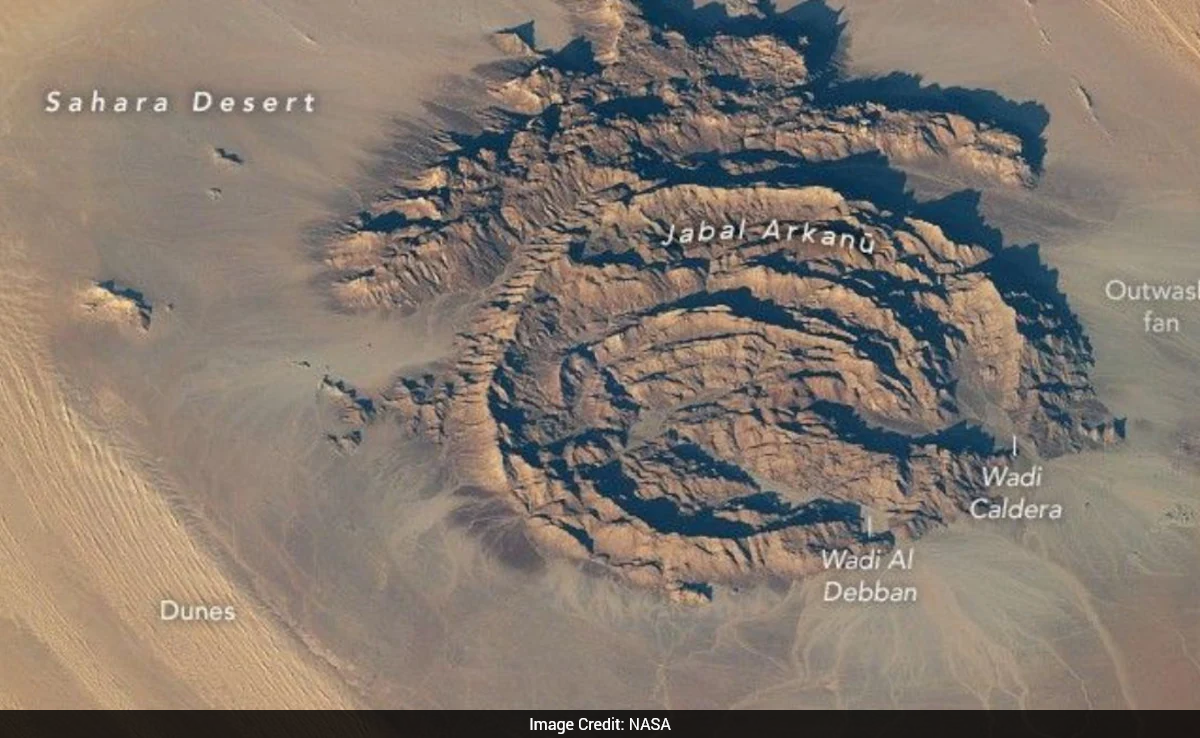
- Jabal Arkanu in southeastern Libya features unusual ring-shaped geological formations visible from space
- The rings formed by magma intrusion, not meteorite impacts as previously believed
- The complex includes igneous rocks and a cap-like structure of sandstone, limestone, and quartz
In one of the driest parts of the Sahara, dark rocky mountains rise sharply from pale desert sand. Among these striking formations is Jabal Arkanu, known for its unusual ring-shaped patterns, reported NASA.
The photograph taken from the International Space Station (ISS) offers a clear and detailed look at this rare geological feature.
Jabal Arkanu, also known as Arkenu, is located in southeastern Libya, near the Egyptian border. Several other mountain ranges surround it, including Jabal al-Awaynat, about 20 kilometres to the southeast, and the Arkenu Formations, about 90 kilometres to the west.
It was previously believed that these circular structures were formed by meteorite impacts. However, subsequent field studies revealed that they are entirely the result of Earth's natural geological processes.
According to scientists, these rings formed when magma rising from within infiltrated surrounding rocks. This process occurred multiple times, creating interconnected circular rings whose centres appear to be tilted approximately southwest.
This ring complex is composed of igneous rocks such as basalt and granite. To its north lies a cap-like structure composed of layers of sandstone, limestone, and quartz.
A new ISS image taken on September 13, 2025, shows long shadows across the desert. Jabal Arkanu's high rocky slopes rise approximately 1,400 meters above sea level, rising about 800 meters above the surrounding sandy plains.
The image shows large boulders, pebbles, and fan-like streams of sand spreading from the mountain's base, leading to tall sand dunes in the desert. Two wadis (dry river channels) also exist within this structure, although water is scarce in this area.
According to NASA and JAXA's Tropical Rainfall Measuring Mission (TRMM), southeastern Libya and the surrounding region of Egypt and northern Sudan receive only 1 to 5 millimetres of rainfall annually.
Slightly more rainfall, about 5 to 10 millimetres was recorded around Jabal Arkanu, which may be due to the slight orographic effect created by the mountains.
This image, ISS073-E-698446, was taken by a member of ISS Expedition 73 using a Nikon Z9 camera and an 800-millimeter lens. It was later cropped and edited for better contrast and clarity.
The ISS Crew Earth Observations Facility and NASA's Earth Science and Remote Sensing Unit (Johnson Space Center) collaborate on this project. Their goal is to enable astronauts to capture important images of Earth and make them freely available to the public. This report is credited to Katherine Hanson.
Track Latest News Live on NDTV.com and get news updates from India and around the world

