



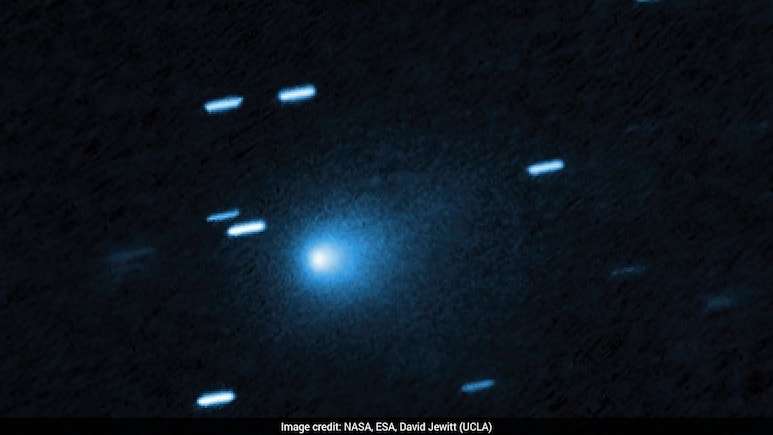
3I/ATLAS, the third known interstellar object to enter our solar system, after 'Oumuamua (discovered in 2017) and 2I/Borisov (discovered in 2019), continue to intrigue space enthusiasts. The comet, discovered in July 2025, sparked speculations about its origins due to its unusual trajectory and properties.
Its mysterious nature prompted some scientists, including Harvard scientist Avi Loeb, to say that the comet might not be naturally occurring. Although NASA refuted all the claims and referred to it as a "comet", nothing else.
Now, a group of astronomers have confirmed it again, saying that 3I/ATLAS is not an alien spacecraft, but rather a natural comet originating from beyond our solar system.
Also read | Hubble Telescope Discovers Cloud-9, A New Type of Astronomical Object
What Did Astronomers Find?
Researchers used powerful radio telescopes, including the Green Bank Telescope and MeerKAT, to scan 3I/ATLAS for signs of alien technology, known as 'technosignatures'.
However, they detected no artificial radio emissions, concluding that the comet is a natural object. "We all would have been thrilled to find technosignatures coming from 3I/ATLAS, but they're just not there," lead researcher Benjamin Jacobson-Bell from the University of California, Berkeley, told Space.com. "Finding no signals was the result we expected, due to the significant evidence for 3I/ATLAS being a comet with only natural features.
"The evidence was against 3I/ATLAS being one such probe, but we would have been remiss not to check."
The interstellar comet 3I/ATLAS made its closest approach to Earth recently on December 19, and apparently caused no harm, passing at a safe distance of 269 million kilometres. But even on its way to exit our star system, the scientists will continue analysing data to understand more about the mysterious comet.
Jacobson-Bell also weighed in on discussions around conducting a similar exploration using probes, such as the Breakthrough Starshot initiative, which is a concept aimed at launching lightweight probes toward Alpha Centauri.
Also read | Don't Miss Jupiter's Spectacular Show On January 10, NASA Shares Skywatching Tips
"There are compelling reasons to think a spacefaring species would send probes to other star systems as a way to learn more about their stellar neighborhood," Jacobson-Bell added.
"Breakthrough Listen searches for life beyond Earth in a variety of ways. The Green Bank Telescope is a radio dish 100 meters wide, situated in a zone federally regulated to be free of most radio interference," Jacobson-Bell said. "Its sensitivity enables us to verify the absence of transmitters down to 0.1 watts, the strongest evidence against technology of any 3I/ATLAS observation to date."
To put this in perspective, smartphones typically emit radio waves at roughly the 1-watt level.
"This is to say that if there were any transmitters on 3I/ATLAS up to ten times weaker than a cell phone, we would have found them," Jacobson-Bell continued.
"Humans produce a lot of narrowband radio signals, including for communication with our own spacecraft," Jacobson-Bell said. "However, by modeling our search strategy on human technological output, we end up detecting a lot of human-made signals! Therefore, we run any detections through filters to distinguish probable human-made interference from possible extraterrestrial signals."
Track Latest News Live on NDTV.com and get news updates from India and around the world

