





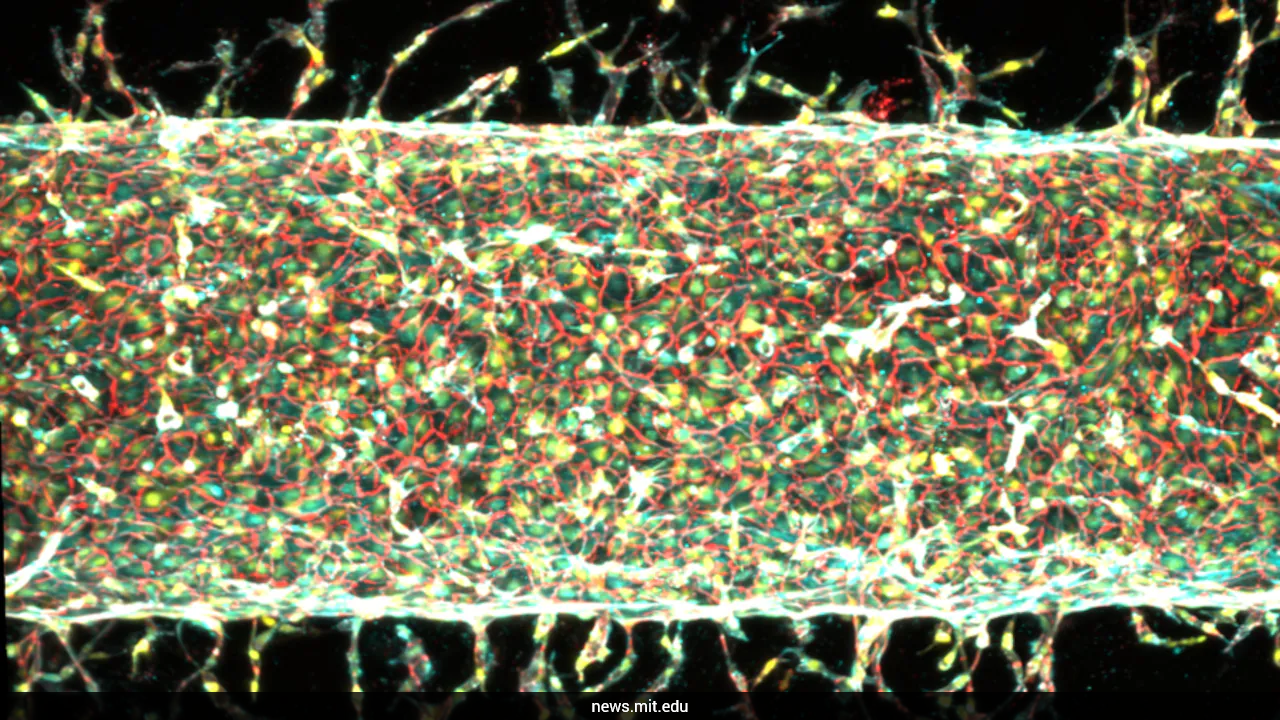
Scientists have made a significant breakthrough in tissue engineering by using magnetic forces to guide the growth of lab-grown blood vessels with unprecedented accuracy. The new technique, developed by a team led by researchers at the Massachusetts Institute of Technology, could pave the way for creating fully functional replacement organs and tissues for medical implants.
Recreating tiny blood vessels known as capillaries in a laboratory environment has long been a major hurdle for biomedical engineers. Capillaries are microscopic, measuring as thin as 0.005 millimetres across, but they are vital for supplying oxygen and key nutrients to living cells. Previous methods relying on chemical growth factors or 3D printing lacked the precision needed to form realistic, organised vessel networks.
The new approach relies on a tiny chip filled with endothelial cells, which are the building blocks that line blood vessels, suspended in a collagen gel. Researchers placed a miniature magnet inside the chip and used external magnetic fields to gently pull and stretch the gel in three dimensions. By adjusting the frequency and strength of the magnetic tugging, the team found they could precisely program the direction, length, and quantity of the growing capillaries.
Mechanical engineer Ritu Raman explained that healthy human tissues depend entirely on organised blood vessel networks. The researchers discovered that stretching the vessel cells back and forth significantly boosted the formation of new capillaries, providing a level of physical control that chemical signals alone could never achieve.
The team also uncovered the biological mechanism behind the process. Experiments revealed that a gene called PIEZO1, which manages pressure-sensitive channels in cells, plays a key role. When this gene was disabled, vessel growth dropped sharply, proving that mechanical stretching triggers specific biological pathways to build the network.
While the research remains at an early stage, the scientists plan to test how effectively blood flows through these magnet-guided vessels and integrate them into larger lab-grown tissues, starting with muscle tissue.
The research has been published in PNAS.
Track Latest News Live on NDTV.com and get news updates from India and around the world

