





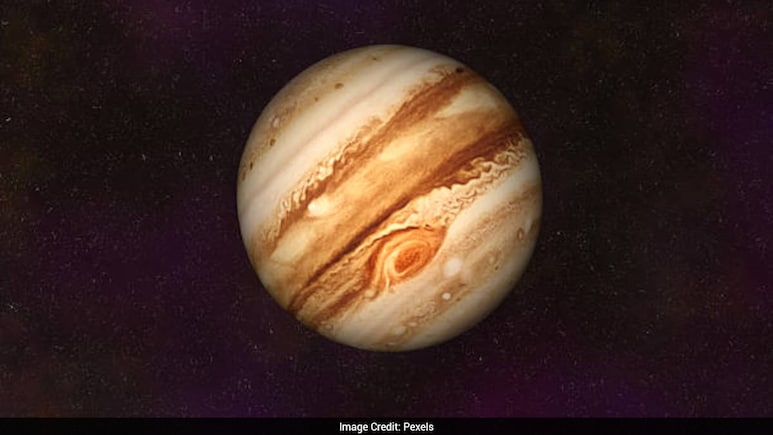
- Jupiter will be closest to Earth in 2026 at 633 million kilometers distance
- The planet will appear in the Gemini constellation near stars Castor and Pollux
- Jupiter shines brightly due to sunlight reflection despite its large distance
This week, the giant planet Jupiter will be at its closest approach to Earth in 2026, offering skywatchers an unmissable view. The planet is extremely bright and easy to spot in the night sky. Jupiter, the largest planet in the solar system, will appear in the constellation Gemini, the twins, reported The Guardian.
It will form a lopsided triangle with Gemini's two brightest stars, Castor and Pollux. Despite being much farther away than Venus, Jupiter shines brightly because its cloud decks reflect a lot of sunlight. Its diameter is more than 11 times that of Earth, making it a truly massive planet. It will be visible from both the northern and southern hemispheres.
At this time, Jupiter will be closest to Earth, at a distance of 633 million kilometers. Sunlight reflected from the planet will take approximately 35 minutes to reach Earth. Meanwhile, light from the Sun's surface takes approximately 43 minutes to reach Jupiter.
Seeing Jupiter's Moons and Cloud Bands
Jupiter can be easily seen with the naked eye when looking east at 20:00 GMT on January 9th. Its four largest moons can be seen with ordinary binoculars. Small binoculars or telescopes with 10x magnification or higher will also reveal the planet's cloud bands, making it a spectacular sight for amateur astronomers.
Track Latest News Live on NDTV.com and get news updates from India and around the world

