





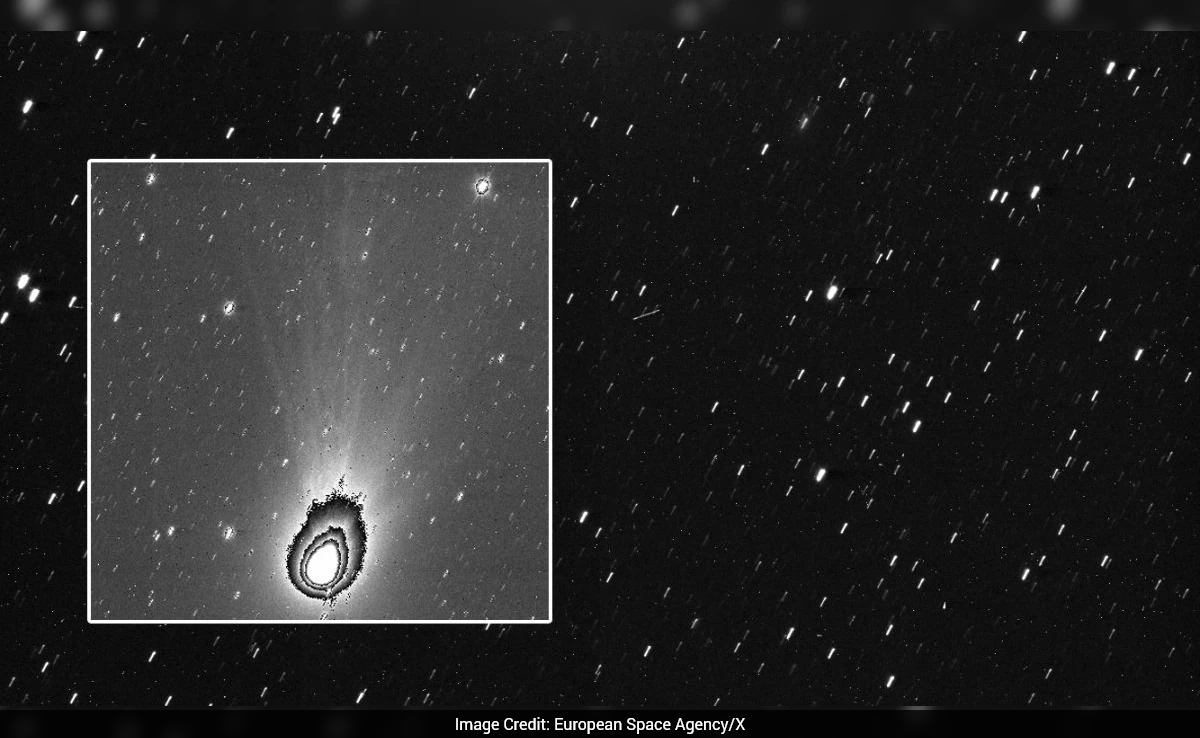
A new space image has given scientists a closer look at a rare visitor from beyond our Solar System. The picture shows an interstellar comet releasing dust and gas as it moved through the inner Solar System, offering important clues about its behaviour, reported Newsweek.
A recent image shared by the European Space Agency's Jupiter Icy Moons Explorer (Juice) reveals a close-up view of the interstellar comet 3I/ATLAS, showing the object emitting dust and gas as it passes through the inner solar system.
This image was taken by Juice's scientific camera, JANUS, on November 6, 2025, seven days after the comet's closest approach to the Sun. At that time, the spacecraft was approximately 66 million kilometers from the comet. Despite this distance, the camera clearly captured the coma, the bright ring of gas that envelops its small, invisible core, as well as the long tail extending away from the Sun.
The image also reveals fine structures within the coma, such as rays, jets, streams, and filaments. A special inset version of the image has undergone additional processing to further clarify these features. The arrows in the image indicate the comet's direction of movement and its position relative to the Sun, allowing scientists to understand how solar heat is affecting its activity.
Although 3I/ATLAS originated from outside the solar system, scientists believe its behavior is similar to that of typical comets made of ice and dust. Upon approaching the Sun, the heat caused the ice on its surface to vaporize, causing the dust to expand outward, forming the coma and tail clearly visible in the image.
Track Latest News Live on NDTV.com and get news updates from India and around the world

