





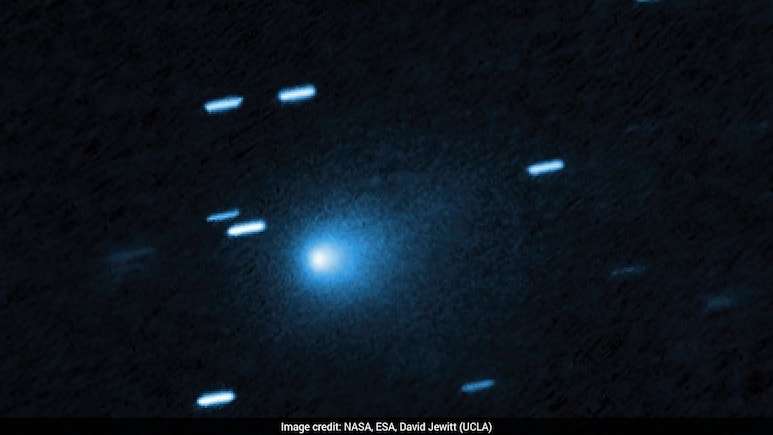
When 3I/ATLAS, the third known interstellar object to enter our solar system, after 'Oumuamua (discovered in 2017) and 2I/Borisov (discovered in 2019), survived its closest approach to the Sun, the scientists analysed it closely.
NASA's SPHEREx mission has been tracking the comet, saying that it detected organic molecules, such as methanol, cyanide, and methane. They also noted that the comet's brightness increased significantly two months after its closest approach to the Sun, suggesting delayed sublimation of subsurface ices.
Also read | NASA's Hubble Telescope Captures Stunning Image of 'Space Egg'
According to the estimates suggest the nucleus is less than 1 km (0.62 miles) in diameter. "Comet 3I/ATLAS was full-on erupting into space in December 2025, after its close flyby of the Sun, causing it to significantly brighten. Even water ice was quickly sublimating into gas in interplanetary space," study lead Carey Lisse of Johns Hopkins Applied Physics Laboratory in Laurel, Maryland, said as quoted by NASA.
"And since comets consist of about one-third bulk water ice, it was releasing an abundance of new, carbon-rich material that had remained locked in ice deep below the surface. We are now seeing the usual range of early solar system materials, including organic molecules, soot, and rock dust, that are typically emitted by a comet."
Also read | AI Uses NASA Images To Locate Luna 9, Historic Soviet Spacecraft Missing Since 1966
3I/ATLAS sprayed water across solar system
The interstellar comet sprayed water across the solar system, leaving scientists astonished, as per a report by Science Daily. Using NASA's Neil Gehrels Swift Observatory, the researchers at Auburn University aimed at the 3I/ATLAS. They detected hydroxyl (OH) gas coming from it, which is a clear chemical sign of water.
The report mentioned that 3I/ATLAS is releasing water at a staggering rate of 40 kilograms per second, equivalent to a fire hose running at full blast.
What's intriguing that the comet is emitting water while being nearly three times farther from the Sun than Earth, a region typically too cold for water to vaporise. "Most comets native to our solar system remain relatively inactive that far out," the report mentions.
3I/ATLAS has a higher ratio of carbon dioxide to water ice compared to comets in our solar system, suggesting it formed in a harsher radiation environment around an older star. The discovery of water on 3I/ATLAS has significant implications for understanding how life's building blocks travel across the galaxy.
Track Latest News Live on NDTV.com and get news updates from India and around the world

