





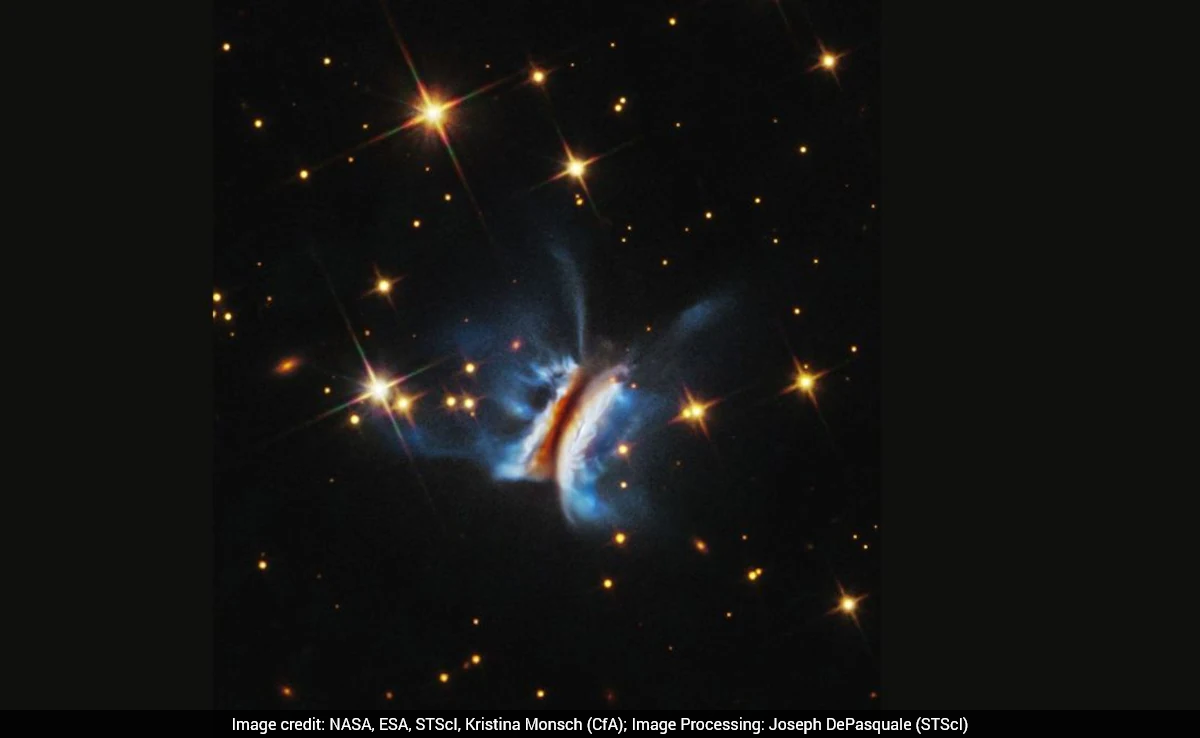
Astronomers used NASA's Hubble Space Telescope to capture stunning images of the largest planet-forming disk ever observed, which is nicknamed "Dracula's Chivito". Located approximately 1,000 light-years from Earth, this massive disk spans nearly 400 billion miles, roughly 40 times the diameter of our solar system.
The disk, officially designated IRAS 23077+6707, is surprisingly chaotic and turbulent, with wisps of material stretching far above and below the disk. This asymmetry is likely due to dynamic processes shaping the disk, such as interactions with its surroundings.
As mentioned by NASA, the edge-on disk looks like a hamburger and the nickname is dedicated to its researchers, one is from Transylvania and another from Uruguay, where the national dish is a sandwich called a chivito.
The findings, which are published Tuesday in The Astrophysical Journal, is a new milestone for Hubble.
Also read | Study Reveals How Clouds Contribute To Earth's Growing Heat Imbalance More Than Air Pollution
"The level of detail we're seeing is rare in protoplanetary disk imaging, and these new Hubble images show that planet nurseries can be much more active and chaotic than we expected," Kristina Monsch, who is the lead author of the Center for Astrophysics | Harvard & Smithsonian (CfA) said as quoted by NASA.
"We're seeing this disk nearly edge-on and its wispy upper layers and asymmetric features are especially striking. Both Hubble and NASA's James Webb Space Telescope have glimpsed similar structures in other disks, but IRAS 23077+6707 provides us with an exceptional perspective — allowing us to trace its substructures in visible light at an unprecedented level of detail. This makes the system a unique, new laboratory for studying planet formation and the environments where it happens."
Also read | Researchers Release Dozens Of Laboratory Mice Into The Wild. This Happens Next
With a disk mass estimated at 10 to 30 times that of Jupiter, IRAS 23077+6707 could potentially host a vast planetary system, offering insights into the formation of our own solar system. The unprecedented detail in Hubble's images allows astronomers to study planet formation in extreme environments.
"We were stunned to see how asymmetric this disk is," co-investigator Joshua Bennett Lovell, also an astronomer at the CfA, said as quoted. "Hubble has given us a front row seat to the chaotic processes that are shaping disks as they build new planets — processes that we don't yet fully understand but can now study in a whole new way."
Track Latest News Live on NDTV.com and get news updates from India and around the world

