





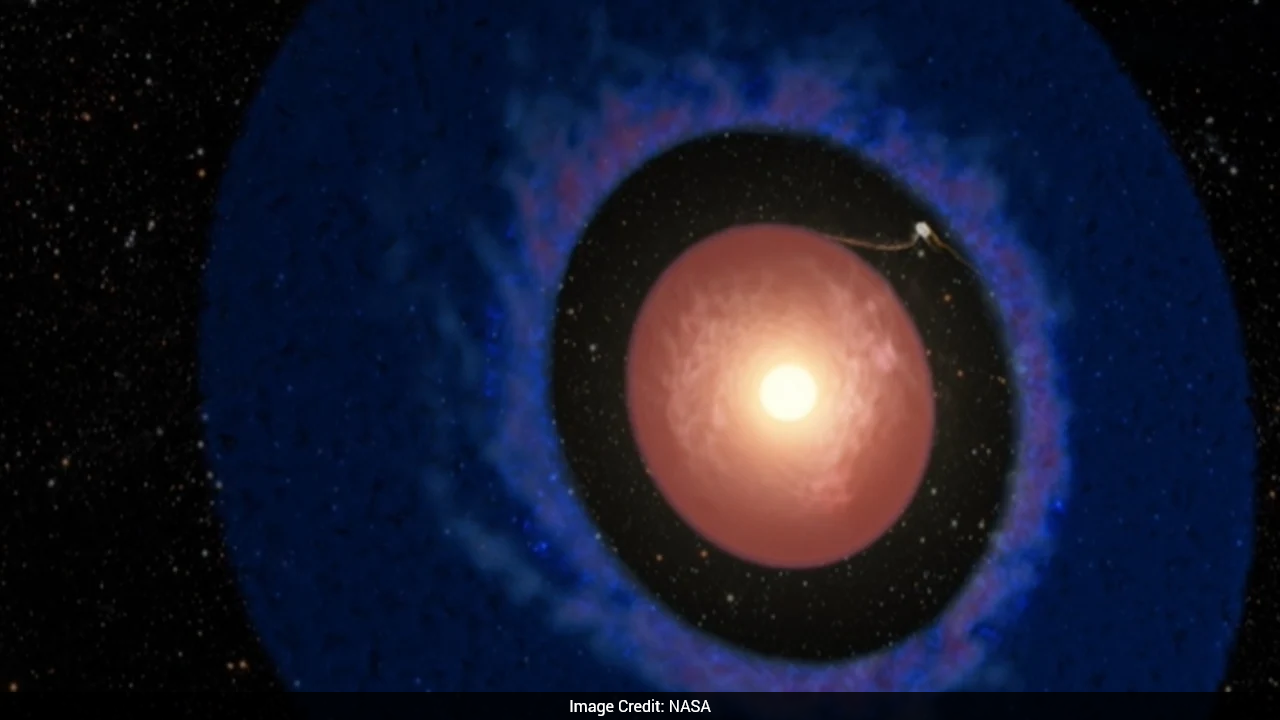
Astronomers have confirmed a planet less than a million years old, making it the youngest known planet. Called Elias 2-24 b, the baby planet is still moving through the disk of dust and gas from which it was formed, according to NASA.
The discovery was made using data from NASA-funded archives. The planet is orbiting the star Elias 2-24, which is about 450 light-years from Earth, and has a mass roughly similar to Jupiter.
In a study published Wednesday in The Astrophysical Journal Letters, a team led by Andrea Bernardi, a doctoral candidate at the Universidad Diego Portales in Chile, studied archival observations of seven stars. The observations were made using the coronagraph at the W M Keck Observatory in Hawaii, which partners with NASA under a cooperative agreement.
The coronagraph blocks light from the stars, allowing astronomers to search for fainter planets within their dusty disks. These disks contain dust, gas, ice and rock, with gaps and structures that can indicate planets are forming.
Bernardi said planets should be found within these gaps because they create them, adding that this is exactly where the team found Elias 2-24 b.
Lucas Cieza, a professor at the Instituto de Estudios Astrofisicos in Chile and co-author of the study, said existing planet-formation models already struggled to explain the previous youngest known planets, which were all more than 5 million years old. He said Elias 2-24 b shows that important processes are still missing from even the best planet-formation models.
Stars form inside swirling clouds of gas and dust. Planets develop from leftover material that gradually clumps together and forms a path around the star. However, studying newborn planets is difficult because thick dust can hide them.
Most confirmed exoplanets have been discovered through transits, when a planet passes in front of its star and briefly reduces the amount of light reaching Earth.
These transits are difficult to detect when planets are buried in dust or orbit far from their stars. As a result, most of the roughly 6,000 confirmed exoplanets are billions of years old and orbit close to their stars.
Scientists use complex theories, simulations and observations of young stars with disks to understand how planets form. Finding more young planets like Elias 2-24 b could help astronomers improve these models.
Cieza said the galaxy continuously produces new stars and planets, meaning there are objects at every stage of evolution. However, he added that there is a large gap in what most telescopes can detect, leaving scientists mostly unable to observe these baby planets.
Track Latest News Live on NDTV.com and get news updates from India and around the world

