





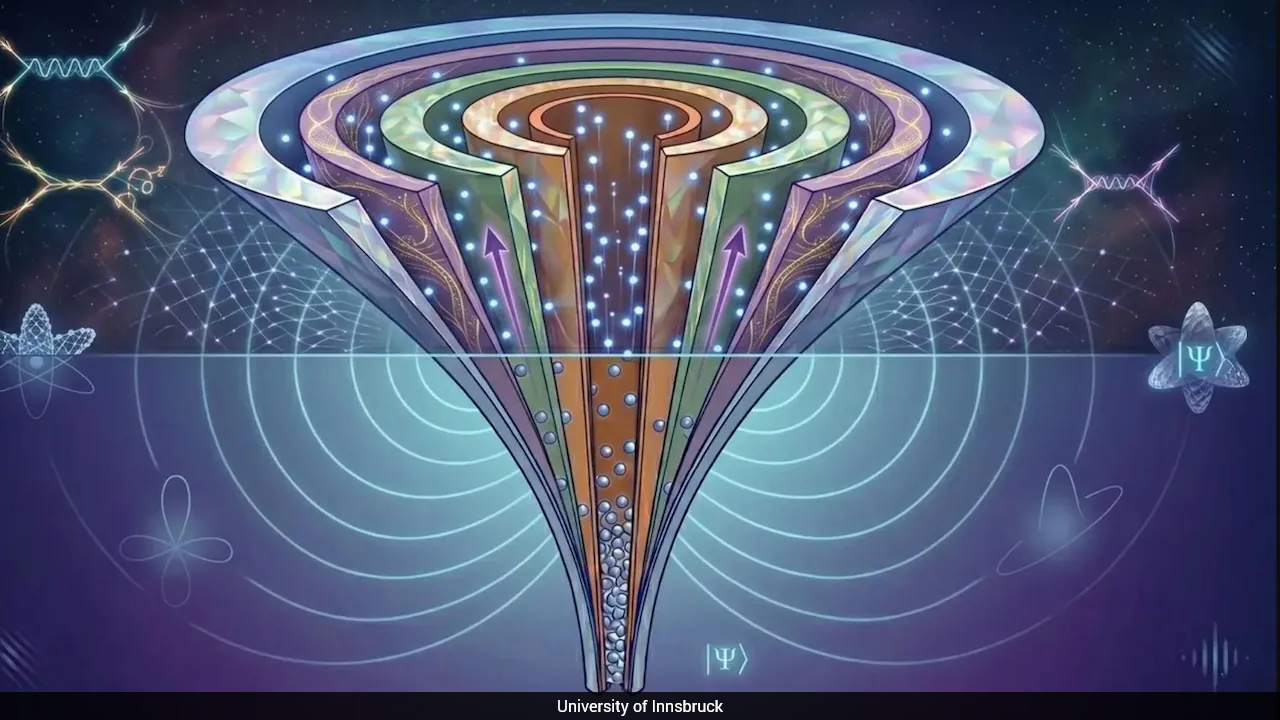
In the deepest, coldest corners of experimental physics, the rules of our everyday world completely break down. Now, an international team of scientists has pushed those boundaries even further, successfully creating a highly unusual and exotic new form of matter.
The breakthrough, which explores the strange landscape of quantum mechanics, has revealed what researchers are calling a "fractional Fermi sea." This research was published in Physical Review Letters and is available at the pre-print server arXiv.
Chilling to the Extreme
To achieve this feat, experimental physicists at the University of Innsbruck in Austria began by cooling a cloud of roughly 70,000 cesium atoms down to just a few nanoKelvins. This temperature is a mere fraction of a degree above absolute zero, the coldest possible temperature in the universe.
At this extreme level, individual atoms lose their identity and begin to behave as a single, unified quantum cloud. The team then trapped this delicate substance inside one-dimensional tubes using a web of lasers known as an optical lattice.
A Cycle of Attraction and Repulsion
Once the atoms were confined, the researchers subjected the matter to a rapid, continuous cycle, forcing the particles to smoothly shift from strongly repelling one another to strongly attracting one another.
Ordinarily, pumping this kind of energy into a system would simply heat it up and cause the atoms to scatter randomly. Instead, the team observed a counter-intuitive phenomenon: the particles self-organized into a hidden, highly structured state.
The Birth of 'Super-Fermions'
In traditional physics, fundamental particles are split into two families: bosons, which can overlap seamlessly, and fermions, which strictly refuse to occupy the same quantum space. The newly discovered state acts as a bizarre middle ground, where quantum states are only partially occupied.
The researchers are still grappling with how to classify these newly formed entities, jokingly suggesting they be called "super-Fermions." Scientists believe this breakthrough will significantly advance the field of quantum simulation, paving the way for hyper-precise sensors, advanced encryption, and revolutionary developments in materials science.
Track Latest News Live on NDTV.com and get news updates from India and around the world

