






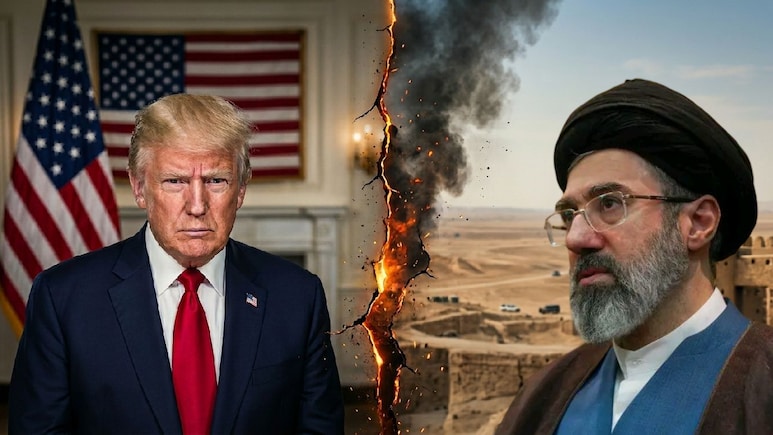
Most conflict analysis explains what just happened. Wargaming does something different. Before events occur, you define the specific observable signals that will tell you which war you are actually watching - so that when something happens, you are reading it, not reacting to it.
That discipline is not about predicting the future. It is about knowing, the moment a specific signal fires, exactly what it means for what comes next.
Four weeks into the 2026 Iran War, the analysis behind this article has been running that wargame in real time. What it has identified is a ten-day window - expiring April 6 - that will determine the shape of this conflict for months. There are specific things to watch that will tell you which future is arriving before it gets here.
The Clock
On March 26, President Trump announced a ten-day pause on strikes against Iranian energy infrastructure, pushing his deadline to April 6. Before that date, one of these three things can happen: a framework for de-escalation emerges; the deadline passes without one and Trump extends again, further draining whatever credibility his ultimatums still carry; or the pause ends and the US strikes Iranian power plants - triggering what Tehran has publicly committed to, a large-scale counter-attack against Gulf energy and water infrastructure.
The third path is the default if the first two fail. That is not a rhetorical warning. It is the structural logic of the situation.
Six Things To Watch - And What Each One Means
Tripwire 1: Does Pakistan deliver a real counter-proposal from Iran? | Window: 48-72 hours | CRITICAL
Pakistan has confirmed it is relaying messages between Washington and Tehran. Pakistani Foreign Minister Ishaq Dar stated publicly that the US has shared a 15-point peace proposal, currently being deliberated by Iran. Iran has reportedly responded through unnamed intermediaries and is now awaiting Washington's reply.
Watch for one specific thing: does Iran send back a formal counter-position, or does it return silence while the IRGC continues firing? A counter-position - even a maximalist one - means a live diplomatic back-channel exists. Silence plus continued escalation means it does not. Iran's publicly stated five conditions include war reparations and formal sovereignty over the Strait of Hormuz. Neither is acceptable to Washington. But an opening position in diplomacy is not a final one. The question is whether there is a conversation at all.
Tripwire 2: What happens to Iran's naval operations in the next 96 hours? | Window: 72-96 hours | CRITICAL
On March 26, Israel killed Admiral Alireza Tangsiri - the Islamic Revolutionary Guard Corps (IRGC) Navy commander who personally designed and ran Iran's maritime strategy in the Strait of Hormuz. He controlled which ships could pass, where mines were laid, and which vessels were targeted by drone boats. The Israel Defense Forces (IDF) subsequently stated that all of his key senior commanders were killed in the same strike.
Watch whether Iran's maritime operations continue at the same tempo and structure, or whether they stutter and reconfigure. If they continue without a visible gap, Iran pre-positioned a parallel command structure - meaning the institution is more resilient than any individual. If they pause or reconfigure, the strike achieved genuine disruption. Either reading changes what comes next in the waterway through which one-fifth of the world's oil normally flows.
Tripwire 3: Is Iran quietly writing Hormuz into its constitution? | Window: Rolling | HIGH
Iran's parliament is drafting legislation to formally establish Iranian sovereignty over the Strait of Hormuz and create a legal basis for charging ships passage fees. The Gulf Cooperation Council (GCC) Secretary-General has confirmed Iran is already collecting this fee, in violation of international law.
Once this becomes domestic law, no future Iranian government can concede free passage through Hormuz as part of a peace settlement without paying a severe political cost at home. Iran is legally hardening its negotiating floor while diplomatic talks are simultaneously underway. Any deal will have to accommodate Iranian control over Hormuz in some form - which is unacceptable to the United States and every Gulf state simultaneously. This is the least-reported and most consequential development of the past 48 hours.
Tripwire 4: Does anything move near Kharg Island? | Window: Within pause window | CRITICAL
Kharg Island processes approximately 90 percent of Iran's oil exports. Tehran has stated explicitly that a strike there crosses an existential red line - meaning an unrestrained response, not a calibrated one. Iran's stated counter would be a large coordinated missile and drone surge against Gulf energy infrastructure: Qatar's gas export facilities at Ras Laffan, Saudi Arabia's Eastern Province oil installations, the UAE's Ruwais refineries.
From open sources, the only advance warning available is ISR activity near Kharg - aircraft patterns, naval positioning, or electronic signatures visible on open tracking platforms. If those signals appear during the pause window, the diplomatic track is almost certainly already dead. Used as leverage with a simultaneous binding US commitment, Kharg has enormous coercive value. Executed without a corresponding diplomatic framework, it forecloses any negotiated exit and accelerates regional escalation on Iran's terms.
Tripwire 5: Does European gas storage force anyone's hand? | Window: Into April | HIGH
Europe enters its summer gas refill season with storage at roughly 30 percent - below the level needed to survive next winter without Russian pipeline supply. Qatar's Ras Laffan, the world's largest LNG export facility, has been severely disrupted since the conflict began. LNG - liquefied natural gas, the seaborne alternative to Russian pipeline supply - is what European governments are counting on for the refill season.
If Qatari LNG exports do not resume by mid-April, European governments face a structural energy problem by autumn that no ceasefire agreement will immediately resolve. Watch for any QatarEnergy force majeure announcement, or for European governments to begin emergency procurement. Either signal means the political pressure on the coalition to find an exit is about to intensify well beyond the military dimension.
Tripwire 6: Does a single commercial ship transit Hormuz unescorted? | Window: Rolling | HIGH
Before the war, 130 ships transited the Strait of Hormuz every day. Fewer than six do now, effectively at Iran's discretion. The Strait is the world's single most important oil chokepoint - roughly one-fifth of global oil supply moves through it in normal times.
Watch UKMTO - the United Kingdom Maritime Trade Operations, which publishes open-source shipping advisories - for any report of a non-Iranian, non-Chinese flagged commercial vessel completing a successful unsanctioned transit. Even one does not mean the Strait is open. But it signals a gap in the maritime denial architecture, and gaps attract testing. Conversely, any report of mine-laying inside the Persian Gulf proper - not just at the Strait entrance - means all alternative export routes are simultaneously threatened and economic paralysis becomes total.
What It All Adds Up To
The Gulf states sitting in the middle of this - Saudi Arabia, Qatar, the UAE, Kuwait, Bahrain - are not bystanders. They are the leverage. Every one of them runs the same structural exposure: a single-commodity economy, critical infrastructure concentrated in a small geographic footprint, populations whose stability depends on uninterrupted oil and gas income, and a security umbrella borrowed from Washington rather than built independently.
Iran does not need to destroy any of it. It only needs these states to believe it can reach their infrastructure - and to demonstrate that credibly, periodically. That demonstration is now complete. Bahrain's fuel tanks were struck. Saudi Arabia's Eastern Province has been targeted repeatedly. The UAE has absorbed 372 ballistic missiles, 15 cruise missiles, and over 1,800 drones in 28 days. The facade of Gulf invulnerability, maintained for four decades through US basing and weapons purchases, is gone. Populations know it. Bond markets know it. The ruling elites know it.
A negotiated exit from this conflict is structurally available - but it requires Iran and the United States to commit simultaneously, not sequentially, through a verified mechanism. Pakistan is now carrying that weight diplomatically. It also requires the IRGC and the Iranian government to be aligned on the same terms, not running different agendas behind the same diplomatic front - which, as of today, remains unconfirmed.
Every one of the six tripwires above is a data point on whether that alignment is reachable before April 6.
The wargame cannot tell you which tripwire fires next. It can tell you - precisely - what each one means when it does. That is the difference between analysis and commentary.
(Captain Rajesh Ramkumar is a career Indian Navy submariner and specialist navigation officer who leads Full Ahead Management Consultants LLP)
Disclaimer: These are the personal opinions of the author

