






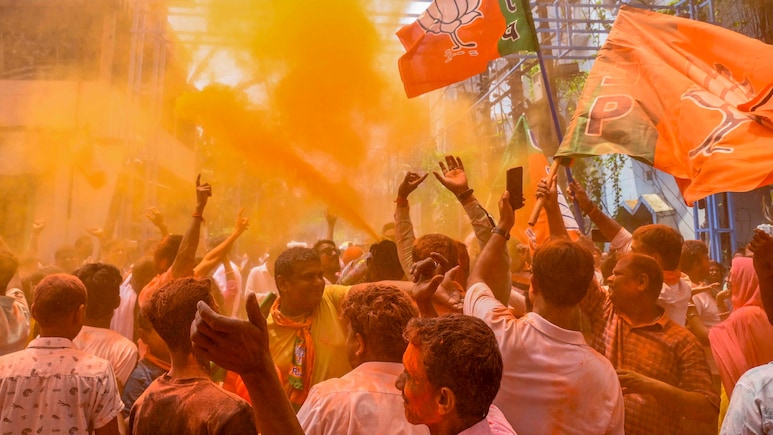
West Bengal has finally turned a page that took decades to write. Elections in India are often described as verdicts on governments. But every once in a while, they become something deeper - a verdict on an idea. Bengal's 2026 election appears to be one such moment. It is not merely a change of party. It is, if sustained, a change of ideology - the first decisive break from a political culture that has shaped the state for about 70-75 years.
To understand the significance of this shift, one must go back to the foundations of Bengal's political trajectory. For decades, the state was dominated by Left ideology - not just as a party formation but as a governing philosophy. The model was consistent: keep development limited, discourage large industry, and build a tightly controlled ecosystem of political patronage. Contracts, local power structures, and economic access were routed through party workers. Political loyalty became the currency of survival.
And when opposition arose, the system had its own method of correction - political violence. It was not incidental; it was structural. It ensured control over booths, narratives, and local economies. Over time, this model hollowed out Bengal's economic potential. Once a thriving industrial hub, the state saw capital flight, declining investment, and a generation of youth looking outward for opportunity.
In 2011, the people of Bengal rejected this order. The rise of Mamata Banerjee was seen as a moment of liberation. Having emerged from the Congress and formed her own party in 1998, she took more than a decade to dislodge the entrenched Left regime. Her movement was built on precisely the promise that Bengal desperately needed-change.
But history can be ironic.
Because while the Left was voted out, Left ideology was not.
In power, Mamata Banerjee did not dismantle the model she had opposed. Instead, she replicated it - often with greater intensity. The most symbolic moment of this shift came early: the opposition to the Tata Nano project. What could have been a turning point for industrial revival became a signal to investors across India-Bengal was still not open for business. The project moved to Gujarat, and with it, a message was sent.
The pattern that followed was familiar. Political patronage networks continued. The ecosystem of contracts and local control remained intact. And crucially, political violence did not disappear-it changed direction. First against the Left remnants, and then increasingly against the BJP as it began to emerge as a challenger.
There is another layer of irony that Bengal remembers well.
In the years leading up to her rise, Mamata Banerjee repeatedly demanded free and fair elections, action against illegal immigrants and more central forces for elections in the state. She argued that if central forces were deployed adequately, if elections were conducted without intimidation, the Left could be defeated. She engaged with leaders like Pranab Mukherjee in Delhi, in the UPA government, to push this case. The demand was simple: level playing field, and the people will decide.
But once in power, the stance shifted. The very mechanisms she had once questioned became tools to be managed. The discourse around central forces, election conduct, and fairness took on a different tone.
This is why 2026 matters.
If this election marks what it appears to mark, then Bengal has not just changed governments - it has rejected a political culture that persisted across regimes. Congress, Left, and Trinamool Congress, despite their differences, operated within a broadly similar ideological framework - state control, political patronage, suspicion of large industry, and tolerance of violence as a political instrument.
For the first time, that continuum seems to have been disrupted.
There is also a deeper historical resonance to this moment.
West Bengal is not alien to non-Left political thought. In fact, one of the foundational figures of modern Indian right-of-centre politics, Syama Prasad Mukherjee, hailed from this very soil. As the founder of the Bharatiya Jana Sangh-the ideological predecessor of today's BJP-he represented a different vision for India and Bengal.
In the very first general elections of 1951-52, the Jana Sangh won just three seats across India. Two of those victories came from Kolkata, including that of Syama Prasad Mukherjee himself and Durga Charan Banerjee. It was an early signal that Bengal's political identity was never monolithic-it was shaped over time.
And it took decades to reclaim that space.
If 2026 is indeed a turning point, it is also a tribute to that long arc of political struggle - a reminder that ideas may be suppressed, but they do not disappear.
However, a word of caution is necessary.
A change of ideology is not automatically a guarantee of better governance. It is an opportunity, not an outcome.
For the BJP, which now stands at the centre of this transition, the real challenge begins now. The temptation in Indian politics is always to adapt to existing models rather than transform them. The risk is clear: to replace one patronage system with another, to mirror the same local power structures, to inherit the same methods under a different banner.
That would be a betrayal of the moment.
If West Bengal has truly moved beyond Left ideology, then governance must reflect it. That means encouraging industry rather than discouraging it. It means dismantling - not rebranding-political patronage networks. It means ensuring that political competition does not slip back into violence. It means restoring institutional confidence, so that both investors and citizens believe that the rules are stable and fair.
For too long, West Bengal remained locked in a framework that prioritised control over growth, loyalty over merit, and ideology over opportunity.
The people have now signalled a willingness to move beyond that.
The verdict has been delivered.
Now begins the test.
(The author is a biographer of Uttar Pradesh Chief Minister Yogi Adityanath)
Disclaimer: These are the personal opinions of the author

