






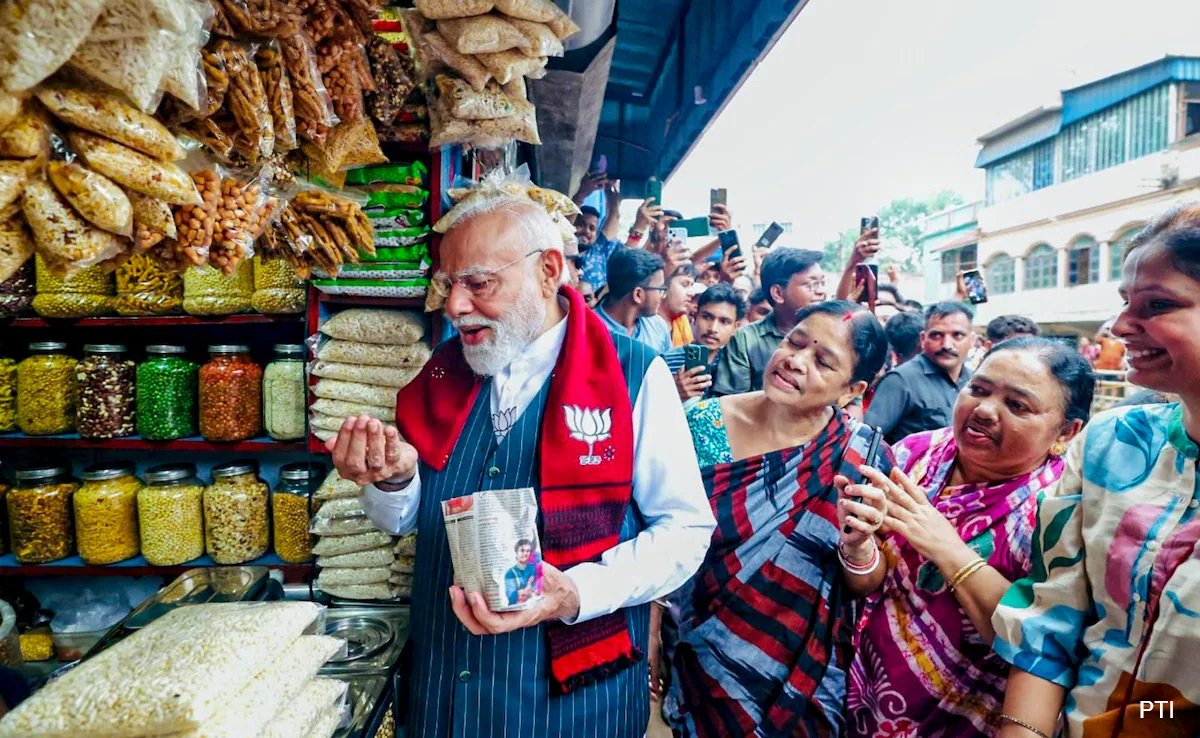
On the TV on April 19, the image arrived the way certain smells do in a city- unexpected, vivid, briefly undeniable. While barnstorming in West Bengal, Prime Minister Narendra Modi at a public stall in Jhargram, Purulia, eating jhalmuri: puffed rice crackling with spice, roadside heat, during the summer scorcher, meeting the language of the everyday. Ten rupees, the story insisted.
Ten rupees, maximum impact
Ten rupees for a bowl of pleasure that looked like it had been made not for cameras, but for hunger. Yet the true magic of such moments is that they don't feel manufactured. They pretend not to be politics at all. They borrow the rhythms of street life: chit chat at the dhaba with the young owner. Insisting that the owner take the money. Talk about eating onions or not. "Pyaz khata hun, dimaag Nahin" (I eat onions, nor brains), said PM Modi. The spontaneous laughter and mirth that doesn't quite match the choreography of a tight election campaign schedule, the hands that reach out in a way that suggests, Here - let me be part of this Bengali common folk tradition.
A symbolic gesture of proximity with the aam aadmi
In Bengal, where public space is never just public space, but a stage for identity, the symbolism lands with extra weight. A man is judged not only by what he says, but by what he is willing to be seen doing.
The point was not merely culinary. It was symbolic-almost liturgical-an enacted gesture of proximity with the aam aadmi.
PM Modi's unique political grammar: The body as witness
There is, in PM Modi's political grammar, a long-running theme: the body as witness. One week, he is meditating in the Rudra Gufa near the Kedarnath Temple in May 2019, located at 12,250 feet, offering a tranquil view of the Kedarnath Temple.
Another week, May 14, 2024, another place: PM Modi offers prayers at the Kal Bhairav temple in Varanasi. PM Modi visits to seek blessings from the "Kotwal of Kashi" (guardian deity of Varanasi) before filing his election nomination. Previously, on December 13, 2021, PM Modi had again prayed in the Kal Bhairav temple before inaugurating the Kashi Vishwanath Corridor.
Yet another week, on April 6, 2025, PM Modi offered prayers at the Ramanathaswamy Temple in Rameswaram, Tamil Nadu. During this visit, he also inaugurated the new Pamban rail bridge. He also visited the same temple on January 20, 2024, ahead of the Ayodhya Pran Pratishtha ceremony. The temple is a sacred site associated with Lord Ram and is one of the Char Dham and 12 Jyotirlingas.
Eat, pray, meditate: Three styles, same impulse
Varanasi, Uttarakhand, Rameshwaram - PM Modi meditates, prays in places that confer a certain spiritual weather on whoever enters them. Then comes another season of the same doctrine, now expressed as street realism: eat where others eat; meet where others meet. Three styles, same impulse-an effort to collapse the distance between leader and led. In earlier eras, proximity was achieved through speeches and promises; in this era, proximity is performed through images that look spontaneous.
Social media did what it always does with such performances: it translated them into fellowship. The views multiplied into something like a digital bonfire, millions gathering around an act that, in any other context, would have been ordinary. But in politics, ordinariness is the rarest currency.
The moral math of the Jhalmuri stall
The Jhalmuri stall scene offered a kind of moral math: if he can lower himself to the street, perhaps the street will rise for him. If he eats the same spicy, noisy snack, perhaps he will also share the same fate.
Mamata Banerjee critiques it as "drama"
His opponents have tried to puncture the spell. The West Bengal Chief Minister called it "drama," suggesting secret cameras, a set of invisible eyes making the whole thing feel staged. The accusation has a familiar shape: if you planned it, then it isn't real. And this is the problem with symbolic politics-its critics must either accept its image as political labour, or reject it as deception.
But here the question becomes less "Is it genuine?" and more "What does it feel like to the viewer?" Political meaning is often an emotion with a caption.
In sharp contrast, Mamata Banerjee's stopover at a public tea stall at Kolkata's Collin Street on April 21, during her election campaign, appeared strained. Mamata Banerjee, sitting on her plastic chair, surrounded by her party leaders, appeared tense and, in fact, looked positively worried. There was no banter with the tea stall owner, no chit-chat, no mirth, no laughter.
Parallel with Trump's McDonald's moment
There is also a broader pattern, one that transcends party lines. In the American campaign imagination, Donald Trump's story of working and eating for a day at a McDonald's became a kind of parable-an act of solidarity with white working-class MAGA supporters. It was less about hamburgers than about dignity: the insistence that a president should be able to stand in the same light as the people who wipe tables. Whether one agrees with Trump's politics is almost irrelevant beside the mechanism: the image signalled belonging and respectability at once.
PM Modi in Jhargram invokes a Bengali sensory memory
Bengal, for all its worldliness, has always been sensitive to this mechanism. A leader seen as too distant becomes suspect; a leader seen as touching the everyday becomes intimate. Bengal loves cleverness, but it also loves the performance of simplicity, especially when simplicity carries an unmistakable scent of Bengali life. Jhalmuri isn't just food; it is sound and texture: the crackle of puffed rice, the tang, the street-side abundance, the spice that clings. It is the kind of snack that carries a regional intimacy. By eating it in Jhargram, PM Modi is not simply imitating folk culture; he is invoking a Bengali sensory memory and claiming it as a shared one.
Will Jhalmuri snack fetch votes for the BJP in Bengal?
Still, the question is a million-dollar one: will such tricks fetch votes in Bengal for the BJP? Here, the answer must be split into two layers: the magnet and the machine.
The magnet is the image itself. It can travel faster than ideology. It can lodge in minds as a kind of proof-he is willing. In a mass democracy, perception is not a footnote. People who might never read manifestos may still remember who stood in which stall, smiled at whom, and chose which kind of street over which kind of stage.
Masterstroke of popular politics: But elections run on machines
In that sense, yes: The jhalmuri moment is a masterstroke of popular politics. It reduces distance, and distance is where scepticism breeds.
But the machine - Bengal's electoral reality runs on harder fuel. Votes are not only attracted by warmth; they are retained by organisation, local leadership, ground-level bargaining, alliances, candidate selection, and the ability to transform attention into turnout. An image can begin affection, but affection has to survive canvassing, persuasion, and the grind of day-to-day campaigning.
And Bengal voters, however moved by spectacle, are famously alert to the difference between theatre and governance.
So the most likely scenario is not that one symbolic act will flip the entire state. Rather, it may do something subtler: it may help the BJP feel less foreign in public imagination, making the party's presence appear less like an intrusion from elsewhere and more like a participant in local life. Symbolic politics often works by changing the emotional weather around a brand. Even when the fundamentals stay the same, the mood changes how people interpret the fundamentals.
Critics will say that PM Modi's folkliness is a costume. Supporters will say it is an earned familiarity. Either way, the election will judge not the costume, but what the costume enables: whether it creates sympathy that converts into votes, whether it breaks the monopoly on "the people" claimed by one party, and whether it supplies the BJP with a new kind of social consent.
In Bengal, consent is not granted by one viral clip. It accumulates through repetition: through who shows up, how often, and whether the showing-up continues when the cameras go quiet. Jhalmuri might open the door. But the election will decide who walks through.
Jhalmuri in Jhargram: small scene with a large ambition
So yes, such campaign tricks can fetch votes. Not because they are magic, but because they are the language of proximity, and proximity is a powerful dialect. The jhalmuri stall in Jhargram is a small scene with a large ambition: to suggest that politics can be eaten, shared, and felt; that a leader can be made to look like the neighbour rather than the distant official.
And in democracies, perhaps that is the oldest truth: the ballot may be cast in secret, but the story people carry into the booth is rarely secret at all.
(The author is Editor, Research, NDTV. Views are personal)
Disclaimer: These are the personal opinions of the author

