






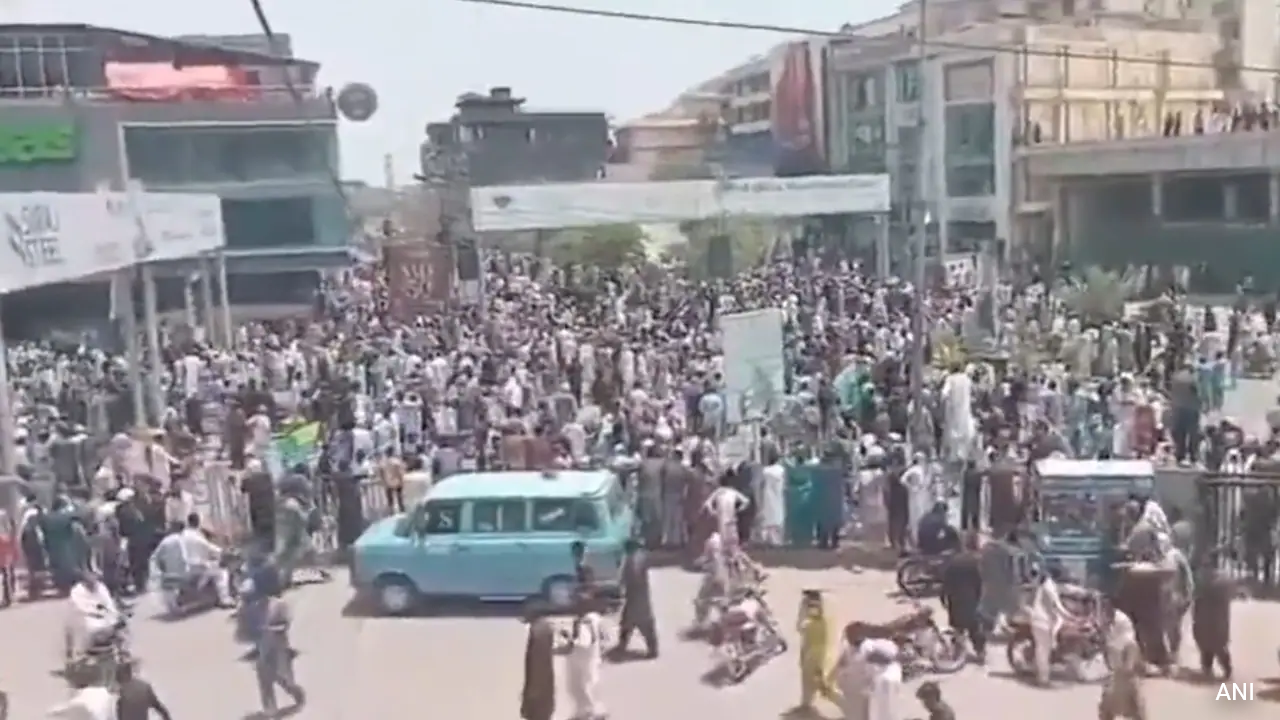
Some years ago, a prominent Pakistani civil rights activist told this writer that his country comprises Punjab and its colonies. In recent years, the Punjabi establishment has been engaged in one battle after another in most of the colonies. There is a full blown insurgency in Balochistan and K-P. There is restiveness in Sindh and South Punjab. But it is the rebellion of people in Pakistan Occupied Jammu and Kashmir (PoK), euphemistically called "Azad Jammu and Kashmir" against the Punjabi dominated Pakistani state that has shaken the military regime fronted by a puppet civilian government.
For decades the two occupied territories of Pakistan occupied Kashmir, namely the sliver of territory comprising the Mirpur-Muzaffarabad region (PoK), and the erstwhile "Northern Areas" or Pakistan occupied Gilgit-Baltistan (PoGB) were a bastion of Pakistani nationalism. Denizens of the region, despite not being incorporated formally in Pakistan, were the strongest and staunchest advocates and defenders of Pakistan. People from PoK were recruited not only as soldiers in the Pakistan Army but also as jihadist cannon-fodder for exporting terrorism into Jammu and Kashmir. PoK was often referred to as the base camp for the 'liberation' of Kashmir from India. Ironically, the same region has today transformed as the base camp for the liberation of Kashmir from Pakistani (or more appropriately, Punjabi) occupation. That the populace in these occupied territories would rise up in revolt against the Pakistan Army dominated state structure was unimaginable even a few years ago. But it is the genius of the Lahori and Rawalpindi military and bureaucratic mindset that has made the impossible possible.
Discontent in PoK has been bubbling under the surface for some years now. It started manifesting itself towards the middle of the first decade of this century when people from the region started identifying themselves as Kashmiris and not Pakistanis. At that time there were some people who were advocating an independent Kashmir. But even though these were fringe voices, the Pakistani establishment was so terrified that it is alleged to have unleashed death squads against people like Arif Shahid to shut them down.
The breaking of the back of the jihadist terrorism in Jammu and Kashmir by Indian security forces disillusioned many people in the region. After it became clear Pakistan could not snatch Kashmir from India, their attachment to Pakistan took a tumble. Meanwhile, existential crises - bread and butter issues - started impacting the daily lives of people. The fact that PoK was ruled by a comprador elite that owed its existence to remaining in the good graces of the military establishment and was more interested in doing the bidding of Islamabad and Rawalpindi than addressing the pressing concerns of the people of the region added to the sense of disempowerment. The political system was completely rigged in a way that whoever ran the government in Islamabad also got to run the government in Muzaffarabad. Since the beginning of this decade, PoK has seen almost half a dozen 'Prime Ministers'.
The first big upsurge against the established order took place in August 2023 over inflated power bills. In May 2024 massive protests broke out over demands of subsidised flour and electricity tariff at the cost of generation of hydroelectric power from the Mangla dam. The protests soon turned violent and the government in Islamabad conceded the demands. It also promised to "review the 'luxuries 'of the privileged class." This put a lid over the discontent in the occupied territory but within months big protests broke out against a draconian ordinance promulgated by the government to regulate public assemblies. This step by the government was seen as a move to introduce laws to curb and crush the people's movement for basic civic and economic rights. In September 2025 massive protests broke out over the 38 demands of the Jammu and Kashmir Awami Action Committee which was spearheading the people's movement in PoK. The protests turned violent after Pakistani authorities tried using strong arm tactics to crush the protestors. Once again the Pakistani state was forced to retreat and an accord was signed assuring the protestors that their demands will be met.
Among the most critical and contentious demands was the one that sought the scrapping of 12 seats in the legislature that were allotted to 'refugees' settled in Pakistan. Elections on these 12 seats with minuscule electorates were always blatantly rigged and used to manipulate the government in Muzaffarabad. The J&KAAC had correctly come to the conclusion that these 12 seats were Pakistan's way to control the political process in the occupied territory. Even otherwise, the 'government' in PoK is pretty much neutered and it was the AJK council dominated by Islamabad that exercised a virtual veto over everything in the territory. If the people of PoK had to run their own affairs, it was only fair that the people they elected were accountable to them, and not to the generals in Rawalpindi or their puppet politicians in Islamabad.
In Muzaffarabad a tectonic shift has taken place. The traditional political parties and players have become virtually irrelevant. Old school politicians have zero credibility and are seen as lackeys and puppets of Islamabad/Rawalpindi. This is a phenomenon not unique to PoK. It has also been witnessed in other colonies of Punjab. For example in Balochistan, the Baloch Yakjheti Council (BYC) led by a woman Dr Mahrang Baloch could bring out hundreds of thousands of people on the streets with the snap of a finger. In Khyber Pakhtunkhwa, the Pashtun Tahaffuz Movement (PTM) captured the imagination of many young people. In Sindh, there was a huge uproar over the Pakistan Army's plans to cut a new canal and the provincial government and the military were forced to retreat. In both Balochistan and K-P, the military establishment used the most brutal tactics to bludgeon the people's movements. The same tactics were tried against the J&KAAC in PoK last year and during the current upsurge, but the fight back there took the military dominated regime by surprise.
Unlike the Baloch and to an extent the Pashtuns affiliated to the PTM, the people of PoK have more agency, and are therefore more assertive than other 'oppressed nations' living under the yoke of Punjab. They have had reasonable representation in the Army and there are many ex-servicemen living in PoK. The diaspora in Europe, especially the UK is strong and vocal, and has the ability to make a lot of noise. Organisationally, the J&KAAC has proved its mettle. It has forged a collective leadership which isn't dependent on a single person or district. It has agglomerated grievances and become a sort of umbrella organisation with which all kinds of people have attached themselves. The fact that it is raising issues linked to civil, political and economic rights of people can be related to by almost everyone in the territory, and has only added to its appeal and strength.
Instead of engaging with and resolving the issues agitating the people, the Punjab run military-political establishment has resorted to its default option: using brute force to silence and snuff out dissent. To add insult to injury, the establishment automatically labels any people's rights movement as a terrorist organisation. In Pakistan, for the Punjabi establishment, peoples movements are terrorist plots while internationally proscribed terrorists are considered patriotic Pakistanis. And if labelling these movements as terrorists is not enough, the establishment and its minions add additional masala by linking these movements to being part of Indian sponsored subversion. This tactic worked to an extent in Punjab against Imran Khan's Pakistan Tehrik-e-Insaf and in other provinces. But it is backfiring in PoK where the agitators are openly accusing Pakistan Army of state terrorism and massacres of protesters.
The agitation in PoK and the attention it is attracting around the world - even the Amnesty International and other human rights groups have weighed in on the issue - is a massive blow to the Pakistani narrative on Jammu and Kashmir. The brutality with which a citizens' protest for civil rights and political reform has been handled has blown apart the entire edifice of Pakistan's propaganda campaign on Kashmir against India. Comparisons of political and economic conditions between PoK and the Union Territory of Jammu and Kashmir are now being made not by Indians but by Kashmiris living under Pakistani control, and Pakistan is being questioned like never before. The anger and resentment against the heavy-handedness of Asim Munir's military - Donald Trump's favorite self-appointed Field Marshal has been reported as saying that killing a few thousand Kashmiris is a small price to pay for retaining control over the territory - has created a volatile situation. For the first time, there are elements in PoK who are talking about ending Pakistan's illegal rule over the territory. The direction in which things are moving means that what was unthinkable a few years ago - liberation of PoK and PoGB and the re-unification of the Indian state - is no longer out of the realm of the possible.
(The author is a Senior Fellow at ORF)
Disclaimer: These are the personal opinions of the author

