





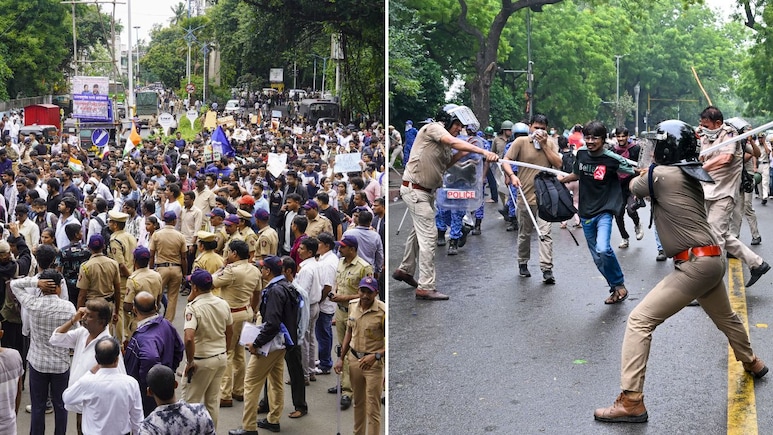
Last week in Delhi, there was widespread violence during the agitation led by the Cockroach Janata Party. Serious questions were also raised about the conduct of the Delhi Police during the protest. The police were accused of using force against students, which allegedly further inflamed the agitation. Could the Delhi Police have handled the movement more effectively? Let us look at how the Mumbai Police dealt with a similar situation. Last year, the Mumbai Police faced a comparable challenge in the form of the Maratha agitation. However, they managed to bring the protest to an end without using a single baton or even slapping anyone.
On the morning of August 29, 2025, Maratha leader Manoj Jarange Patil arrived at Mumbai's Azad Maidan from Jalna and began his hunger strike demanding Maratha reservation. Along with him came nearly 60,000 protesters from different parts of Maharashtra in around 8,000 vehicles. The sudden arrival of such a large number of people affected normal life in South Mumbai to some extent. From August 29 to September 2, over these five days, the protesters created considerable disruption. They broke through police barricades, blocked roads, played kabaddi at CST railway station, and entered shops and shopping malls to create disturbances. Yet the police exercised restraint and did not resort to any strict action.
The protest concluded peacefully without any violence. Behind this success was the well-planned strategy devised by Mumbai Police Commissioner Deven Bharti and then Joint Commissioner of Police (Law and Order) Satyanarayan Chaudhary.
Advance Planning
The first step was to gather intelligence on how many people were likely to participate in the agitation, where they would come from, and which routes they would use. Based on this information, traffic was planned in such a manner that protesters arriving from outside the city could reach Azad Maidan directly, while causing the least possible inconvenience to Mumbai residents. Some routes were closed to the public, while traffic in several areas was diverted to alternate roads.
Studying The History Of Similar Agitations
While preparing the security arrangements, the police examined the history of Maratha agitations. Previous Maratha protests, particularly in 2018 and 2023, had witnessed significant violence. Mumbai Police analyzed those movements to identify the shortcomings in how they had been handled earlier. Based on these lessons, they determined what should and should not be done during the Mumbai protest.
Maintaining The Morale Of The Force
During such agitations, police personnel often have to stand at one spot for long hours. They may not get timely food or water, while also having to endure harsh weather conditions such as intense heat or heavy rain. In such circumstances, if protesters behave aggressively or disrespectfully toward officers, there is a risk that police personnel may lose their temper.
Senior police officers took this psychological factor into account and made efforts to keep the morale of their team high. Food packets and water were delivered on time to personnel deployed on duty. Senior officers were also visibly present on the ground alongside the rank-and-file officers overseeing the arrangements. Police personnel were reassured that the entire leadership stood firmly behind them.
Resolving Issues Through Dialogue, Not Force
Police personnel were instructed not to use force regardless of how much the protesters provoked them. Force was to be used only if there was a threat to human life or damage to public property.
The police had identified certain volunteers among the protesters who were respected within the movement and could influence others. These volunteers acted as a communication link between the protesters and the police. At that time, the situation was so volatile that even a minor baton charge could have triggered widespread violence, with repercussions across Maharashtra.
Whenever tensions flared between police personnel and protesters, senior officers intervened, mediated, and ensured that the matter was resolved immediately.
Emergency Preparedness
Despite all the preparations, Mumbai Police also made contingency plans in case the situation deteriorated and the crowd turned violent. Technology played an important role in these arrangements. CCTV cameras and drones were used to monitor the activities of the protesters.
For example, if violence had erupted in South Mumbai, alternate evacuation routes had already been identified to move people to safety. Additional security forces were also deployed at important government installations.
On September 2, following the intervention of the Bombay High Court, Manoj Jarange Patil withdrew his agitation. Subsequently, the protesters peacefully returned to their respective districts. Mumbai breathed a sigh of relief, and the Mumbai Police's strategy received widespread praise.
Former Mumbai Joint Commissioner of Police (Law and Order) Satyanarayan Chaudhary, who now heads the Traffic Police, said: "Handling the Maratha agitation was the most sensitive and challenging responsibility of my tenure."
Had the Delhi Police studied a few pages from the Mumbai Police playbook, perhaps it would not be facing so much criticism today.
Track Latest News Live on NDTV.com and get news updates from India and around the world

