






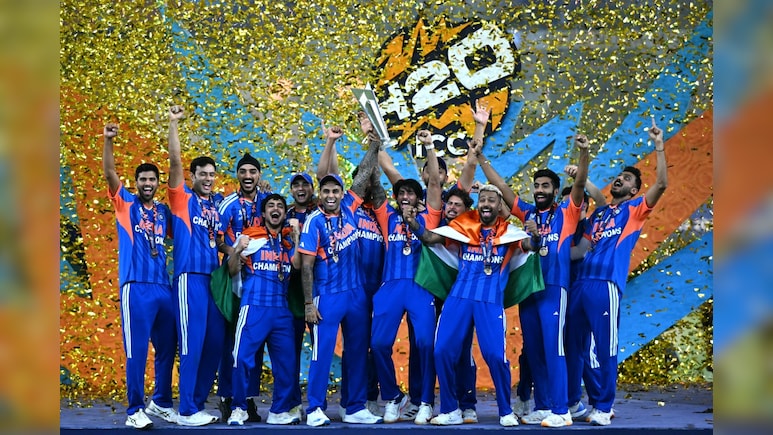
It was fitting in a way to see that the first two Indian cricketers being interviewed together on the field after India's mind-bogglingly one-sided thrashing of the Kiwis in the final of the T20 World Cup were Abhishek Sharma and Varun Chakravarthy.
Over the course of the two must-win knockout matches that India played in the tournament (the virtual quarter-final against the Windies and the semi-final vs England) before the final, the Indian T20 juggernaut that had struck fear in the hearts of the rest of the cricket playing world over the last two years was well and truly up and running again, finding that crucial element that fuels T20 teams more than any other - momentum. The only two big question marks that remained ahead of the summit clash were hanging heavy on Abhishek and Varun. Ironically, for many, the top-ranked T20i batter and bowler in the world didn't deserve a place in the playing XI for the final. Those of us who have followed Indian cricket for years knew that the team management would never tinker with a winning combination, regardless of form concerns for a couple of key players and that too just before the last match of the tournament. India went in with an unchanged XI, and Abhishek had a great day in the office, while Varun, though expensive, was amongst the wickets.
And with that, almost every box was ticked for a national team that represents a country which became the first to win three men's T20 World Cup titles.
The records that were made and broken, of course, don't just end there. India has also become the first team to successfully defend the title and also the first host nation (co-hosts this time with Sri Lanka) to win the cup. But these records will be merely of academic interest in the corridors of power of Indian cricket. The biggest takeaway of this World Cup win will be a crown that was not amongst the prizes that were handed out on Sunday night - that of being hands-down the best and most ruthless T20i machine in world cricket. One that is so far ahead of the others that a single blip, like the shock loss vs South Africa in the Super Eights, is viewed as a major catastrophe. India had absolutely dominated bilateral T20i cricket from after the 2024 edition of the World Cup (in which they were unbeaten) till before the beginning of this edition, winning eight consecutive bilateral T20i series. Everyone knew what this team was capable of. But a World Cup title is the final, biggest seal of approval and stamp of authority. Suryakumar Yadav might have become the third Indian captain - after MS Dhoni and Rohit Sharma - to win the title, but his team has become perhaps the first T20i set of players who are not just world champions, but the absolute bosses of the shortest format of the game on the international stage.
The one thing that I fervently stressed on while doing a pre-match analysis was Team India's big-match temperament. In my mind, there is a gulf the size of the Antarctic Ocean between India and every other team when it comes to the mental toughness that is required to play a World Cup final, regardless of what happened just before that or how they got there. Remember how the men in blue struggled a bit in the initial stages of the tournament, even against "minnows" and were searching for that "complete game", that absolutely clinical performance that was expected of the top-ranked T20i team in the world that had blown away all opposition in its path? We didn't really see that happen consistently in the league stage as such (though the win against Pakistan was not a nerve-wracking one), and neither in the Super Eights (India lost to South Africa, and even Zimbabwe made 184 against Surya and co.). Every Indian cricket fan had their hearts in their mouths in the second semi-final, where England, thanks to a blitzkrieg of a knock by Jacob Bethell (105 off 48), almost chased down a mammoth 254-run target. But in the final, facing a team they had never beaten before in the history of the tournament (NZ had a 3-0 win-loss record against India at the men's T20 World Cup before this final), we were served a performance that was so clinical - in both the batting and bowling departments (the fielding, especially catching needs to be worked on) - that the contest (if it can be called that) had lost all its sting inside the first 10 overs of the second innings and incredibly bordered on being "boring".
The final result? A huge 96-run win for India that meant that the trophy that was won back in 2024 was not going anywhere. Who would have envisaged this almost complete performance and show of dominance when in their first match of the tournament India were reduced to 77/6 against the USA, or when Namibia, ranked 15th in the ICC T20i team rankings toppled nine Indian wickets or when the Netherlands managed to get up to 176/7, with India winning that encounter by just 17 runs, or when South Africa shot out the overwhelming pre-tournament favourites for just 111, handing them a 76 run loss?
Even if India were to win, it wasn't going to be easy. South Africa had emerged as serious title contenders - just like they did in 2024. And just like in 2024, we knew that if India had to win the title, they would have to find a way to beat Aiden Markram and his team. An India vs South Africa final seemed almost destined to happen. And then the almost unthinkable happened. The Proteas were hit by the Allen-Seifert storm in the first semi-final. It was a play so much out of left field that it stunned even the staunchest of Kiwi supporters. An unbeaten 33-ball century - the first century ever in a T20 World Cup knockout match, and that too the fastest, a 117-run first wicket stand, a more than comfortable nine-wicket win inside 13 overs against a tournament favourite that had humbled the mighty Indian T20i cavalcade! Let no one tell you any different - nobody saw this coming. And just like that, South Africa had been eliminated, and with that, India's biggest bogey team had been shown the door. Regardless of what the overall head-to-head statistics might have been against New Zealand before this final, if there was a poll run on who Indian fans would like to see on the opposite side in the final between South Africa and New Zealand, I can bet the majority of the fans would have voted for the latter choice.
I agree that hindsight is perfect vision and true that there is a historical similarity between the two teams - neither have won a World Cup, etc. - but given how South Africa had been playing and the fact that Ahmedabad (the venue for the final) had become almost a home base for them (five matches at the venue), where they remained unbeaten, they could have potentially been fiercer foes. That's not to say that India couldn't have beaten them in the final. But it would probably not have been this one-sided. And so, the heavens decided that it was time for Team India to once again wear the crown of the best in the world. True they didn't beat South Africa and didn't have as unblemished a record as they did in 2024, where they became the first team to win the title without losing a single match, but after having already shown their ability to dominate opposition after opposition in bilateral cricket, including South Africa (who they beat both home and away in two separate series), England, Australia, New Zealand, Zimbabwe, Bangladesh and Sri Lanka, a World Cup title is the ultimate validation. This Indian team, that is undefeated in bilateral T20is since August 2023 (when they lost to the West Indies 2-3 on an away tour), is the closest one can get to T20I perfection. Just look at the weapons their arsenal boasts of - especially the batting top three.
I was one of the loudest advocates to include Sanju Samson in the playing XI right from the time Abhishek registered his second successive duck in this tournament. In just five games, Sanju broke Virat Kohli's record of the most runs by an Indian batter in a single edition of the men's T20 World Cup (Virat made 319 in the 2014 edition, while Sanju scored 321 this time, finishing as the third-highest run-getter). What his incredible form (scores of 97, 89 and 89 in the last three matches) did was turn the entire Indian top three into a gun-batting unit. Ishan Kishan dropping to number three meant India had an explosive left-right hand opening combination (Abhishek and Sanju). And in the final, when all three fired in unison, you saw what the impact was (the Indian top three scored 205 of the 255 team runs scored on Sunday night). Going forward, I would urge the Indian management to maintain this top-three combination, especially in home conditions, where a five-bowler strategy should usually work and where Axar Patel comes in at number eight, which ensures you don't need to reduce your batting depth. This also allows Tilak Varma to fall down to number five or six and play with complete freedom rather than be in two minds about whether he should anchor the innings or look for the big shots. How the management can make room for Rinku, though, is something they will have to work on.
Overall, India have way more match-winners in their line-up than any other team. In fact, such is the depth of India's T20i resources that they can field two or three separate teams, and they will all be world-class. From the top three to Tilak, to the two best all-rounders in world cricket currently - Hardik Pandya and Axar Patel, to the big hitting and in my opinion quite underrated match winner Shivam Dube, to the magician that is Jasprit Bumrah, to the young but almost fully matured Arshdeep Singh to mystery spinner Varun Chakaravarthy, to those on the bench and itching to come off it - India's arsenal is frankly scary, especially when they fire on all cylinders.
The next big target? According to Surya, it's the gold medal at the LA Olympics in 2028, where cricket will be played for just the second time, and the first since 1900. With the global T20i silverware firmly tucked under their belts, it's gold and the title of Olympic champions that Team India are going for next.
Disclaimer: These are the personal opinions of the author

