






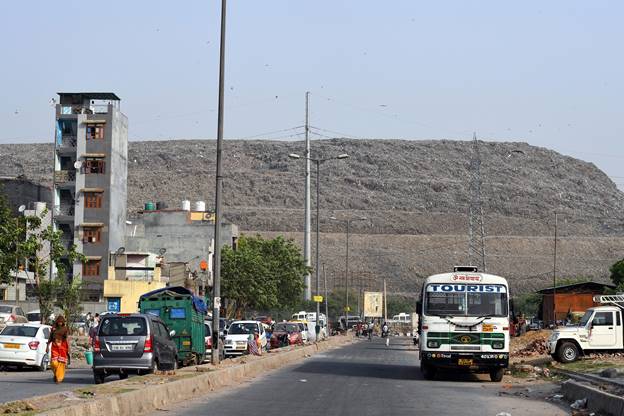
Every morning in east Delhi, trucks climb a hill that was never meant to exist. Ghazipur began taking the city's waste in 1984 and was supposed to stop at about 40 metres. A court-appointed commissioner who visited in March 2025 found it at roughly 60 metres, cracked on top, and venting methane. Fires break out regularly. Three decades of cleanliness drives have produced a clean pavement and a burning mountain a few kilometres away.
The Swachh Bharat Mission, launched in 2014, is rightly celebrated for its toilets and door-to-door collection. Its record on what happens after the dustbin is lifted is far weaker. Calling this a "complete collapse" in every city goes beyond the evidence. Calling the official numbers reassuring does too. The honest description is a mission that measured what was easy, declared success early, and left the hard, expensive downstream work half done.
Two Sets Of Numbers
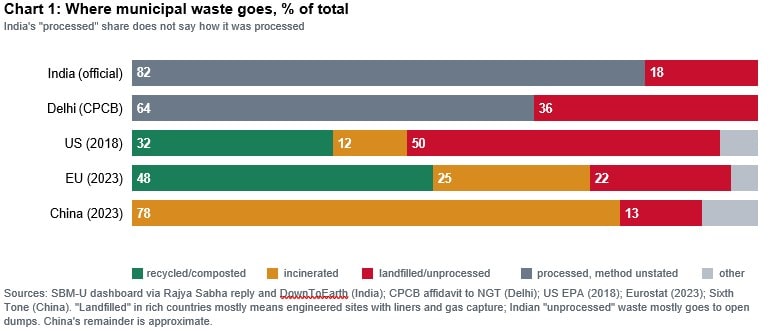
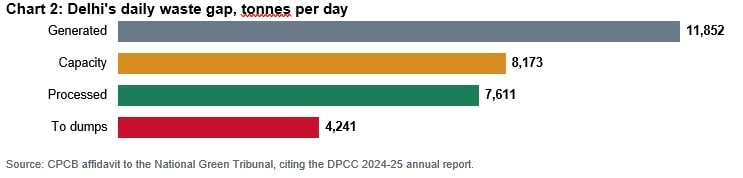
Official dashboards say India's cities generate about 161,000 tonnes of municipal solid waste a day and that roughly 80-82% is processed. Yet the capital, with the best-resourced municipality in the country, told the National Green Tribunal through the pollution regulator that it processes 64.2% of its 11,852 daily tonnes. Some 4,241 tonnes a day go to the Bhalswa and Ghazipur dumps. Processing capacity (8,173 tonnes) is itself below generation, and actual use falls short of capacity.
An Ever-Growing Mountain
Ghazipur is the symbol, not the exception. Delhi's three big dumps - Ghazipur, Bhalswa, and Okhla - were assessed by a CPCB, NEERI, and IIT Delhi committee as having caused environmental damage valued at about Rs 1.4-1.6 billion rupees. A 2022 report to the tribunal found only 7% of Ghazipur's legacy waste had been bio-mined. Delhi's municipal corporation told the tribunal in 2026 that the site still receives around 2,400-2,600 tonnes of fresh waste a day. Delhi's landfills are reported to be 55-60% organic material, the fraction that rots into methane and feeds fires.
Nationally, officials put legacy waste at 270.2 million tonnes, of which 65.8% had been remediated by May 2026. The target, "Zero Dumpsites", falls due this month. A few sites hold most of what is left: 214 high-impact dumps contain about 80% of the remaining legacy waste. Remediation is also a flow problem. Clearing an old mound while fresh, unsorted waste keeps arriving simply refills it.

Why The Mission Missed
It measured the wrong thing. Toilets built and wards declared open-defecation-free are countable and photogenic. A functioning organic plant is not. Cities competed in the annual cleanliness survey, in which tidy streets scored well even when the waste was trucked to a dump on the edge of town.
Waste arrives mixed. Processing plants, composters, and waste-to-energy units need segregated feedstock. Wet waste dominates Indian bins, but segregation at source is patchy outside a few cities. Indore, the survey's perennial winner, shows it can be done; it is the exception that proves how rare the discipline is.
Municipalities are poor and fragmented. Waste is a local-body job, yet most urban local bodies lack the revenue, staff, and land to run plants. Central funds helped build capacity; the recurring cost of operating it is another matter. Self-reported dashboards let a city count capacity as processing.
Health costs are real but poorly measured. Landfill fires and methane are linked to bad air near dumps, and doctors report rising respiratory complaints. But data tying specific illnesses to specific dumps has barely been collected. A health crisis is plausible; proving its scale needs research India has not funded.
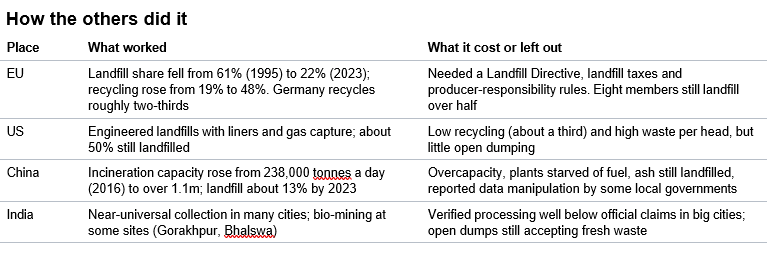
The comparison cuts both ways. Rich-world landfilling is not a model for India to copy, and America's 50% landfill rate would be a catastrophe without liners. China's incinerator boom shows state capacity but also how targets set from above can be met by building rather than by solving the underlying system. Europe's slower, rules-driven route is closest to what India's cities need: taxes on dumping, mandatory segregation, and enforcement.
What Would Fix It
Start by auditing the dashboard: independent verification of processing claims, city by city. Tie central money to tonnes actually processed rather than plants commissioned. Ban the dumping of unsegregated wet waste and charge a landfill levy that makes recycling cheaper than disposal. Fund health surveillance around the big dumps so the costs become visible. Without such changes, every remediated mound will be rebuilt by tomorrow's trucks.
India has shown it can change behaviour at scale when it measures honestly and spends on operations. The first Swachh Bharat cleaned up what could be seen. The second must deal with what is merely out of sight.
(The author is a waste management expert)
Disclaimer: These are the personal opinions of the author

