






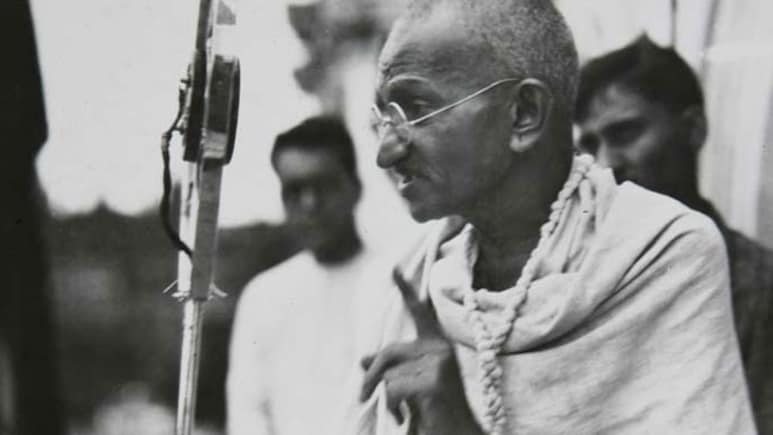
When Mahatma Gandhi was assassinated on January 30, 1948, the nation was plunged into grief. But what followed in parts of Maharashtra in the days after the assassination remains one of the least acknowledged episodes of post-Independence India: a wave of violence directed at the Chitpavan Brahmin community. It was not a communal riot, not a clash between two sides, and not a spontaneous outburst alone. It was a moment when an anger transformed into collective punishment, and an entire community was made to pay for the crime of one man.
Nathuram Vinayak Godse, Gandhi's assassin, belonged to the Chitpavan Brahmin community. Although his actions stemmed from his individual ideology, and although no institution or organisation claimed responsibility for the assassination, Godse's caste identity became the lightning rod for frenzy led by these apostles of non-violence. Rumours spread rapidly across districts that "Brahmins supported Gandhi's murder", that they "celebrated the assassination", and that "the conspiracy was caste-driven". Without evidence, without inquiry, without pause for reason, the anger of mobs turned towards identifiable Brahmin homes, shops, and families.
The violence was most intense in Pune, Satara, Sangli, Kolhapur, and adjoining regions. For generations, these districts had been strongholds of the Chitpavan community - administrators, teachers, priests, small landowners, and freedom fighters. Within hours and days of the assassination, their neighbourhoods became targets. Mobs organised, marched, and attacked with a clarity of intent: the punishment of a community for the act of an individual.
Homes were burnt. Properties were looted. Schools, temples, and libraries associated with Brahmin families were vandalised. Oral records and local testimonies suggest that thousands of houses were attacked, and in many villages, entire Brahmin settlements were forced to flee. While exact figures are impossible to verify - owing to the absence of official documentation, police records, or judicial inquiry - community accounts estimate that hundreds were killed, and some later estimates put the toll in the thousands (8,000 killed with some estimates) when including those who died from injuries, starvation, or displacement.
One of the most tragic casualties was Narayan Damodar Savarkar, the respected scholar and elder brother of Veer Savarkar. Dragged out of his home and beaten by a mob, he sustained grievous injuries and passed away months later. His killing is often described as one of the first mob-lynchings of free India - a dark irony, given that it happened in the name of the man who preached non-violence.
The famous New York Times newspaper's initial headline, "GANDHI IS KILLED BY A HINDU; INDIA SHAKEN, WORLD MOURNS", drew attention to the fact that the killer was a Hindu, a detail that became a focal point for subsequent communal violence and unrest. Advocate PL Inamdar, quoted in Vikram Sampath's Savarkar: Echoes from a Forgotten Past, Vol. II, documented how the 1948 backlash after Gandhi's assassination turned into a "manhunt" against Maharashtrian Brahmins, noting that even his own relatives narrowly escaped lynching "only because they were not found at home during the raids". Contemporary figures such as journalist GT Madkholkar and filmmaker Bhalji Pendharkar suffered major losses as violence spread across Nagpur, Kolhapur, Sangli, and other districts. Dwarka Prasad Mishra, a senior Congress leader, wrote in his memoirs that many perpetrators in Nagpur and Berar were actually Congressmen, some even office-bearers - an admission rarely acknowledged in mainstream narratives. The most academically credible documentation comes from Maureen Patterson, the British political historian who extensively researched the immediate aftermath of Gandhi's assassination and recorded targeted attacks, displacement of Brahmin families, and widespread destruction across Satara, Kolhapur, Belgaum, and the Deccan region, estimating property losses of Rs. 6-10 crore based on unofficial and field-level sources. Together, these published accounts - Inamdar (via Sampath), Mishra's memoirs, and Patterson's scholarly work - form primary research-based references available on the largely forgotten violence against Brahmins in 1948.
The government imposed curfew and deployed police forces, but the response came slowly and unevenly. No central inquiry commission was ever formed. Few perpetrators were ever identified or punished or prosecuted. Once the violence subsided, the administration moved on, and no report was compiled to assess the scale of the destruction. The absence of documentation ensured that the tragedy remained largely outside national discourse.
What makes this episode even more neglected is the political sensitivity surrounding it. Post-Independence India was building its national story - one of unity, recovery, and moral purpose. A targeted attack by mobs, many aligned with local Congress factions, did not fit the narrative the new nation wanted to project. Unlike the large communal riots that were widely reported and studied, the violence against Chitpavan Brahmins slipped into silence. Families rebuilt in private; memories were passed within households, not through public forums.
The tragedy also raises fundamental questions about mob psychology and collective blame. How does a society that had just fought for freedom and justice turn so swiftly against its own people? How does the rhetoric of peace give way to the instinct for vengeance? And why did the nation choose to forget, rather than confront, this painful episode?
Ethically, the violence stands as a reminder of the dangers of identity-based retribution. Morally, it challenges the idealised image of early independent India as a period untouched by internal conflict. Historically, it underscores how narratives get shaped: some events enter the textbooks, others are left out because they do not fit the desired storyline.
This genocide finds similarity in Sikh massacre after 36 years in 1984 where thousand of Sikhs were killed following the assassination of Mrs. Indira Gandhi. Seventy-seven years later, the silence surrounding the 1948 violence remains striking. There are no national memorials. No officially recognised list of victims. No public commemorations. What survives are fragments of private memory: charred documents kept in family trunks, letters describing the flight from burning villages, and stories told in low voices so that children would not be frightened.
Remembering this tragedy is not about assigning blame to any community or rewriting history with bitterness. It is about acknowledging what happened, giving dignity to the victims, and understanding the fragility of social harmony. When a society chooses to forget, it also risks repeating.
In a nation built on diversity, the real lesson of 1948 is simple: collective punishment has no place in a democracy, and anger-no matter how justified-must never be allowed to turn into hatred.
Until these truths are openly spoken, the story of the Chitpavan Brahmins after Gandhi's assassination will remain what it has been for decades: a forgotten chapter of free India.
(Rajiv Tuli is an independent columnist)
Disclaimer: These are the personal opinions of the author

