






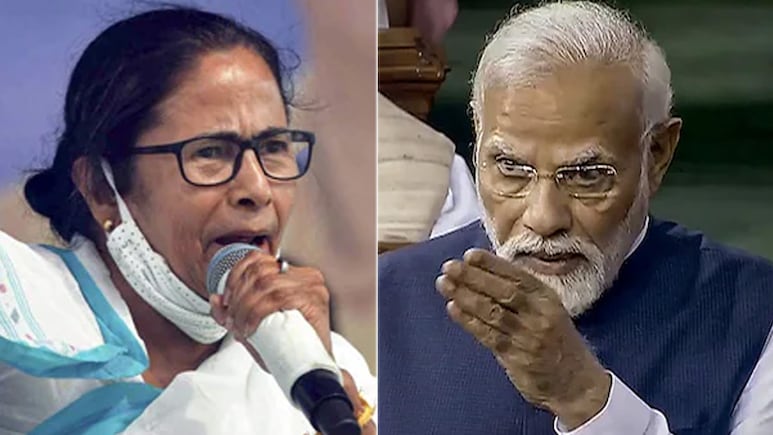
With barely a few days left for voting, the West Bengal Assembly election has entered its decisive final stretch. In this last leg, both sides have begun to deploy their sharpest strategies, pushing every possible narrative to influence voters. What was once a contest framed around slogans like "Jai Shri Ram" or "Jai Maa Kali" has now evolved into a more layered political battle, where multiple issues intersect. At this point, one of the most critical questions shaping the campaign is the impact of SIR and how it may influence voter behaviour.
On the campaign front, Mamata Banerjee has clearly shifted her narrative towards a strong anti-Delhi positioning. She is intensifying the argument that Delhi, with all its institutional power, is attempting to dominate Bengal politically, culturally, and socially. Her campaign suggests that Bengali identity, culture, and traditions are under threat, and that an external force is trying to reshape Bengal in its own image. This framing is being consistently amplified across rallies and public messaging.
At the same time, the BJP, led nationally by Narendra Modi, has recalibrated its approach. While Hindutva remains a core ideological pillar, the party is now equally focused on projecting itself as a genuine well-wisher of Bengal. From North Bengal to South Bengal, BJP leaders are making visible efforts to demonstrate their emotional and cultural connection with the state, emphasising development, identity, and inclusiveness rather than relying solely on religious slogans.
Fish Enters Poll Battle
Perhaps the most unusual and striking feature of this election campaign has been the emergence of what can only be described as "fish-centric politics". For Bengalis, fish is not merely food; it is an essential part of life, often referred to colloquially as "Ganga phal", symbolising its deep cultural significance. Without fish, many Bengalis would consider life incomplete.
In this context, past controversies such as restrictions on fish displays and similar disputes over the subject have come into play. Sensing an opportunity, Mamata Banerjee has begun warning voters that if the BJP comes to power, it could interfere with their food habits, even suggesting that fish consumption might be affected. The Trinamool Congress has skilfully tied this issue to Bengali identity, framing it as a matter of cultural survival.
This narrative has taken a highly visual turn. In South Kolkata, senior TMC leader Arup Biswas, considered close to Mamata Banerjee, was seen leading processions carrying large katla fish. He even purchased fish from local markets and turned it into a symbolic campaign act. Such scenes, with candidates and leaders marching with fish while residents watch from balconies, are unprecedented in Kolkata's electoral history. This phenomenon, humorously likened to a modern-day "Matsya Purana" (the ancient text, here used metaphorically), marks a new and curious phase in Bengal's political theatre.
However, the BJP has not stayed behind in this symbolic contest. Its leaders have also taken to the streets with fish, clearly signalling that they are "no less than anyone else" in connecting with Bengali cultural identity. In one notable instance, BJP leader Rakesh Singh, contesting against Kolkata Mayor Firhad Hakim-a leader who was until recently in jail and had earlier been associated with the Trinamool Congress-has been actively campaigning with a large fish in hand. Posing for cameras, he has openly stated that BJP leaders also consume fish and have never spoken about banning it. He has accused Mamata Banerjee of spreading falsehoods, asserting that her claims are misleading.
This entire episode shows how, in the final phase of the election, Bengali identity politics has intensified sharply. BJP leaders are now repeatedly clarifying that they have never proposed banning fish. In fact, they cite examples from states like Tripura where, after the BJP came to power, even RSS gatherings-where earlier only vegetarian food was served-were adapted to local culture. Recognising that both tribal communities and Bengalis in Tripura consider fish an essential part of their diet, it was included in such events.
In that sense, the debate over vegetarianism versus non-vegetarianism should ideally be a non-issue. Many intellectuals and observers argue that it is, in fact, a distraction. According to them, the real issues should be unemployment, lack of industrial growth, and the non-implementation of pay commission benefits. They question whether food habits can genuinely be an electoral issue. Yet, somewhat unexpectedly, this is precisely what has happened in West Bengal: symbolic identity markers have taken centre stage.
Identity vs Ideology
At the same time, it would be incorrect to assume that identity politics has replaced ideological politics entirely. The BJP's "Jai Shri Ram" narrative and its broader Hindutva framework remain core to its campaign. However, the party is currently facing a challenge with the Matua community, where a significant number of votes have reportedly been affected by voter list changes. In Thakurnagar, the religious centre of the Matuas, both the TMC and BJP candidates belong to the influential Guruchand Thakur family, making the contest distinctly Matua-centric.
Shifting Dynamics
In these areas, the political discourse has shifted. Instead of focusing primarily on allegations of corruption against the TMC, the debate now revolves around what each party has actually delivered for the Matua community. This detailed scrutiny-almost a microscopic evaluation of promises and performance-is shaping the electoral contest between the two sides in 2026.
The Matua stronghold of Ranaghat remains crucial in this context. Several assembly segments fall within this region, including Ranaghat North-East, Ranaghat North-West, Ranaghat South, and Krishnaganj. While earlier the TMC did not face a very intense contest here, the situation has changed in this final phase. In nearby Bongaon and Bagda, which are considered core Matua belts, the dynamics are slightly different, and even within Nadia district, variations in Matua voting behaviour are visible.
Interestingly, the TMC is not foregrounding corruption allegations as its primary campaign issue in these areas. Instead, it is focusing on identity, arguing that the BJP is attempting to undermine the Matua community's social and cultural position. With nearly 40% of the community comprising refugees, and many belonging to the Scheduled Castes and tribal backgrounds, their vote becomes extremely significant.
This pattern is not limited to the Matua belt alone. In North Bengal, similar community-driven politics is visible among the Rajbanshis, while in regions like Purulia, tribal communities are at the centre of campaign strategies. As a result, the final leg of the election has become heavily community-focused across different regions.
Clash Of Titans
Another defining feature of this phase is the BJP's high-intensity campaign, almost resembling what can be described as "carpet bombing". Senior leaders are arriving one after another to strengthen the campaign. Smriti Irani, for instance, has been actively engaging with voters by eating local food, speaking in Bengali, and holding press conferences in Kolkata to project herself as culturally connected, even portraying herself as a "daughter of Bengal". Similarly, leaders like Rekha Gupta are also campaigning, alongside several other prominent figures.
At the organisational level, Bhupender Yadav has taken charge of micro-managing district-level operations, focusing on booth-level mobilisation to ensure voter turnout. The BJP's effort is to maximise efficiency in the final push, ensuring that every possible supporter reaches the polling booth.
On the other side, the Trinamool Congress is concentrating on ensuring that its core voters actually turn up to vote. However, this time, the situation is more complex than before. With the Election Commission taking control of the local administration, transferring district magistrates, police officers, and other officials, the traditional influence over local machinery has changed. The BJP's strategy appears to rely on leveraging administrative control, while the TMC argues that the BJP lacks grassroots organisational strength and is therefore depending on institutional mechanisms, including central forces.
The TMC, in contrast, is focusing on its strength in manpower management, mobilising workers and supporters across constituencies. With the election being conducted in two phases, the BJP believes this structure works to its advantage, as it limits the ability of TMC workers to move across constituencies on polling days.
Taken together, the situation in West Bengal at this moment is one of intense political drama. From fish symbolism to identity politics, from community equations to organisational battles, every possible lever is being pulled in these final days. The campaign has reached a high pitch, where emotion, strategy, and symbolism are all converging, making this last leg one of the most unpredictable and closely watched phases of the election.
Another important dimension of the campaign is the deployment of high-profile leaders. The BJP has brought in several prominent figures from outside Bengal to strengthen its outreach. In response, Mamata Banerjee has crafted a counter-strategy by inviting opposition leaders from across India, such as Hemant Soren, Akhilesh Yadav, and Tejashwi Yadav, to campaign against the BJP.
Interestingly, none of these leaders is Bengali. This, however, is part of a deliberate narrative. Mamata Banerjee is attempting to project herself as a leader under siege - a regional figure being targeted by powerful national institutions and forces aligned with Delhi. The campaign seeks to portray her as a victim of coordinated pressure from the Election Commission and central agencies, turning the election into a broader struggle between Bengal and external authority.
In the final analysis, the last leg of the West Bengal election is no longer about a single issue or slogan. It is a complex contest where identity, culture, welfare, religion, and institutional trust are all intertwined. As both sides intensify their efforts, the outcome will depend on which narrative resonates more deeply with voters in these crucial final days.
(The author is Contributing Editor, NDTV)
Disclaimer: These are the personal opinions of the author

