






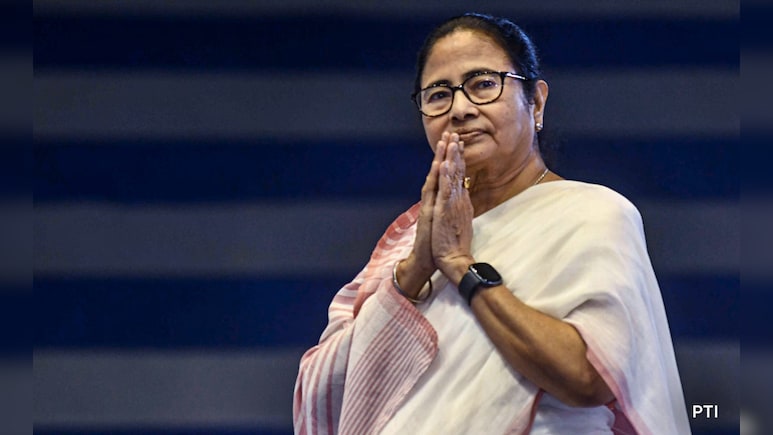
At every rally and public event, Mamata Banerjee states that she does not practise appeasement of any particular religion and that her politics is secular.
A few days ago, however, the West Bengal government announced it would build a Durga temple in New Town, Kolkata, where Mamata laid the foundation stone for the project. The project is called 'Durga Angan', and the invitation card for the inauguration ceremony was issued on behalf of the state government. The letter noted that West Bengal's traditional Durga Puja was recognised by UNESCO in 2021 as an Intangible Cultural Heritage of Humanity, and that the Durga Angan project was meant to preserve that tradition.
During the ceremony, Mamata placed a red sari and a white dhoti at the site. The explanation offered was symbolic: Durga is where Shiva is, and Shiva is where Durga is - the merger of 'Gauri' and 'Hara'. Mamata also announced plans to build a Mahakal Shiva temple in North Bengal.
The BJP leadership views these actions as a response to political pressure and to ease the perception that the Trinamool Congress engages in Muslim appeasement. Union Home Minister Amit Shah says that while building a Durga temple is not a problem and is, in fact, a good thing, Mamata's actions have come too late and may be seen as inauthentic.
But what's behind this shift in Mamata's politics?
It is undeniable that Hindutva has been central to the BJP's politics. With the BJP in power in most states, it has been able to spread its Hindutva agenda nationwide. To counter this, parties have had to take their own respective routes. Images of Rahul Gandhi wearing the sacred thread and taking a dip in the Ganga aren't a surprise anymore. Earlier, Rajiv Gandhi had sent Buta Singh to Ayodhya. Kejriwal, too, frequently visits temples before elections. However, the fact is that often, when opposition parties adopt Hindutva to counter the BJP, they often end up appearing like its B-team.
Mamata's case, however, is shaped by the distinct nature of Bengali Hinduism. For instance, Bengali Hindus are largely non-vegetarian, with fish considered auspicious in their culture. In several temples, fish offerings are still common. Shakta traditions are deeply influential. Bengalis are culturally pluralistic, shaped by both Aryan and non-Aryan influences. The Hinduism of Ramakrishna Paramahamsa and Swami Vivekananda reflects this difference. Mamata Banerjee's composite cultural identity is also rooted in this Bengali tradition.
Mamata never really foregrounded her religious identity in the past. Yet, like many Bengali Hindu women, she has always been personally devout. What has changed now is the public display of her religiosity. This approach helped her against the BJP in the 2024 Lok Sabha polls. What will happen in 2026 remains to be seen.
Mamata has also built a political narrative positioning Modi and Amit Shah as outsiders from Delhi, framing their presence as an attempt by an 'external' power to take control of Bengal. By saying “they are not Bengalis”, Mamata isn't referring only to ethnic Bengalis but also Gujaratis, Marwaris, Maharashtrians and Hindi-speaking residents. Linguist Suniti Kumar Chattopadhyay explained extensively how the Bengali identity is rooted in language. It is this collective Bengali identity that Mamata is trying to tap to take on Delhi.
As an opposition leader, Mamata is also positioning the election as a direct contest between herself and Modi, rather than between the West Bengal BJP and the Trinamool Congress. While the BJP relies on Modi's brand, Mamata is banking on her radical anti-Centre politics. There is no single axis to this election.
The BJP, meanwhile, is looking towards new political formations to split the Muslim vote. It hopes that Humayun Kabir's party will make gains in North Bengal and that the ISF will weaken Mamata in the South. With Murshidabad's 21 seats and Malda's 10, these districts are key targets. Owaisi, too, is attempting to dent Mamata's Muslim support. In any case, many Muslim leaders have begun feeling that Mamata is overperforming Hindu religiosity and neglecting Muslim concerns. Mamata, however, counters this by warning Muslims that such fragmentation will only help the BJP.
(The author is Contributing Editor, NDTV)
Disclaimer: These are the personal opinions of the author

