






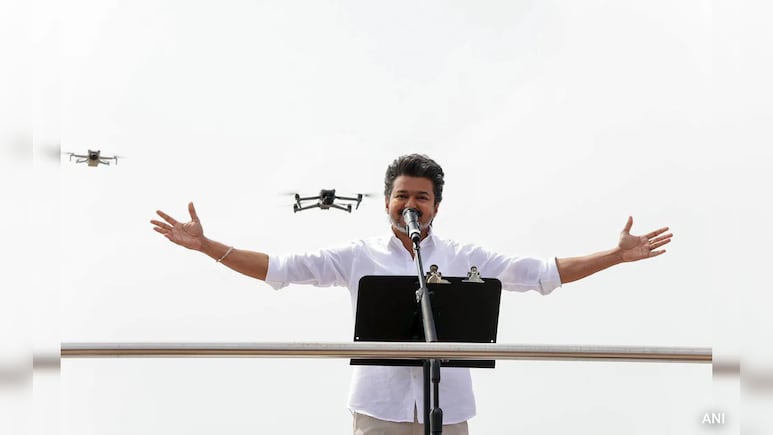
The first major takeaway from actor-politician and Tamilaga Vettri Kazhagam (TVK) chief Vijay's Erode rally is unmistakable: the animosity between the TVK and the ruling DMK has only intensified.
The DMK's sharp attacks on Vijay - particularly its attempts to hold him and his party responsible for the tragic stampede in Karur on September 27 - appear to have hardened his political posture. Vijay's response has been to turn this into an open and bitter rivalry.
Invoking the late Chief Minister J Jayalalithaa, Vijay justified the fierce language she once used against the DMK. Declaring the DMK an “evil force” and positioning the TVK as the “pure force”, he delivered the message with the flourish of a cinematic monologue - equal parts vehemence and vengeance.
By framing the upcoming election as a battle between good and evil, Vijay is deliberately reviving memories of the Jayalalithaa-Karunanidhi rivalry - an intense, deeply personal feud that defined Tamil Nadu politics until they died in 2016 and 2018. Crucially, Vijay is attempting to rewrite the state's political script: no longer DMK versus AIADMK, but DMK versus TVK.
Vijay's use of Periyar's name, accusing the DMK of exploiting the state in the name of the Dravidian icon, underlines the ferocity of the rivalry he is building. Periyar remains the DMK's most powerful ideological symbol, and attacking the party on this front is a calculated provocation, especially in Erode, which is Periyar's birthplace.
This emotionally charged DMK-versus-TVK narrative does not just threaten the ruling party. It poses an equally serious challenge to the AIADMK. Vijay's rise risks cutting into the AIADMK's traditional vote base, spelling trouble for Edappadi K Palaniswami (EPS), whose leadership has failed to deliver an electoral victory since Jayalalithaa's death in 2017. The party has lost the 2019 (Lok Sabha), 2021 (Assembly), and 2024(Lok Sabha) elections, and the erosion shows.
What worsens matters for the AIADMK is the entry of KA Sengottaiyan into the TVK. The nine-time AIADMK MLA, now head of TVK's coordination committee, knows the party and EPS intimately. More importantly, he hails from the “Kongu” region in western Tamil Nadu - EPS's last major bastion. Sengottaiyan's presence represents a direct strategic threat.
Interestingly, Vijay's attack on the BJP was relatively muted, especially when compared to his sharp criticism of the DMK. The AIADMK, too, was largely ignored as a political force - embarrassingly for the opposition party, given the rally was held in a region traditionally loyal to the AIADMK. Vijay's declaration that more leaders like Sengottaiyan would soon join TVK should make the AIADMK wary.
Yet for all its drama, Vijay's speech offered little in the way of concrete political substance. There was no clarity on alliances, no roadmap to address agrarian distress or corruption beyond rhetorical references. The only policy position he clarified was that he was not opposed to welfare measures or so-called freebies.
While he avoided personal attacks on Chief Minister MK Stalin, the speech leaned heavily on emotion, spectacle, and symbolism - hallmarks of Vijay's appeal, especially among his fans.
And that fan base remains formidable. Despite the Karur tragedy, there was no visible drop in turnout or enthusiasm at Erode. The emotional fervour was as intense as ever. Notably, none of the families of the 41 victims who died in the stampede have publicly blamed Vijay - an indication of the extraordinary emotional bond he enjoys with his supporters.
Strikingly, Vijay made no reference to the tragedy during his speech, despite addressing a crowd just 70 kilometres from the location of the tragedy. There was no public display of grief. This signals a conscious strategic decision: the TVK has chosen to move forward without allowing guilt or remorse to define its campaign. Politically, the party has placed responsibility squarely on the DMK, alleging conspiracy, while keeping outreach to victims' families personal and away from the public gaze.
As Tamil Nadu moves closer to the 2026 Assembly election, Vijay's strategies will face their toughest test. An AIADMK-TVK alliance appears virtually impossible, for now. EPS is unlikely to accept Vijay as the face of an alliance, and Vijay, by the same token, is unlikely to play second fiddle to anyone.
An understanding with the BJP appears even more improbable, given Vijay's minority vote base. At present, this forecloses the possibility of a TVK-AIADMK partnership within the NDA, pointing instead to a three-cornered contest in 2026: TVK versus DMK-led alliance versus NDA.
Yet politics has a way of making the impossible possible. Vijay has noticeably softened his tone towards the BJP since the stampede. With the case now under CBI investigation and before the Supreme Court, could legal and political pressures alter his stance?
If not, will the anti-DMK vote split, handing the ruling party an advantage? Or could Vijay punch through the DMK's defences, particularly among youth and marginalised communities?
Perhaps the most consequential question is whether Vijay can emerge as a credible third pole capable of attracting smaller parties. Tamil Nadu politics has long forced regional and national parties alike to choose between the DMK and AIADMK. Vijay's arrival offers them a third option - and greater bargaining power.
Alliance arithmetic has always been central to electoral success in the state. As the DMK grapples with seat-sharing tensions within its 14-party alliance and the AIADMK struggles to consolidate anti-DMK forces under EPS, Vijay stands as the disruptor. How deeply he disrupts the existing alliance equations may well be the biggest X-factor of the 2026 elections.
One thing, however, is already clear: Vijay and his TVK have not been politically crushed by the stampede tragedy, controversy, or sustained attacks. The “good versus evil” narrative will get stronger as his politically charged feature film, Jana Nayagan (tr. "the People's Hero") hits the screens in January. It may be a box office buster as all his recent films have been, but will it lead to a political blockbuster in the assembly polls?
(The author is Executive Editor, NDTV)
Disclaimer: These are the personal opinions of the author

