






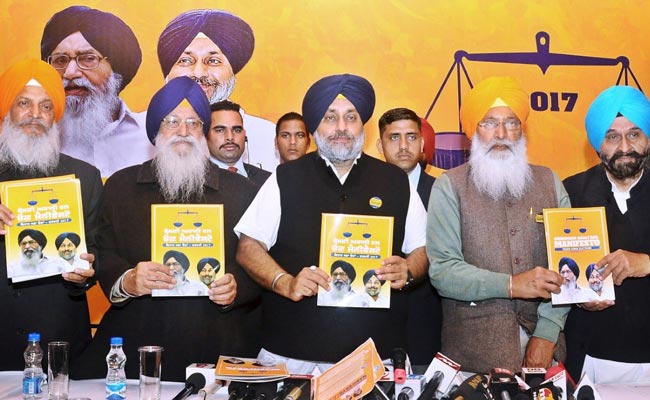
The Shiromani Akali Dal (SAD) is one of India's oldest regional parties, founded in 1920 and almost as old as the RSS. For over a century, it has been deeply connected with Punjab's political, religious and social history. In contrast to many regional parties that emerged around personalities or electoral issues, SAD was born out of a mass movement and built its legitimacy through struggle and sacrifice.
The party played a historic role in the Gurudwara Reform Movement, participated in the freedom struggle, led the Punjabi Suba agitation, and emerged as the principal political voice of Sikh aspirations. During the Emergency, Akali leaders were among the strongest defenders of democratic rights. For decades, SAD positioned itself as the champion of Punjab's federal rights, Sikh interests, and farmers' concerns, giving it a stature far beyond electoral politics.
Electorally, SAD has been one of Punjab's most successful parties, forming governments multiple times and producing towering leaders such as Parkash Singh Badal, Gurcharan Singh Tohra, etc. Its long alliance with the BJP has often been cited as a successful model of Hindu-Sikh camaraderie and social harmony after the turmoil of the 80s. Together, the alliance dominated Punjab politics for nearly two decades. However, since 2015, the party has witnessed a dramatic decline.
A number of reasons were behind this decline. Akali Dal's electoral success was based upon pragmatism and ruthless use of money and power, which led to a number of mafias - land, sand, transport, drugs, cable - dominating the party. Ideology and the old Jathedar base of the party was jettisoned for family, "Halqa incharges", and new "moneybags". Controversies like Beadabi, farm laws and Article 370 ensured that the Akalis alienated their core votebank of Sikhs and peasants.
Meanwhile, new ascendant social forces - youth, NRIs, unemployed, influencers; new social movements - farmers and Panthic and new political outfits - PPP, AAP, using new digital technologies, prospered at the expense of Akalis, painting them as the real villains of Punjab and holding them responsible for all its ills. At the same time, demographic changes - such as outmigration of the core Akali vote bank of Jatt Sikhs - also hurt the Akali Dal the most.
All this ensured the dramatic decline of the Akali Dal as an electoral force. Its votebank has crashed from 35% to 13%, and its seat share in the state assembly has declined from 58 to three since 2012. It reached a nadir in the 2024 Lok Sabha elections, when it lost deposits on 10 of 13 seats and secured just 13.42% votes. Along with electoral decline, Akali Dal has to face a prolonged period of ideological confusion as it veered from one extreme - batting for Bandi Singhs and Rajoana in elections to another, like supporting Article 370 move and farm reforms.
Electoral defeats were also accompanied by a challenge to Sukhbir's leadership from disgruntled Akalis - Dhindsa, Chandumajara, Jagir Kaur and from Jathedars along with resentment among the religious over the "Beadabi" issue.
One of the most significant results of the decline of the Shiromani Akali Dal over the last decade has been the fragmentation of Punjab's Panthic political space. What was once largely monopolised by a single party is today contested by four distinct formations-Akali Dal (Badal), Waris Punjab De, Akali Dal (Mann), and the various rebel Akali factions often described as Akali Dal Punar Surjit. Each seeks to position itself as the authentic voice of Panth and Punjab, but each carries its own strengths and limitations.
Despite its dramatic decline, the Akali Dal under Sukhbir Badal remains the largest and most organised Panthic force. Its greatest strengths are its century-old legacy, extensive organisational network, Sukhbir Badal's leadership, financial resources, and deep roots in rural Punjab. It remains the only Panthic outfit with a proven record of governance and state-wide presence. Moreover, the party has shown signs of revival by its improved showings in bypolls and local elections in the last year. The party has held a series of rallies recently to bolster its support. It remains strong in the rural Malwa heartland and parts of Majha.
However, its weaknesses are equally apparent. Akali Dal continues to suffer from a severe credibility deficit arising from the Beadabi, drug charges, alleged mafia links and pressure from "neo panthics". The ruling AAP continues to poach Akali leaders. Youngsters remain suspicious of its intentions and unconvinced by its attempts at reinvention. SAD remains weak in urban and eastern parts of the state.
The rise of the jailed MP Amritpal Singh has transformed Waris Punjab De into a dynamic challenger within the Panthic space. Its principal strength lies in its ability to connect emotionally with sections of Sikh youth who feel alienated from mainstream politics. It has successfully harnessed social media, symbolism, and grievance-based mobilisation to create a powerful narrative.The core area of Waris Punjab De remains in rural Majha and parts of rural Malwa.
Yet Waris Punjab De has significant structural weaknesses. It lacks a proven organisation, experienced leadership, coherent policy agenda, and resources. It also faces the charges of being another family-controlled outfit. Much of its appeal remains personality-driven and emotional. The challenge before Waris Punjab De is whether it can evolve from a protest movement into a sustainable political organisation.
Led by Simranjit Singh Mann, Akali Dal (Amritsar) enjoys considerable credibility among hardline Panthic voters. Its greatest strength is ideological consistency around Khalistan. Unlike many competitors, it has maintained a clear and uncompromising position for decades.
Its problem, however, is growth. The party remains confined to a relatively narrow social and geographical base, mainly old Panthics and Sangrur/Fatehgarh belt. It repeatedly struggled to expand beyond its core supporters and is often viewed as revolving around a single ageing leader in Mann. While it commands respect among committed supporters, it has found it difficult to translate ideological purity into broad electoral appeal and is now rapidly losing the radical space to Waris Punjab De.
The Giani Harpreet-led Punar Surjit Akali Dal was formed in opposition to Sukhbir Badal's leadership and his defiance of Akal Takht directives. The outfit comprises many former Akali stalwarts like a young Prem Singh Chandumajra, Parminder Ghindsa, Bibi Jagir Kaur, etc, and aims to restore the original Panthic ethos.
However, the party has been largely a non-starter. Lack of leadership, resources, organisation and credibility has led many of its leaders, like Surjit Singh Rakhra, Manpreet Ayali, etc, to desert the party. The party is rapidly eroding even before the elections and is the weakest among the Panthic forces.
Overall, the shrinking and fracturing of the regional and Panthic space only gives the advantage to the more centralised parties like the ruling AAP, Congress and BJP.
(The author teaches history at SGGS College, Chandigarh)
Disclaimer: These are the personal opinions of the author

