






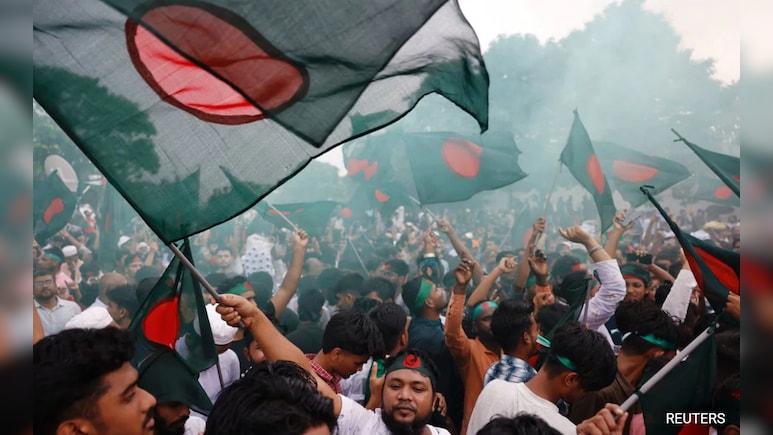
"Dream delivers us to dream, and there is no end to illusion."
The morning of December 16, 1971, was one such dream, delivered nine months after it was first dreamt on March 26. The birth of a nation. Bangladesh was free. Pakistan had been defeated. The colonial trope had been replicated barely two decades after the British left the Indian subcontinent. It was all supposed to go well for the 'baby' of the region. The carnage in East Pakistan, leading up to the historic surrender of the Pakistan Army to India, was meant to birth a terrible beauty.
Except it didn't.
And that's one of the biggest paradoxes of the idea of nationalism. An idea as strong as any to mobilise multitudes.
Autonomy And Nationhood
It suits almost all stakeholders to imagine the independence of Bangladesh as an example of the nationalist collective will finding its just culmination. A beleaguered people, facing political discrimination based on their linguistic and cultural identity, seceded from the hegemonic West Pakistan. The independence of Bangladesh was, after all, a belated correction to address the mistake of the earlier independence project. The dream of 1947 delivering 1971, to go back to the opening quote by Ralph Waldo Emerson.
Anthony D Smith, a prominent theorist of nationalism, asserts, "Autonomy is the goal of every nationalist." In Bangladesh's case, the autonomy was achieved twice in less than a quarter of a century. Smith, along with many others, believes in the primordial idea of nationhood: nations predate modernity because they are rooted in associations that are almost visceral. The civic framing of a nation - governance, citizenship, the whole nine yards - is just a vessel to contain and legitimise this a priori idea of belonging.
There has been a vehement criticism of this idea of nationalism by the modernists like Elie Kedourie and John Breuilly, who situate nation-ality in rationality. Nations are well-reasoned units of governance, emerging out of the various processes associated with modernity, including the Industrial Revolution. The modernists argue that for the nationalist, unity makes sense because it achieves several goals ranging from good governance to territorial integrity.
But why are we delving into the theory of nationalism?
Who Is The More 'Important' One?
Because the answers that we are looking for in the aftermath of the latest bloodlust in Bangladesh are all writ large in the boring pages that historians, psychologists, and political philosophers painstakingly produced. The "Too Long, Didn't Read" cohort can stop after the following sentence: The us-and-them framing of human associations finds and rationalises ways to assert that some of us are more important than others, and the latter can be conveniently eliminated for the greater good.
For the present idea of Bangladeshi nationalism, a Hindu factory worker claiming that God is one and the same for everyone, despite different names, is an inconvenience. It hasn't been a new inconvenience, though. The much-eulogised secularism of Bangladesh has always had the subterranean current of religious extremism. It's easy to romanticise Sheikh Mujibur Rehman's call for arms to protect the Bengali pluralism because it's far enough in history. But was it truly that? Or, did it remain so for long? The answer to the second question is a definitive no. And the fault lies in the nature of the beast called nationalism.
What To Do With A Coloniser - Once They Leave?
Since nationalism, an idea that refuses to die despite its many obituaries, remains one of the most powerful mobilising forces in human society, it doesn't stop at achieving the goals it originally stated. In the context of post-colonial nations, it was the independence from the colonial master. But what does society do with all the energy and momentum once the coloniser has been ousted? The stronger the push to the coloniser, the greater the chances of the unmanageability of the 'yes, we can' euphoria. The nobleness of the decolonising project can go only thus far and no further. We must remember that the birth of Bangladesh was the consequence of a war that caught the attention of the world's superpowers.
Now, let's invoke theorists Marvin and Ingle, who shock us by stating that nations can stay together only when the ritual of blood sacrifice is done periodically. So, picture a people mobilised for a noble cause, doing all it takes to assert themselves, suddenly finding themselves twitching, restless once the goal has been achieved. Once "Mukti" from the oppressor - the British, the Pakistani, Sheikh Hasina - is attained, the rites of unity must be performed. The victims are the 'others'. They must be expended to purify, unify, and fructify the 'true' idea of a nation. Because what came before was impure, imperfect, yet importunate. A perfect nation ought to perform and progress unbothered. Wasn't this, after all, the face (of a new perfect nation) that launched a thousand ships?
Who knows if Helen was real or just an illusion?
To conclude, "Once independence was achieved, however, the new state was faced with the problem of giving substance to that illusion," says Margaret Canovan about the burden that nationalism carries. It has to offload somewhere. Anywhere will do, but the site of least resistance works the best.
(Nishtha Gautam is a Delhi-based author and academic. She's currently researching Nationalism at Jindal School of International Affairs)
Disclaimer: These are the personal opinions of the author

