






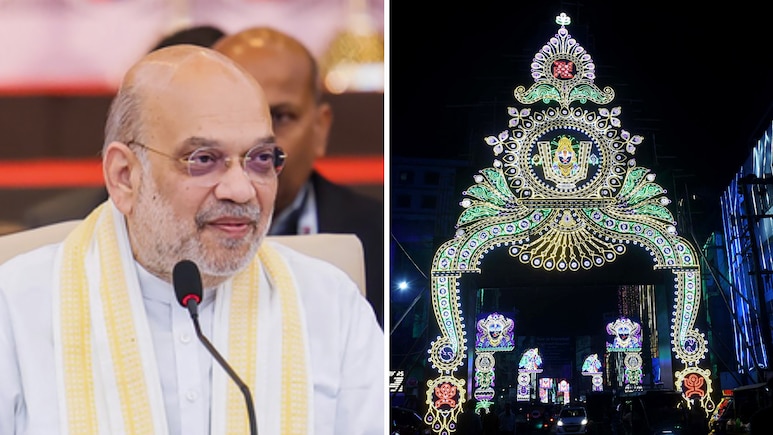
Union Home Minister Amit Shah could not visit West Bengal on Mahalaya despite an invitation from Chief Minister Suvendu Adhikari to participate in the Durga Puja celebrations on Red Road. He will, however, be in the state on Sunday, and a full-day programme has been planned for him.
The minister will be staying at the Atithi Griha in Alipore, and his Durga Puja engagements will begin at Belur Math, the headquarters of the Ramakrishna Math and Ramakrishna Mission. This choice is important because it signifies that he is seeking to connect with a deeper and more enduring aspect of Bengal's cultural identity.
After visiting Belur Math, he is expected to explore some of Kolkata's prominent Durga Puja celebrations, including traditional household pujas and community-organised festivities. Shobhabazar Rajbari represents the older tradition of aristocratic family pujas, while the Barowari or community puja has a different social history. The Chetla Agrani puja pandal is another prominent destination associated with the city's contemporary Durga Puja culture.
In other words, Shah wants to return, once again, to the cultural foundations of Bengal and connect with what might be called the Bengali DNA.
How Is Amit Shah's Visit Different This Time?
The most obvious difference is that, earlier, the BJP was in the opposition and its political position and its approach to Bengal's cultural life were therefore different.
Consider Santosh Mitra Square, one of Kolkata's well-known Durga Puja destinations. BJP leaders, including MLA Sajal Ghosh, have been associated with its organisation. The BJP has also developed its own presence in the state's Durga Puja celebrations. But the question is whether these festivities should be viewed merely as pujas organised by one political party or as part of a broader cultural tradition that belongs to the people of Bengal.
The first criterion should be that the distinction between your puja and our puja must not become the defining feature. Durga Puja is larger than party politics. The festival belongs to the people of West Bengal, and political parties should recognise that it cannot be reduced to a contest between rival political organisations.
The BJP's strategy in Bengal appears to be an attempt to move beyond a narrow political identity and establish a connection with Bengali society through its cultural traditions. This approach has parallels with the political culture of India's Hindi heartland, where Navratri and its associated traditions occupy an important place.
But Bengal's cultural identity has its own distinct history, and the BJP must engage with that history if it wants to establish a lasting connection with the state. Because of this, Shah has prioritised the 'Bonedi Bari Pujo' by planning a visit to the Shobhabazar Rajbari. The tradition was that Durga Puja was celebrated in houses and Shobhabazar Rajbari was the first such puja in Bengal's history.
From Rajbaris to Barowari Pujas: The Democratisation of Durga Puja
For generations, Durga Puja in Bengal was closely associated with the wealthy and aristocratic families who organised celebrations in their rajbaris. Shobhabazar Rajbari is one of the best-known examples of this tradition. These household pujas were often grand affairs, reflecting the status, wealth and social position of their patrons.
However, the older system also had its limitations. The traditional household pujas could be exclusive, and people from some communities or other religious backgrounds did not always have equal access to the celebrations. The social structure surrounding these events could reflect the inequalities of the time.
Netaji Subhas Chandra Bose drew attention to the significance of community-organised pujas and wrote a letter saying Durga Puja must be made more accessible by having community pandals to encourage socialisation. The distinction between the old household pujas and the Barowari puja is important because the latter helped make the festival more accessible to a wider section of society.
The Barowari tradition represented a form of democratisation. Instead of remaining confined to a particular royal or aristocratic household, Durga Puja increasingly became a collective celebration in which the wider community could participate. The festival's social reach expanded, and its public character grew stronger.
This transformation is an important part of Bengal's cultural history.
Shah's proposed visit to both Belur Math and prominent puja destinations can therefore be understood in this context. He will not merely be visiting a series of pandals, but connecting with the cultural traditions that have shaped Bengal over generations.
The BJP's Cultural Strategy: Books, Festivals and Bengali Identity
The same strategy can be seen in the BJP's approach to book festivals and literary events. The party's cultural outreach in Bengal is not limited to Durga Puja. It also seeks to challenge the narrative that the BJP is opposed to Bengali literature, books or the state's intellectual traditions.
The CPI(M) and other political opponents have raised concerns about the BJP's cultural approach, suggesting that the party could restrict or undermine activities associated with Bengal's literary life. The BJP has countered this by organising book-related activities and selling books at Durga Puja venues.
This is an example of how political parties use cultural activities to challenge their opponents' narratives. The BJP wants to demonstrate that it can participate in Bengal's cultural life rather than remain confined to electoral politics.
The strategy also has to be understood against the backdrop of the party's earlier political messaging in the state. Before the election, Amit Shah had spoken about the need to strengthen Bengali-medium education and address concerns involving students educated in Bengali.
At the same time, the BJP's relationship with certain cultural and religious organisations has generated controversy. During earlier Durga Puja celebrations, remarks about people who eat non-vegetarian food, including fish and meat, were interpreted by critics as attempts to impose a more rigid version of Hindu identity on Bengal's traditions. Such controversies have sometimes intensified concerns that the cultural approach associated with some Hindu organisations is not fully aligned with the more pluralistic character of Bengali society.
The activities of ISKCON and other Hindu organisations have also formed part of the broader discussion about religious identity in Bengal. Some organisations have adopted a more assertive form of Hindu cultural expression, which has occasionally generated debate about how much space such approaches leave for Bengal's diverse traditions.
Bengal's cultural identity cannot, however, be understood through a single religious or political lens. Swami Vivekananda, for instance, remains a central figure in the state's intellectual and spiritual history. His legacy is part of a Bengali cultural character that developed over centuries through the interaction of religious thought, social reform, literature, philosophy and public life.
Shah and the BJP are attempting to connect with this historical and cultural inheritance. Their challenge is to demonstrate that they understand the distinctive character of Bengali society and can engage with it without reducing its traditions to a narrow political identity.

