





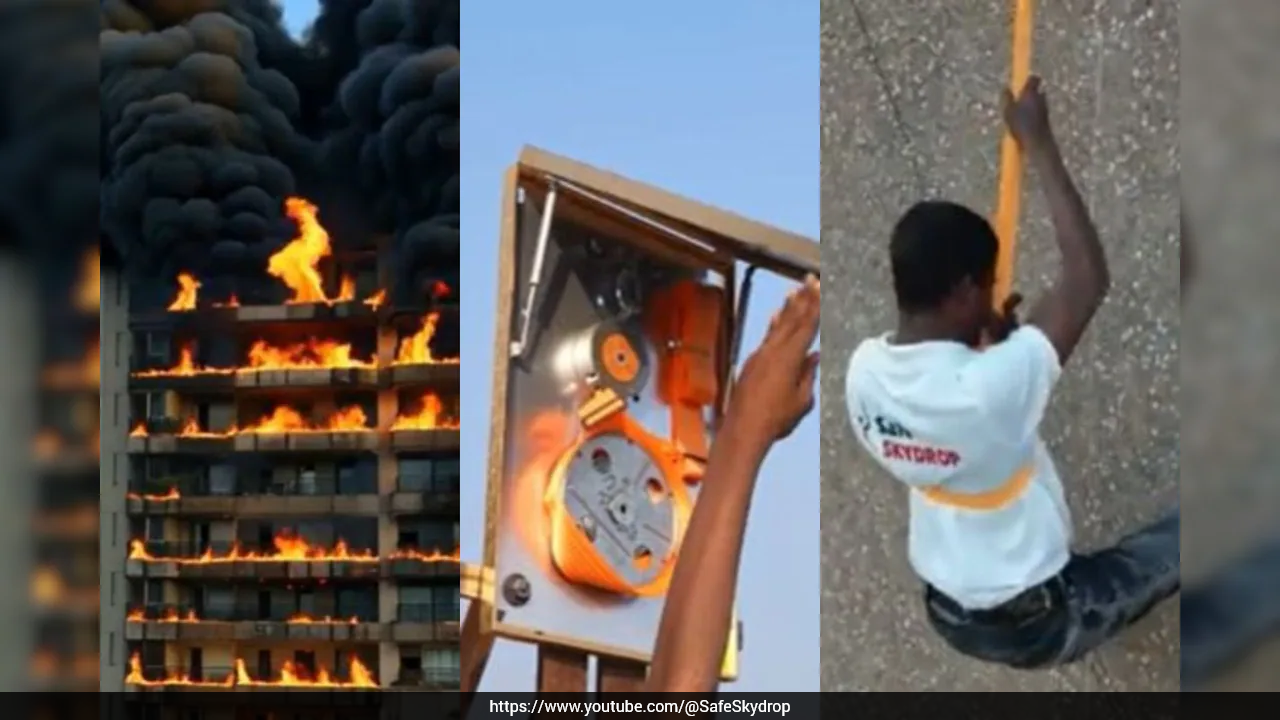
Imagine being trapped on the 14th floor of a high-rise residential complex as a massive fire breaks out. The elevators shut down instantly, the stairwells quickly choke with dense, suffocating smoke, and emergency teams are miles away battling city traffic. For millions of high-density apartment dwellers across India, this horrifying scenario has increasingly turned into reality over recent years, causing preventable casualties due to severely limited emergency exit options.
While multi-story societies routinely spend crores on luxury amenities, a critical gap remains in localized life-saving infrastructure. Addressing this dangerous deficit, Delhi-based safety startup Safe Skydrop has introduced India's first CE-certified personal vertical egress device. Designed specifically for high-rise emergency evacuations, the system offers an alternative route when traditional paths are completely compromised.
Watch the video here:
Imagine you're on the 14th floor. A fire or earthquake strikes, lifts stop working, and you're alone with your child.
— Rohit (@Iam_Rohit_G) June 20, 2026
How do you escape?
An Indian company, Skydrop, has introduced a balcony safety cable system with free training for every user, offering a potential emergency… pic.twitter.com/0NNkIdTs4i
The technology relies on an entirely mechanical, automatic speed-control descender housed inside an aluminum hydraulic frame, which is permanently anchored to a reinforced cement concrete (RCC) balcony wall. It functions without batteries or electricity, ensuring operational readiness during complete power failures or blackouts.
According to its website, during an emergency, the operation takes under a minute: the user opens the wall unit, dons a heavy-duty safety harness, clips into the industrial-grade steel carabiners, and steps over the balcony. The system's internal braking mechanism automatically regulates a smooth, hands-free descent to the ground at a controlled velocity of 0.8 to 1 meter per second. Crucially for families, the setup includes specialized child safety harnesses and allows multiple individuals to descend sequentially using a single customized galvanized steel cable, which can extend up to 99 meters high.
By providing mandatory hands-on training to every user alongside annual inspection protocols, the system attempts to transform high-rise safety from passive reliance on external emergency services into an active, independent survival tool.
Track Latest News Live on NDTV.com and get news updates from India and around the world

