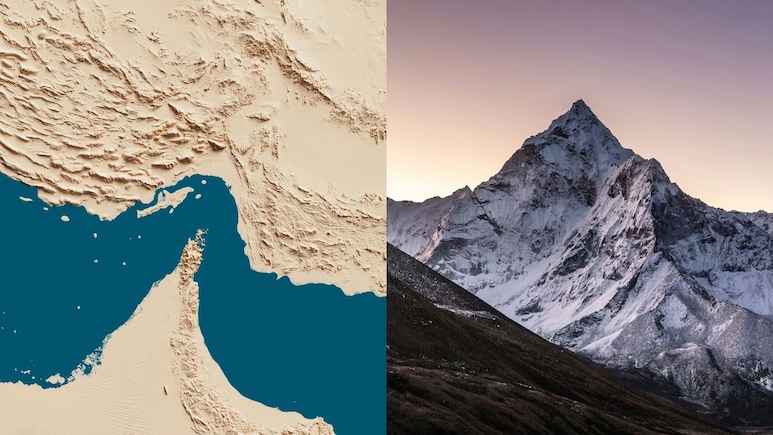
- The Strait of Hormuz formed from the shrinking Tethys Sea millions of years ago
- The Arabian Plate's collision with the Eurasian Plate created the Strait and Zagros Mountains
- The Tethys Sea's seabed was uplifted by the Indian Plate collision, forming the Himalayas
The Strait of Hormuz has been making headlines for a while now.
Tensions in the region have disrupted shipping through one of the world's most critical oil routes, a narrow passage that normally carries a significant share of global energy supplies. When something happens here, the ripple effects are immediate, from oil prices to geopolitics.
But here is the strange part. This narrow, high-stakes stretch of water exists because of an ocean that disappeared millions of years ago.
That ocean was the Tethys Sea.
The Geography Behind The Strait
To understand the Strait of Hormuz, you have to imagine the Earth as it was around 250 million years ago.
There were no continents as we know them today. Instead, there were massive landmasses: Laurasia in the north and Gondwana in the south: with the Tethys Sea stretching between them.
Over millions of years, the Earth's tectonic plates began to move. The Arabian Plate slowly pushed northwards, colliding with the Eurasian Plate. As this happened, parts of the Tethys Sea began to disappear, squeezed shut between these massive land blocks.
This collision did two important things.
First, it created the Zagros Mountains in present-day Iran, as the Earth's crust crumpled under pressure. Second, it narrowed what remained of the sea into a tight channel, the very passage we now call the Strait of Hormuz.
So the Strait is not just a random gap between landmasses. It is the last visible remnant of a much larger ocean, compressed over millions of years into a narrow exit point between the Persian Gulf and the Arabian Sea.
From Ocean Floor To The Roof Of The World
Now shift your focus thousands of kilometres east, to the Himalayas.
They may look worlds apart from the Strait of Hormuz, but they share the same origin story.
Around 50 to 40 million years ago, the Indian Plate began crashing into the Eurasian Plate. Unlike oceanic plates that slip beneath each other, these two were both continental-thick, buoyant, and stubborn. Instead of sinking, they crumpled.
What got trapped between them? The floor of the Tethys Sea.
Layer upon layer of marine sediment: limestone, shells, and ancient seabed deposits, was compressed, folded, and pushed upwards. Over time, this formed the Himalayas.
It is why, even today, you can find marine fossils high up in these mountains. The rocks at the top of Mount Everest were once at the bottom of an ocean.
The Common Link
The link between the Strait of Hormuz and the Himalayas becomes clearer when you look at the bigger picture.
The Tethys Sea did not disappear all at once. Its closure happened gradually, in different regions, over tens of millions of years.
- In the west, the Arabian Plate's collision narrowed the sea into what became the Strait of Hormuz
- In the east, the Indian Plate's collision lifted the seabed into the Himalayas
Same ocean, different outcomes.
In one place, it left behind a narrow, strategic waterway. In another, it created the highest mountain range on Earth.
Track Latest News Live on NDTV.com and get news updates from India and around the world
