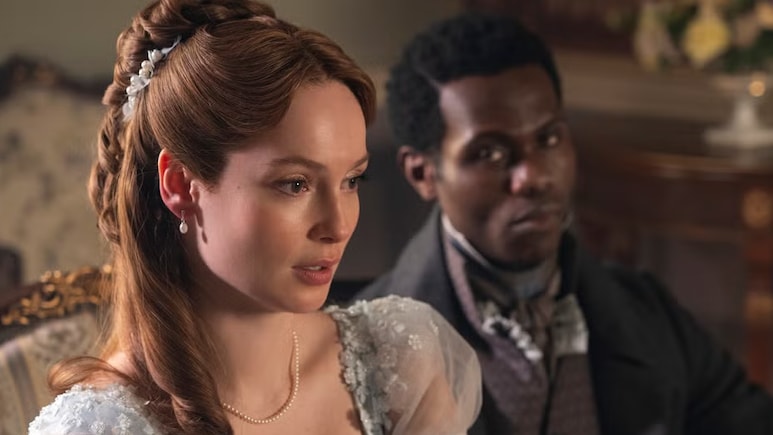
The corsets are tight, the string quartet is covering a pop anthem, and somewhere in Mayfair, a Bridgerton sibling is having earth-shattering sex.
Except this time, she isn't.
For a show that built its brand on flushed cheeks, heaving chests, and orchestral versions of modern bangers, Bridgerton Season 4 does something far more radical than another slow-burn seduction: it admits that sex isn't always seamless. That sometimes, it's quiet.
Awkward. Unfinished. And that sometimes, a woman does not reach her "pinnacle."
This season, that woman is Francesca Bridgerton.
The Season Of The "Pinnacle"
At the end of Season 3, Francesca (Hannah Dodd) quietly married John Stirling (Victor Alli), the Earl of Kilmartin. Their courtship was gentle, muted, built on companionship rather than smouldering glances across crowded ballrooms. It felt refreshingly introverted.
Season 4 takes us into their bedroom, and the mood follows suit.
Their intimacy is careful. Soft. Polite. John rolls over afterwards, satisfied. Francesca stares at the ceiling, unmoved.
The show does not dramatise this with explosive music or thunderclaps. It lingers in silence. In confusion. In something missing.

Francesca and John in a still from Bridgerton Season 4.
When John later asks her if she is achieving her "pinnacle," she replies quickly, "Yes, of course." The lie lands lightly, but heavily.
The word "pinnacle" becomes the season's quiet obsession. It is whispered in drawing rooms and tea conversations, discussed in coded language among women who were never properly taught the mechanics of their own bodies.
Francesca begins to worry that her inability to reach this elusive height may be why she is not yet pregnant. Pleasure and fertility collapse into one anxious question: Is something wrong with me?
Eventually, she confesses, "I have not ever, and I am starting to think it is why we are not yet with child. Forgive me, I do not know what is wrong with me."
John, in a moment that feels almost anachronistically evolved, reassures her, "Whatever you wish for in life, I will always endeavour to give it to you. Children, pinnacles. But I also hope you know you are just right as you are and we are just right as we are, right now."
The Orgasm Gap Enters Mayfair
Francesca's storyline pulls a very contemporary issue into Regency London: the orgasm gap.
Dr Aditi Mehra, a clinical sexologist and relationship therapist, explained, "The orgasm gap refers to the consistent disparity in orgasm frequency between men and women during partnered sex, particularly in heterosexual encounters. Research over decades shows that heterosexual men report orgasm in 85-95% of encounters, while heterosexual women report significantly lower rates. Yes, it absolutely still exists."
Why does it persist, even now?
"It persists due to three main reasons: overemphasis on penetration as 'real sex,' limited understanding of clitoral anatomy, and cultural conditioning that prioritises male pleasure, she added.
In Season 4, Francesca's confusion is not about desire. It is about mechanics and misinformation. Like many women, she assumes penetration should be sufficient.
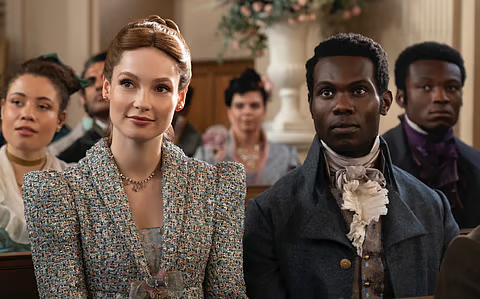
A still from Bridgerton Season 4.
But as Dr Mehra noted, "The vast majority of women require direct or indirect clitoral stimulation to orgasm. Only a minority reliably orgasm from penetration alone. It is not only common, but it is also statistically typical."
The tragedy in Bridgerton is not dysfunction. It is silence.
Performance, Shame, And The Art Of Faking It
Francesca does what countless women have done before her: she performs pleasure.
The scene is painfully recognisable. Determined to "fix" things, she practically pounces on John at tea time, trying to manufacture passion. Later, she delivers a convincing imitation of ecstasy, her best Sally Albright impression, only to be met with unexpected gentleness.
"You do not have to perform for my sake," John tells her.
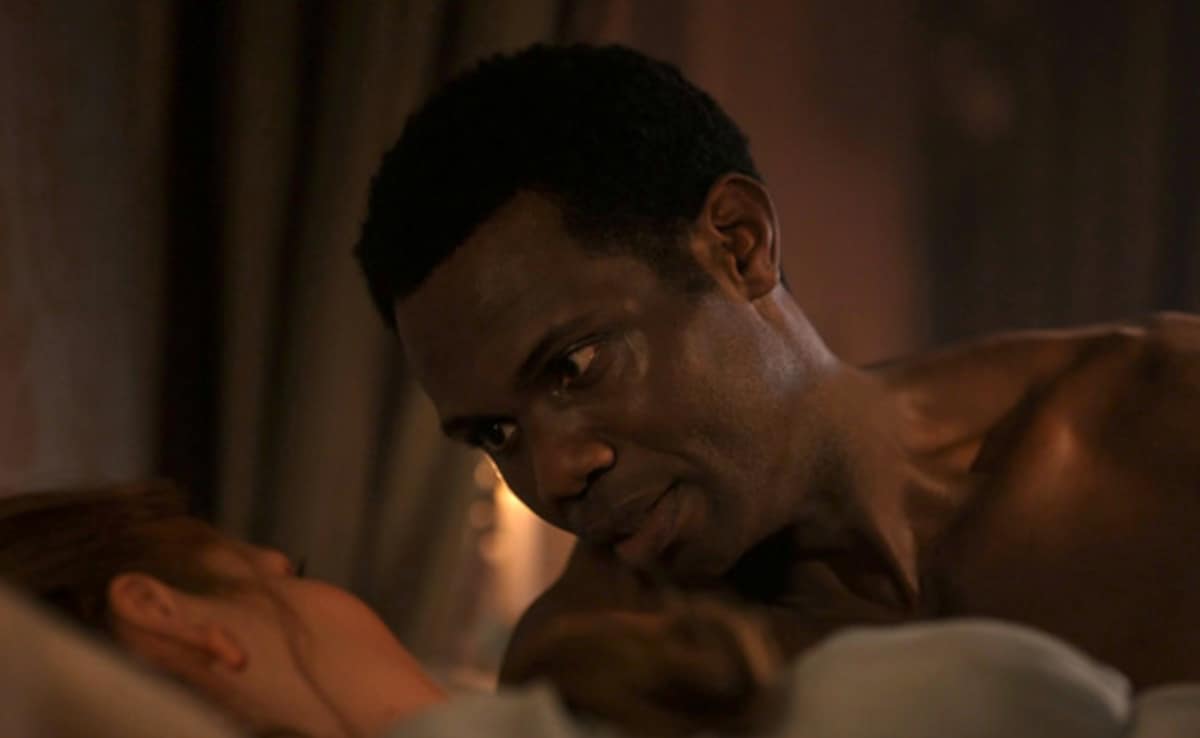
A still from Bridgerton Season 4.
Dr Kavita Rao, a psychosexual therapist, said this moment is painfully real.
She shared, "Women fake orgasms primarily to protect their partner's ego, avoid conflict, or end sex that isn't pleasurable. Many women are socialised to prioritise harmony over honesty."
The long-term cost?
"Faking reinforces ineffective sexual patterns. It trains the partner to repeat what doesn't work. Over time, it can create resentment and emotional distance," she added.
Francesca's panic: the sense that everyone else is "doing it right" echoes modern anxieties. Penelope's wildly enthusiastic married life only sharpens the contrast.
"Shame grows in the gap between expectation and reality. Many women assume something is wrong with them rather than questioning the situation or the lack of communication," Dr Rao added.
From Daphne's Fantasy To Francesca's Reality
To understand how significant this shift is, one must look back at Season 1.
In Season 1, Daphne's sexual awakening unfolded under the guidance of Simon, Duke of Hastings. He explains orgasm as a "pinnacle," a "release," instructing her on how to touch herself. Soon after, she discovers pleasure almost magically.

Daphne and Simon, the lead couple of Bridgerton Season 1.
But critics pointed out the imbalance: her awakening is mediated entirely through a man. The camera lingers on his climax more than hers. Her orgasm feels swift, cinematic, almost mythic.
Season 4 corrects that fantasy.
Dr Nikhil Suri, a sexual health educator and researcher, called the shift significant, "Showing difficulty disrupts the fantasy that good chemistry equals automatic climax. It validates real experiences."
He added, "Unrealistic portrayals create performance anxiety. Women may think, 'Why isn't this happening for me?' Men may think, 'I should automatically know what to do.' Both are harmful myths."
Where Daphne bloomed instantly, Francesca hesitates. Where Season 1 idealised instinct, Season 4 explores learning.
Communication, The Most Radical Intimacy
Perhaps the most striking element of this season is not the lack of orgasm, but the conversation about it.
"Sex is hard to talk about because it touches identity, desirability, and competence. Many people equate sexual feedback with criticism," said Dr Mehra.
Francesca and John are introverts. They have known each other for barely a year. Their attempts at communication feel halting, imperfect. And yet, they try.
According to Dr Suri, "A healthy response sounds like: 'Thank you for telling me. I want us both to feel good. Let's figure this out.' Curiosity instead of ego."
John's response, "You do not have to perform for my sake", models precisely that.
In a culture where sex education remains limited, and conversations around female pleasure are often reduced to whispers, such representation carries weight.
"Many people have never seen examples of sexual communication that are gentle and nonjudgmental. Showing supportive responses helps challenge the idea that women should simply endure discomfort or stay quiet," Dr Rao explained.
Why This Storyline Matters
Bridgerton is not a documentary. Its hair is flawless. Its men yearn beautifully. Its lighting flatters everyone.
And yet, within this fantasy, something quietly radical is happening: a mainstream global series is acknowledging that female pleasure is neither automatic nor guaranteed, and that the absence of orgasm is not a personal failure.
Dr Mehra offers perhaps the most important takeaway: "Pleasure is not automatic. It's collaborative. Nothing is 'wrong' with a woman who does not orgasm from penetration alone. But if one partner consistently never experiences pleasure, that deserves attention."
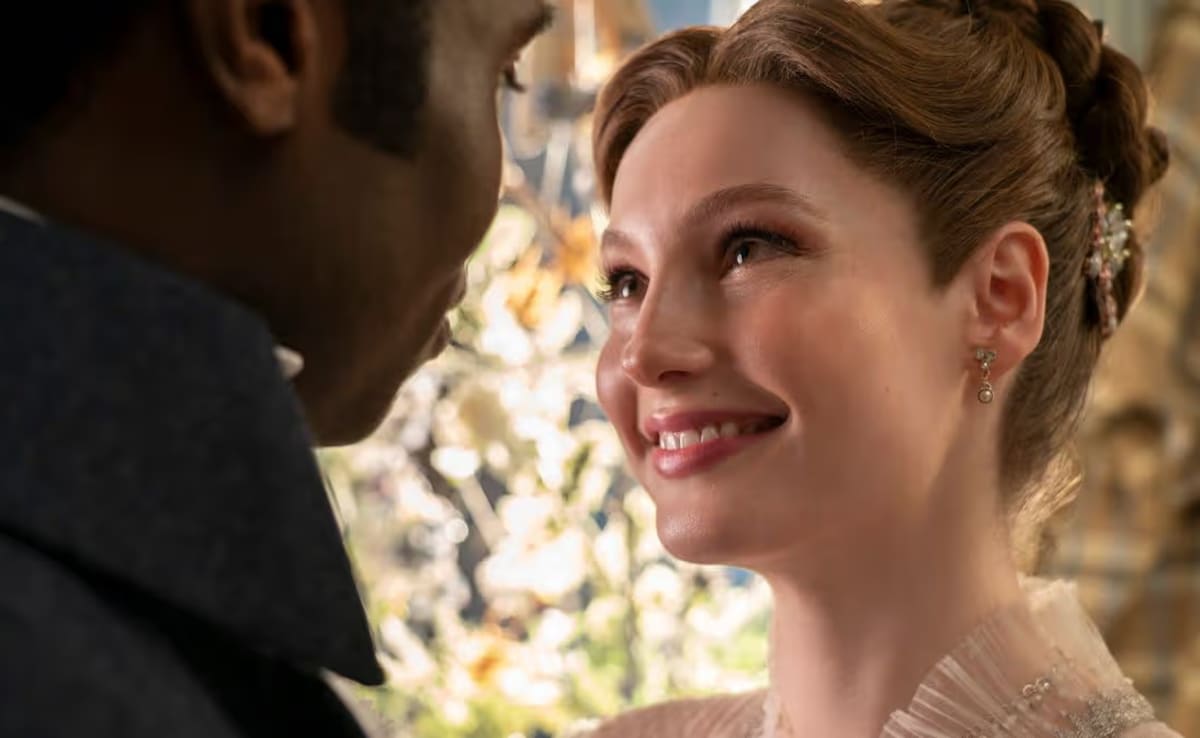
A still from Bridgerton Season 4.
Francesca's arc does not end with a dramatic breakthrough, at least not yet. It ends with honesty. With vulnerability. With a couple willing to try again.
For a show that once equated passion with perfection, that may be its most mature evolution.
In Mayfair this season, the true scandal is not gossip, it is silence. And the boldest rebellion is not seduction, but saying: I have not ever.
And perhaps, finally, being heard.
Track Latest News Live on NDTV.com and get news updates from India and around the world
