




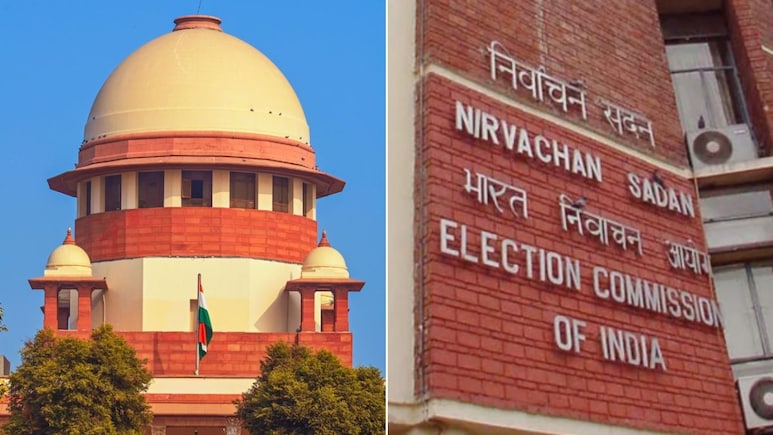
The Supreme Court on Wednesday agreed to examine a plea seeking recall of its recent split verdict on whether challenges to the 2023 law governing the appointment of the Chief Election Commissioner (CEC) and Election Commissioners (ECs) should be referred to a larger Constitution bench.
On September 23, a bench of Justices Dipankar Datta and Satish Chandra Sharma gave split opinions on whether a batch of pleas challenging the validity of a 2023 law that excludes the Chief Justice of India (CJI) from the selection panel should be referred to a larger Constitution bench.
Justice Datta declined the Centre's request for such a reference, while Justice Sharma favoured placing the matter before a larger bench.
On Wednesday, the recall application was mentioned before a bench comprising the CJI and Justices Joymalya Bagchi and V Mohana by senior advocate Gopal Sankaranarayanan.
The plea has pointed out that the engagement of Justice Satish Chandra Sharma's son as a lawyer with ECI was not disclosed during the five hearings in the matter. It has raised an apprehension of bias on part of Justice Sharma.
The plea has stated had the engagement of his son as standing counsel for the ECI been disclosed during the hearings, they would have requested Justice Sharma's recusal from the case.
"We will examine and take a call," the CJI said.
The CJI also said that he had read that a curative petition has also been filed. Sankaranarayanan answered in the affirmative, and said it has been filed by another party.
Earlier a curative petition was filed in the Supreme Court after media reports said that the son of Justice Satish Chandra Sharma, who was part of the bench that delivered the split verdict, is the poll panel's standing counsel before the Madhya Pradesh High Court.
The plea raised grounds of "reasonable apprehension of bias and propriety" and stated that after the pronouncement of the split verdict, the petitioner came to know about Justice Sharma's son being on the EC's legal panel.
It added that a judge cannot decide a case in which a family member of the judge is representing one of the parties.
The plea further contended that the case is fully covered by the 'reasonable likelihood of bias' and 'real danger test' laid down by the Supreme Court and that Justice Sharma's presence on the bench vitiated the September 23 decision.
Track Latest News Live on NDTV.com and get news updates from India and around the world

