





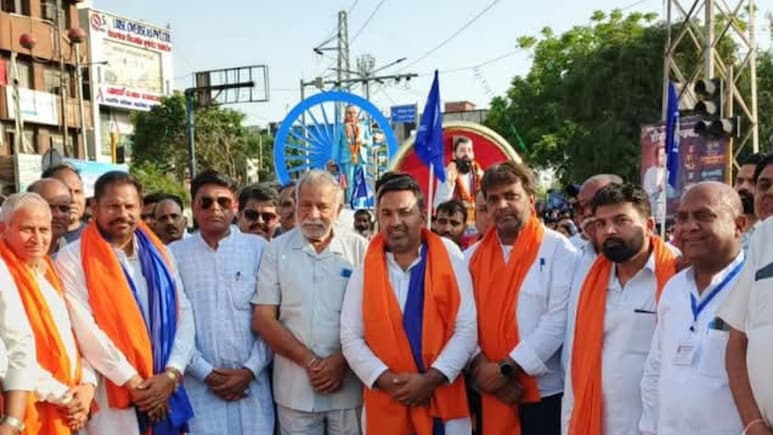
Punjab has nearly 32 per cent of the Dalit population, the largest in the country. It is ironic that despite a sizeable share in the population and dominance in the electorate, Dalits remain sidelined on various fronts, including politics, education, economics and social issues. They lack adequate representation in the cabinet; 96.6 per cent of them do not own agricultural land, and despite following Sikhism, they are subject to untouchability and harsh treatment.
Out of a total of 117 assembly constituencies, 34 are reserved for the Dalit community in Punjab. Their numbers matter in the Vidhan Sabha, but they have never ruled Punjab because they are fragmented and divided by sub-caste and even on religious grounds.
Beyond the fragmentation of the Dalit vote, Jat Sikhs have maintained long-standing political and social control due to their ownership of agricultural land and influence over key rural institutions.
Bhagwant Mann's cabinet has five Dalit cabinet ministers, including Harpal Singh Cheema, Dr Baljit Kaur, Lal Chand Kataruchak, Ravjot Singh and Mohinder Bhagat. This constitutes 27.78 per cent of 18 ministers, including Chief Minister Bhagwat Mann. The Congress government formed in 2022 had three Dalit Cabinet ministers, then four after Charanjit Singh Channi, the first Dalit Chief Minister, formed the government. This represented 16.67 per cent to 22 per cent respectively. The SAD-BJP government in 2017 had the same percentage of Dalit cabinet ministers.
The Congress in 2022 made Charanjit Singh Channi, a Dalit, Chief Minister to win over the Dalit voters, but that backfired as the party was only able to get 31 per cent of Dalit community votes. While the AAP bagged a maximum of 38 per cent Dalit votes, SAD-BSP and BJP won 25 per cent and 6 per cent votes, respectively.
Punjab's only Dalit Chief Minister Charanjit Channi was last year seen pleading for a representation for the Dalit community in the state party organisation, which the upper-caste Jat community has hijacked.
The Jat community, despite only having a 20 to 22 per cent share in the population, continues to rule all communities, including the Dalit community. Surprisingly, the Bahujan Samaj Party (BSP), which has roots in Punjab, has never formed a government in the state. The Dalit community has expressed its views through mainstream political parties: the Congress, Shiromani Akali Dal or AAP. BSP's vote share, which was 4.3 per cent in 2012, slipped to 1.5 per cent in 2017 and 1.78 per cent in 2022, showing the party failed to win the trust of the Dalit community, which was its primary votebank.
The Voting Myth: Why a 32% Population Share Hasn't Led to Dalit Dominance in Punjab
Despite a 31.94 per cent share in the population, Dalits own just 3.5 per cent of agricultural land in Punjab, which is estimated at around 4.2 million hectares and constitutes nearly 84 per cent of the total geographical area.
Although Rule 6 of the Punjab Village Common Land (Regulation) Act 1964 has a provision to reserve one-third of cultivable Shamlat (village common land) for the Dalit community, that provision remains on paper. Being landless has hindered the economic upliftment of the state's Dalit community. Since 73.3 per cent of Dalits live in villages and are landless, their only way to earn a livelihood is to work as farm labourers. Not owning land also blocked this community's foreign aspirations, unlike the landowners who could readily mortgage their land and move abroad.
A state where 58 per cent of people profess Sikhism, which preaches total human equality and rejects the caste system, casteism is still a reality where Dalits were not welcome at Gurdwaras set up by the upper caste people. A study shows Dalits who converted to Sikhism were compelled to establish over 10,000 Gurdwaras and Ravidas Deras to assert religious and social autonomy. This has also resulted in mass conversions of Dalits to Christianity.
However, the Doaba region is an exception where Dalits form a majority. Some villages there have a Dalit population between 40 and 65 per cent. Following access to urban lifestyle, better education and non-agricultural occupations, Doaba Dalits were able to migrate to foreign countries, which reduced their dependence on traditional village power structures, unlike those seen in the Malwa region.
"There is an urban and rural divide among the Dalit Communities. Those living in rural areas remain economically and socially weak. Migrations from the Doaba region have resulted in higher foreign remittances, which elevated the economic status of Dalit communities like Ad Dharmis and Chamars," a study published in the National Geographical Journal of India, titled "Dalit Population in India: A Case of Punjab" by Surya Kanta confirms this.
How Economic and Social Exclusion Trapped the Dalit Community
Dalit community is less literate than non-Dalit communities. The 2011 Census put the State's Dalit literacy rate at 64.81 per cent compared to non-Dalits, which was 75.84 per cent. Despite their presence in Punjab, Dalit literacy is even lower than the national average of 66.7 per cent. Education trends reveal a notable disparity between genders. 70.66 per cent of Dalit males were educated; only 58.39 per cent of females were educated.
Ad Dharmis, who are 11.5 per cent of the total Dalit population, are concentrated primarily in the Doaba region; this group records one of the highest literacy rates within the Dalit population at 76.4%-matching or exceeding the state's general average.
The Dalit community comprising Chamars, Ramdasia or Ravidassia constitute 23.5 per cent of the state's Dalit population and has a literacy rate between 68 and 72 per cent. The Balmiki community, with 9.8 per cent of the electorate, is third, with a literacy rate between 52 and 56 per cent.
Mazhabi Sikh community, the converted Dalits who adopted Sikhism and were called Rangrete Guru ke bete by Guru Gobind Singh Ji, constitutes 29.7 per cent of the Dalit community and has a 42.3 per cent literacy rate. The least educated among all Dalit communities are nomadic and marginalised groups like Bazigars, Bauria, Sansai and Dumna, who constitute 10 to 15 per cent of the total Dalit population and have a literacy rate below 40 per cent.
Doaba region is home to the Ad Dharmi community; the Majha Region, is the stronghold of Mazhabi Sikhs; the Malwa is jointly dominated by the Mazhabi Sikhs and Chamars. Shahid Bhagat Singh Nagar has the highest Dalit population at 42.5 per cent.
Track Latest News Live on NDTV.com and get news updates from India and around the world

