



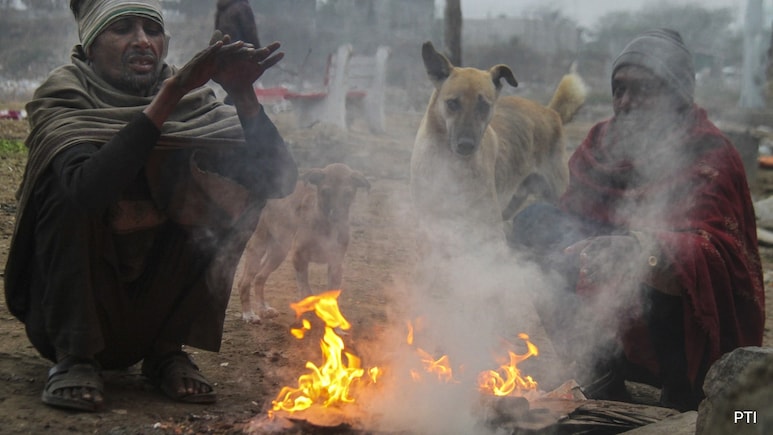
- Gurugram recorded its coldest night in decades at 0.6 degrees Celsius on Monday
- Cold wave caused by lack of western disturbance and cold Himalayan winds over north India, said an expert
- Frost and zero visibility reported across north India with dense fog expected to persist
At 0.6 degrees Celsius, Gurugram recorded its coldest night in decades on Monday, while Delhi recorded a minimum temperature of 3 degrees Celsius on Tuesday morning, a degree lesser than Shimla. The sharp dip in temperatures came as north India continued to experience a cold wave.
Experts attributed the chill to the lack of western disturbance combined with winds coming from the Himalayas. IMD senior scientist Naresh Kumar told NDTV, "There is no western disturbance over northwest India, and cold winds are incoming from the Himalayas with a vertical extension of 5-6 kilometres. Thus, the temperatures are much lesser than normal."
The icy air has accumulated in the plains, intensifying the cold wave and leading to zero visibility and frost in many areas across north India. Further, as clouds trap heat emanating from the ground, many hill stations are warmer than Delhi-NCR.
Kumar said that cold wave to severe cold wave conditions are very likely to continue over Himachal Pradesh, Punjab, Haryana, Delhi, Rajasthan, Jharkhand and Odisha during next 2-3 days and abate thereafter. Further, dense fog conditions very likely to continue during morning hours over northwest India and Bihar during next 5-6 days. He added that an active western disturbance is expected to impact north west India, causing weather activity to begin in Jammu and Kashmir, Himachal Pradesh and Uttarakhand.
Punjab's Bathinda recorded a low of 0.6 degrees Celsius, while Fatehpur in Rajasthan's Sikar district crossed the freezing point threshold to reach minus 0.4 degrees on Monday. A layer of frost covered surfaces in NCR, including in Faridabad and Rewari, leading to ground frost, particularly visible on farms and vehicles.
In Jammu and Kashmir, parts of Srinagar's Dal Lake and other water bodies froze as Chilla-i-kalan, the harshest winter period, brought freezing temperatures.
In Uttar Pradesh, cold weather conditions prevailed across large parts, with day temperatures in major cities ranging between 13 degrees Celsius and around 19 degrees Celsius.
According to the Meteorological Department officials, a weak Wester Disturbance is likely to affect the weather system in the Kashmir valley on Friday, followed by a stronger system three days later. This has raised hopes of snowfall in the region, especially in the plains, which has seen deficient precipitation this winter.
Track Latest News Live on NDTV.com and get news updates from India and around the world

