





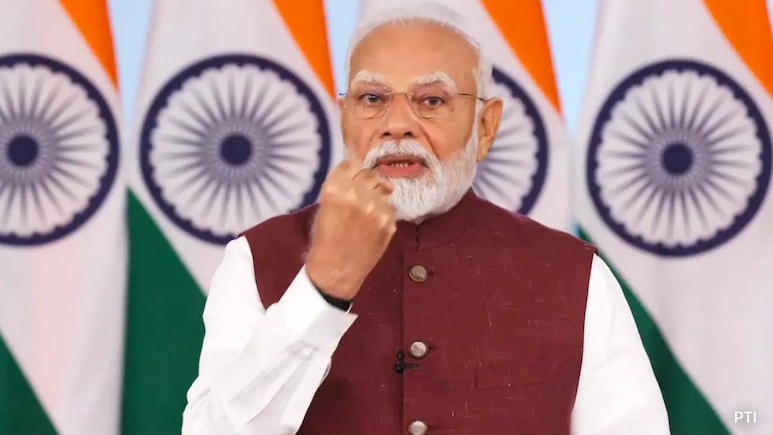
Prime Minister Narendra Modi on Sunday hailed the latest Budget and a spate of global trade deals signed by his government as foundations for Viksit Bharat, and urged the private sector to step in "more aggressively" and "boldly" now.
In a wide-ranging interview with PTI, PM Modi blasted the UPA government for failing to achieve substantial trade agreements, and asserted that women will play the "most important role" in Viksit Bharat.
He said political stability and predictability have restored investor confidence in India and that stronger manufacturing, services and MSMEs have enabled it to negotiate free trade pacts with 38 countries from a "position of strength." He listed three top priorities for the next three decades--more structural reforms, deepening of innovation in technology, manufacturing and services, and simpler governance so that citizens and businesses can operate with greater ease and trust.
Asked if he is satisfied with the progress made by India's Reform Express, he said "I must say that by temperament I am never fully satisfied...." "I believe public life demands certain constructive restlessness. At the same time it is important to acknowledge the scale of progress achieved in the journey of Reform Express." He was asked if India is ready to take the moonshot for Viksit Bharat and was it a now or never situation that led his government to create a Budget that was not typically a 'Bahi Khata' document.
"First of all I would respectfully say that none of our budgets has been made with an attitude of creating a run-of-the-mill Bahi Khata......if one takes a closer look at my approach in the last 25 years it becomes clear that our work does not happen in bits and pieces." The prime minister said there is a broader strategy, a plan of action and an effective implementation that reflects the 'whole of the nation' thinking, continuity of purpose and a long-term vision, progressively unfolding step by step, year after year.
"So, this is not a 'now or never' moment born out of compulsion. It is a 'we are ready' moment born out of preparation and inspiration. This (2026-27) Budget reflects this yearning to become a developed nation." In the written interview, PM Modi also said his government has used its years in office to plug "structural gaps left behind by earlier administrations", pursued bold reforms and laid the foundations for a developed India.
India has in quick succession concluded landmark trade deals with the European Union and the United Kingdom, securing sweeping tariff reductions and expanded market access for goods and services, while also reaching an understanding with the United States to ease tariff frictions and deepen trade engagement. Together, the moves are seen as significantly improving access for Indian exporters in advanced markets and reinforcing New Delhi's push to integrate more closely with global supply chains.
"We now have FTAs with 38 partner nations, an unprecedented milestone in India's trade history. A remarkable feature of these trade agreements is that they span continents and include countries of varying economic strength," PM Modi said.
"There is a new confidence in our nation. Our national character has revealed itself even in times of different kinds of challenges and we are a bright spot of growth even in difficult global circumstances." Calling productive spending a hallmark of his government, PM Modi said the Union Budget deliberately avoided short-term populism and instead channelled record capital outlays into infrastructure to drive jobs and sustainable growth.
"Taken together, Budget 2026 is all about strengthening the manufacturing ecosystem, expanding value addition and creating conditions for skill and scale to come together. The end result will be Aatmanirbharta and massive job creation." PM Modi said the next leap toward Viksit Bharat by 2047 will depend on how boldly Indian enterprise invests in innovation, builds long-term capacity and positions itself as a globally competitive, technologically confident and socially responsible engine of growth.
The prime minister urged the dynamic private corporate sector to invest "more aggressively" in research and development, adopt frontier technologies, deepen supply-chain capabilities and compete on quality and productivity rather than on protected margins.
"Policy can only create the enabling framework. The next phase of transformation requires a decisive response from the private sector. Incentives and tariff preferences can catalyse growth, but durable competitiveness must rest on innovation, efficiency and scale." "Equally, as productivity rises, the gains must be shared fairly between workers, shareholders and owner-managers. Sustainable growth requires social legitimacy. Rising real wages, skill upgrading, and stable employment reinforce domestic demand and social cohesion, which, in turn, support long-term investment." On the hike in Defence budget and military modernisation, PM Modi said the benefits of a decade of defence reforms were evident during 'Operation Sindoor', and asserted that India has to be prepared at all times to deal with security challenges.
Leveraging fresh Budget incentives to turbocharge investments in data centres, PM Modi also pitched India as a global hub for digital infrastructure and artificial intelligence, saying the country is ready to host the world's data and lead the next wave of the technology revolution.
His pitch came a day before India hosts the global assembly of tech tycoons, AI business leaders, policy makers, investors and innovators.
The Global AI Impact Summit from February 16 to 20 will see a host of heads of state and government, including France's Emmanuel Macron and Brazil's Luiz Inacio Lula da Silva, along with representatives of more than 60 other countries, convene in New Delhi.
(Except for the headline, this story has not been edited by NDTV staff and is published from a syndicated feed.)
Track Latest News Live on NDTV.com and get news updates from India and around the world

