





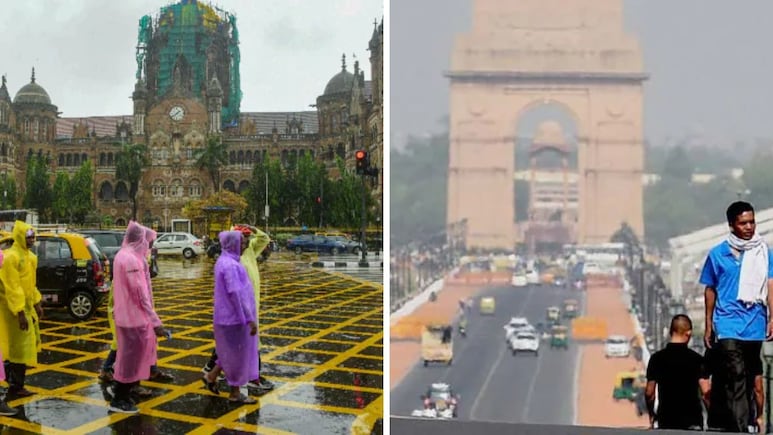
- Monsoon rainfall in India shows significant regional disparities between Mumbai and Delhi
- Mumbai receives heavy rain due to proximity to Arabian Sea and active weather systems
- Delhi's rainfall is delayed as moisture reduces traveling 1400 km inland and systems lag
The monsoon in India started off with a huge rainfall deficit, close to 40 per cent. As parts of India experience heavy rainfall, cloudbursts, localised flash floods, many other parts still experience drier spells. These spells raise significant questions about the disparity in rainfall received. For instance, while parts of Mumbai see continuous and heavy rainfall, the national capital remains relatively dry with light pours.
But experts argue that this distinction between showers received between Delhi and Mumbai has always existed. The difference is often attributed to a host of factors, the most important of which being geography and weather systems.
Geographical Differences
The most important difference remains the city and their location's proximity to the ocean. Mumbai acts as the "front door" and lies right on the coast of the Arabian Sea. Humid winds infused with moisture consistently feed into the west coast directly from the water. As these clouds come in contact with land and rise against the Western Ghats, they sprinkle large amounts of water over Mumbai.
On the other hand, there is the national capital of Delhi which lies deep in North India, roughly 1400 kms from Mumbai. By the time monsoon clouds travel hundreds of kilometres from the oceans to the capital, they have usually already shed most of their moisture over other states, thereby triggering later and fewer rainfall.
Speaking on the disparity in rainfall received, Mahesh Palawat, Vice President of Meteorology & Climate Change at Skymet Weather, said, "There is a trough extending from South Sindh to Odisha across North Maharashtra and Madhya Pradesh leading to intense weather activities over the areas including Mumbai."
Speaking about Delhi, Palawat added, "Delhi receives rain due to the moment of monsoon trough, which is at present over Central India. This trough will gradually move towards Indo-Gangetic plains by July 5th and Delhi as well as Uttar Pradesh, Bihar, Jharkhand and West Bengal will be receiving rain."
Weather System
Not just the locations but the weather systems are also something that experts point at while noting key differences.
As per environmentalist Siddhant Sarang, Mumbai is home to an organised system that Delhi misses out on. Pointing out the presence of an active weather system in Mumbai, Sarang says, "There is an active weather system sitting off the west coast right now, organizing the incoming sea winds into continuous, heavy rain the moment they hit the coast and rise against the Ghats behind the city. The entire difference is that Mumbai has a system doing the work of turning moisture into rain, Delhi is still waiting for one to show up."
The El Nino effect
The El Nino phenomenon has received widespread attention owing to its role in India's overall monsoon deficit. Experts believe that El Nino has likely played a supporting role, though it is not the only factor behind the delayed and weak monsoon over Delhi.
Speaking on the impact that El Nino may have had, Palawat said, "During an El Nino year, the central and eastern Pacific Ocean becomes warmer than normal. This alters the global atmospheric circulation, often weakening the cross-equatorial flow and the low-level southwesterly monsoon winds that transport moisture from the Arabian Sea and the Bay of Bengal into the Indian subcontinent."
He explained, "This season, we have seen that the monsoon current over northwest India, including Delhi, has been relatively sluggish at times. The weaker monsoon flow meant moisture transport was not sustained, delaying the advance of the monsoon and reducing rainfall activity."
However, Palawat still insists that the delay in such a pattern was not the work of El Nino alone. "El Nino is only one of several influencing factors. Intraseasonal oscillations, the position of the monsoon trough, the strength of low-pressure systems over the Bay of Bengal, and the Madden-Julian Oscillation also significantly affect rainfall over Delhi. So, while El Nino may have weakened the background monsoon circulation, the day-to-day weather over Delhi depends on a combination of these atmospheric systems."
Monsoon Misconceptions
A common misconception that citizens hold is that the "arrival" of the monsoon guarantees rain. The India Meteorological Department (IMD) officially declared the arrival of the monsoon in Delhi on July 2, but the capital's skies have remained largely empty, facing a staggering rainfall deficit in some pockets.
Environmentalist Siddhant Sarang explains the phenomenon. "People assume the monsoon 'arriving' in a city means it starts raining there, but that is not really how it works. The declaration is based on changing wind directions and humidity levels, not on rain actually falling. For a city to get sustained rain, it needs an actual weather system, a pocket of low pressure that organizes the incoming moisture into rain-bearing clouds and holds it over the region."
Concerns
While both the cities hold distinct weather patterns, experts warn that the patterns reflect on a growing pattern of climate volatility.
Reflecting on the larger picture, Siddhant Sarang noted, "This June was among the driest starts to the monsoon season the country has recorded since 1901. This was largely because the usual cloud and rain-bearing pulses from the ocean did not show up on schedule, and the low-pressure systems that typically pull moisture inland failed to form."
He added, "A dry June followed by such an intense July is exactly the kind of volatility climate scientists have been warning would become more common as the atmosphere and oceans continue to warm. Consequently, the gap between a city that receives a triggering weather system and one that does not is sharper than usual this year."
Highlighting the distinct vulnerabilities of both cities, Sarang cautioned that in Mumbai the problem lay not just with rainfall patterns but also with management mechanisms. "Drains and low-lying colonies were never built to handle water this intense, leading to flooded homes and loss of life within hours.
Talking about Delhi, the environmentalist added, "Delhi's dry spell may look harmless from the outside, but it is quietly exacerbating the water stress the city already struggles with annually. "
As India experiences monsoon, experts believe that nature acts unevenly leaving cities unprepared for whichever side of extreme that climate hits them with.
Track Latest News Live on NDTV.com and get news updates from India and around the world

