





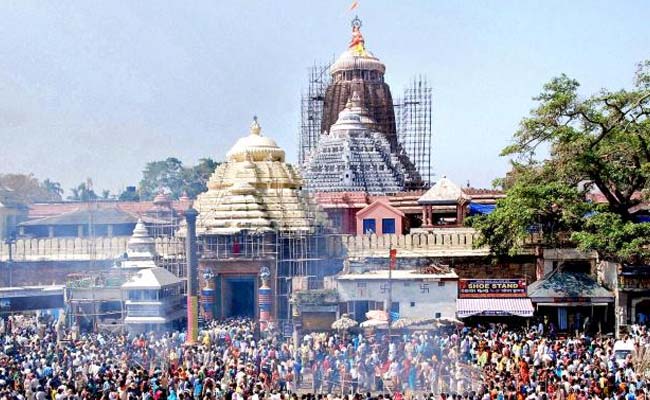
A Ground Penetrating Radar (GPR) survey conducted during the execution of the Srimandir Parikrama project has revealed significant archaeological features, suggesting that an extensive ancient settlement lies beneath the city of Puri.
The survey, commissioned following public concerns regarding excavations at the Emar Math, has identified what experts describe as “substantial subsurface structural remains” extending beyond the immediate temple periphery.
The findings have brought to light the existence of a possible urban settlement that spans multiple locations across the city. The survey was initiated after earlier excavation work at the Emar Math led to the discovery of relics, including two broken lion statues, believed to date back to the Ganga dynasty.
These findings prompted a demand for a scientific assessment, leading authorities to engage experts for a subsurface mapping exercise.
In a specific zone identified as “Area-H,” which encompasses the Emar Math, the Nrusingha Temple, and the Budhi Ma Temple, at least 43 potential subsurface heritage locations have been detected.
The report indicates the presence of various artefacts, including clay and metal vessels, which appear to be remnants of daily life from earlier historical periods. Structural formations within a confined area of approximately 21.6 square metres were also recorded during the mapping process.
A draft report of the GPR survey, conducted by IIT Gandhinagar in 2022, highlights anomalies indicative of structural remains, including a significant 30-foot-long wall and a chamber measuring 7.6 metres by 3 metres.
There is ongoing speculation that these chambers may have once housed historical treasures or idols, particularly given the site's association with the East Ganga Dynasty, which ruled the region from the early 5th century to the early 15th century.
Among the most significant revelations is the detection of a possible subterranean passage linking the Jagannath Temple to the sea. While local legends have long mentioned such a tunnel, the scientific survey has now provided data suggesting the existence of a passage or tunnel-like structure.
Archaeologists, speaking on the condition of anonymity, said that such tunnels in ancient urban planning were typically used either as secret exit passages or as sophisticated drainage channels.
While the findings have significant implications for heritage conservation and future urban planning in Puri, they have also led to calls for greater administrative transparency. Senior temple official Binayak Das Mohapatra said, “Emar Mutt carries deep historical and cultural significance. Gold and silver bricks have been found within its premises in the past. It is also believed that Ramanuja himself once visited this place. If any such findings exist and the government possesses an official report on the matter, that information should be made public without delay. Moreover, with plans underway to establish a library and other facilities there, it is essential to initiate a proper archaeological survey at the earliest. If the site indeed holds ancient or historically valuable elements, they deserve to be properly documented and preserved.”
The discovery comes amid varied reports regarding hidden chambers in the shrine's Ratna Bhandar, though some of these claims were recently dismissed by state officials. Nevertheless, the GPR data confirms that the area surrounding the temple is dense with archaeological remains.
The presence of these structures suggests that the modern city of Puri sits directly atop a much older, sophisticated urban layout that may require dedicated archaeological intervention before further construction proceeds.
With inputs from Dev Kumar
Track Latest News Live on NDTV.com and get news updates from India and around the world

