





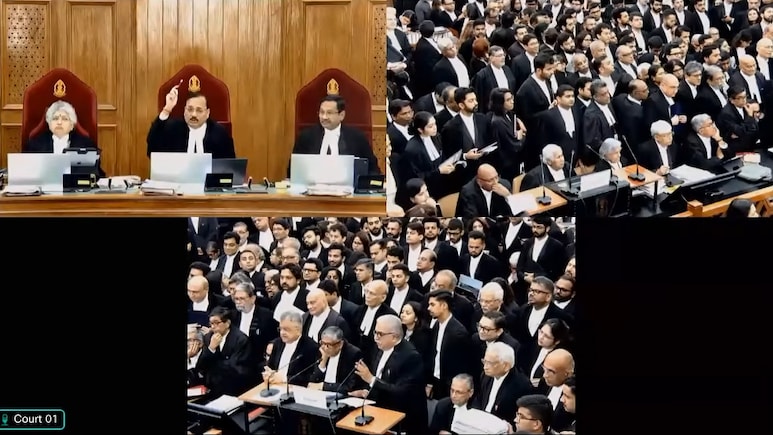
A light moment marked the eighth day of hearing in the Sabarimala Temple review case when Supreme Court judge Justice BV Nagarathna remarked that information cannot be accepted from "WhatsApp University".
The comment came while a nine-judge Constitution bench was hearing petitions related to discrimination against women at religious places, including the Sabarimala Temple in Kerala, and to the ambit and scope of religious freedom practised by multiple faiths.
During the hearing by a bench composed of Chief Justice Surya Kant and Justices BV Nagarathna, MM Sundresh, Ahsanuddin Amanullah, Aravind Kumar, Augustine George Masih, Prasanna B Varale, R Mahadevan, and Joymalya Bagchi, senior advocate Neeraj Kishan Kaul told the top court that there should be no hesitation in accepting knowledge and wisdom irrespective of the source. He was referring to an article by Congress MP Shashi Tharoor, which called for judicial restraint in matters involving religious relief.
Responding to this, Chief Justice of India Surya Kant said that while the court respects eminent thinkers and authors, such writings remain personal opinions.
"Personal opinion is personal opinion," he noted, indicating that such views do not have binding value on judicial decisions.
Kaul, who was representing the Dawoodi Bohra community head in a petition challenging the practice of excommunication, then argued that there was "no harm in drawing knowledge and wisdom from all sources".
"If knowledge and wisdom come from any source, any country, any university, they should be welcomed. We are far too rich as a civilisation not to accept all forms of knowledge and information," he said.
Justice Nagarathna, in a lighter vein, responded, "But not from WhatsApp University", drawing laughter in the courtroom.
Kaul said he was not getting into that.
"I am not into which university is good or bad, which is really inconsequential to this debate... The point is simply that wherever knowledge and information come from, they must be accepted," he said.
During his submissions, Kaul argued that the rights of a religious denomination under Article 26(b) cannot always be made subject to social reform laws enacted under Article 25(2)(b). Referring to past judgments, he said these provisions must be interpreted contextually and not as a blanket rule. He emphasised the need for a "harmonious construction" of Articles 26(b) and 25(2)(b).
At this point, Justice Nagarathna observed that laws enacted under Article 25(2)(b) cannot be overridden in all cases by denominational rights.
"Those rights are themselves subject to public order, morality and health. That can form the basis of social reform or social welfare legislation," she said.
Kaul agreed with the observation.
On the question of morality, he argued that the term in Articles 25 and 26 should not be interpreted as "constitutional morality". He maintained that objectionable practices would in any case fall foul of "public morality", making it unnecessary to import a broader constitutional standard.
"If constitutional morality is read into morality, then we are bringing in a lot more than what has been envisaged," he cautioned.
The argument came in response to a query by Justice Amanullah, who asked why constitutional morality could not be applied to these provisions, given that it is an evolving concept, unlike social morality, which may remain static.
The top court on Wednesday said it was very difficult, if not impossible, for a judicial forum to define parameters to declare a particular practice of a religious denomination as essential and non-essential.
A five-judge Constitution bench, by a 4:1 majority verdict in 2018, lifted a ban that prevented women between the ages of 10 and 50 years from entering the Sabarimala temple and held that the centuries-old Hindu religious practice was illegal and unconstitutional.
Track Latest News Live on NDTV.com and get news updates from India and around the world

