






- Indian stock markets have underperformed, losing billions in company valuations over 18 months
- Foreign investors began withdrawing funds before the recent Iran conflict escalated in February 2026
- Experts debate if Indian stock valuations are inflated, citing limited manufacturing depth and sector froth
Over the past one-and-a-half years, Indian stock markets have underperformed, wiping out billions in company valuations. Even before the fresh Iran conflict began on February 28, foreign investors had started pulling money out. Some blame the lack of a strong AI value chain in the system, while others point to better returns in competing Asian markets.
A section of industry experts has long argued that valuations of several Indian stocks had turned unrealistic. A recent viral tweet by investor-entrepreneur Shankar Sharma has reignited that debate -- is the Indian stock market in a bubble?
In a post on X, Sharma wrote: "Looking at the remarkable success of Iran's tech in missiles, drones, infrared tracking, etc., I am convinced it's because they don't have a stock market. Their engineers build real products instead of food & lipstick apps for 500x PE (price-to-earning)."
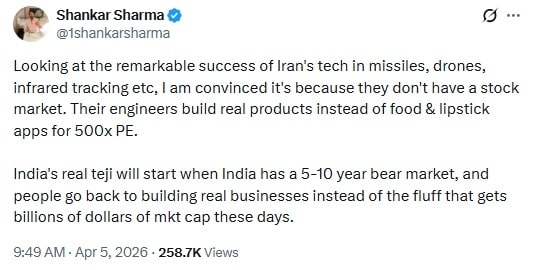
Sharma was referring to soaring valuations of Indian companies with limited manufacturing depth. He contrasted them with what he described as a more engineering-focused ecosystem, citing Iran's defence technology.
His post added: "India's real teji (growth) will start when India has a 5-10 year bear market, and people go back to building real businesses instead of the fluff that gets billions of dollars of market cap these days."
Is The Indian Market In A Bubble
Technically, the Indian stock market is not seen as being in a systemic, bursting bubble as of April 2026. However, it is witnessing sharp volatility and sector-specific froth. Some market observers describe this phase as a "necessary correction" after a prolonged period of outperformance.
Commenting on the post, Sarthak Sharma, Founder, ModxComputers, said, "The development of a sound economy needs a balance between consumption-led companies and those that deal with production. Over the last decade or so, the number of consumer-focused startups has exploded. Such ventures help in improving user experience and digital transformation. However, excessive focus on these kinds of firms may result in skewed capital investments."
He added, "The foundational industries such as manufacturing, industrial advancements, and infrastructures also have their significance in boosting the economic strength of any region. They create jobs in large numbers, improve logistics operations, and ensure sustainable development. Therefore, consumer technology and real economies cannot be considered opposing entities. Instead, they complement each other's strengths to foster economic success. Digital technology can increase operational efficiency, whereas industries can form the base of any economy."
'Invest In Education For Innovation'
Adding to this, Pallavee Dhaundiyal Panthry, Chief Communication Advisor, Sustainability, World of Circular Economy (WOCE), said, "In a long period of time during bull markets, due to plentiful liquidity and confidence, the flow of funds goes toward investments that have high valuations and low entry barriers, especially in consumer technology and the digital space. Such enterprises usually ensure quick scalability and return on investment, but may not necessarily solve the underlying issues. But during the period of market correction or bear markets, the emphasis changes. Investors take into account practical aspects like profitability and resilience," said .
She added, "In effect, investments are steered towards such sectors as manufacturing, deep technologies, and infrastructure -- all of which are patient industries that promise value generation down the road. The process serves as a much-needed reboot to foster disciplined innovation and guarantee that economic expansion is anchored on fundamentals."
Speaking on long-term fixes for building a innovation base in India, Siddharth Maurya, Managing Director, Vibhavangal Anukulkara, said, "Countries that invest in education, technology incubators, science, and innovations are likely to come up with more groundbreaking ideas. Apart from government investments, private capital, venture environments, and industrial relationships are important in shaping the final output of innovation processes. It would be simplistic to concentrate on public stock markets alone when discussing innovation since there is a lot that goes into creating a sustainable innovation ecosystem. For this reason, rather than relying on stock market dynamics, it is important to enhance the environment that enables entrepreneurs to innovate and make a difference."
Track Latest News Live on NDTV.com and get news updates from India and around the world

