



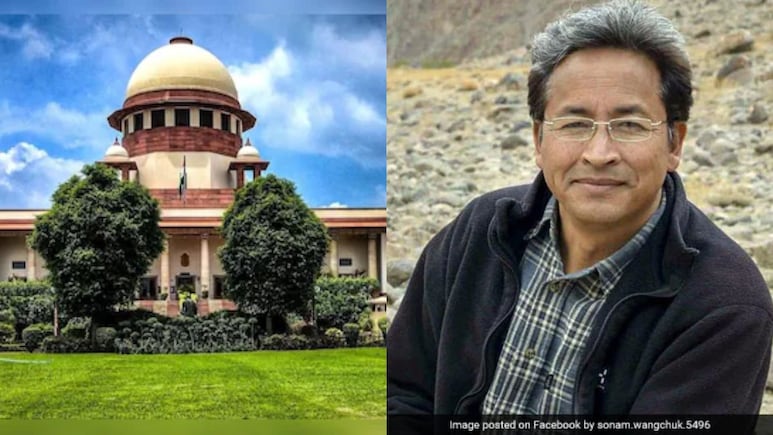
- Sonam Wangchuk was arrested under the National Security Act after Leh protests turned violent.
- Wangchuk's wife challenged his detention, citing lack of evidence disclosure by prosecution.
- Senior Advocate Kapil Sibal argued detention grounds were incomplete, violating Article 22(5) of Constitution
Activist Sonam Wangchuk, who has always spoken against violence and received 30 awards for nation-building, is now being portrayed as a criminal, the Supreme Court was told today.
Wangchuk was arrested on September 26 after violence broke out in Ladakh's Leh during protests demanding statehood and safeguards under the Sixth Schedule of the Constitution. He has been charged under the stringent National Security Act.
Gitanjali Angmo, his wife and educator, has challenged his detention and approached the top court. Appearing for Angmo, Senior Advocate Kapil Sibal said the defence has not been provided the videos that the prosecution is using to justify Wangchuk's detention.
"The law is well settled that if all the grounds of detention are not supplied, it will vitiate the order of detention. That is settled law in the context of Article 22 (5)," he said. Article 22 of the Constitution protects all Indians from arbitrary arrest and detention.
"When any person is detained in pursuance of an order made under any law providing for preventive detention, the authority making the order shall, as soon as may be, communicate to such person the grounds on which the order has been made and shall afford him the earliest opportunity of making a representation against the order," Article 22 (5) states.
"Please see the detention order. My detention is necessary because it will affect public order. They are saying that if I am not detained, it will hamper public order, maintenance, and threaten security. The intent is to prevent me from continuing my activities. I was detained on 26th. On September 10th, I went on a hunger strike. On the 15th day of my hunger strike, there were incidences of violence with which I was very disturbed. I broke my hunger strike on 24th and gave a speech saying the violence should stop," Sibal said on Wangchuk's behalf.
The activist's counsel also drew a parallel between his decision to end his hunger strike and Mahatma Gandhi's decision to halt the non-cooperation movement against the British Raj after the Chauri Chaura incident on February 4, 1922.
"I made a speech while breaking my hunger strike. I said I cannot accept this violence and we should stop this violence and I am appealing to you to stop this violence. That is the video I wanted to play to your lordship. You might remember that Gandhiji did the same when there was violence after the Chauri Chaura incident," he said, adding that facts are being manipulated to "show as if I am a criminal".
"My speech, in fact, says that I am against the violence. It is taken to be such that if I were not detained, violence would continue, while the intent was exactly the opposite. They had this video, but they did not rely upon it," Sibal said, and the video was played in court.
The senior lawyer said that the decision to hold the hunger strike was not Wangchuk's. "It is not as if I individually decided. The whole organisation decided that there should be a hunger strike and requested me to do it along with other volunteers and I readily agreed, considering it another step in pursuance of Satyagraha in the spirit of the path shown by Mahatma Gandhi," he added.
"The point is that they referred to four videos. But the video on the 24th was also available to them. They were aware of it. Is it not their duty to also hand over the video so that the detaining authority can go through all the facts before coming to a decision? He said he was against violence on 24th. That vital video, which was available to them, was not given to the detaining authority. The detaining authority was kept in oblivion. Your lordships have said that even documents in favour of the accused have to be given if they cite them in the chargesheet," Sibal argued.
The matter will be heard next on Monday.
Earlier, the Union Home Ministry had accused Wangchuk of inciting people. "On 24th September, at around 11.30 am, a mob instigated by his provocative speeches left the venue of the hunger strike and attacked a political party office as well as Government office of the CEC Leh. They also put these offices on fire, attacked the security personnel, and torched a police vehicle. The unruly mob attacked the police personnel in which more than 30 police/CRPF personnel were injured. The mob continued to destroy public property and attack the police personnel. In self-defence, police had to resort to firing in which, unfortunately, some casualties are reported," the ministry said in a statement in September.
"It is clear that the mob was incited by Shri Sonam Wangchuk through his provocative statements. Incidentally, amidst these violent developments, he broke his fast and left for his village in an ambulance without making serious efforts to control the situation," it said, adding that the government was already in talks with Ladakh organisations over the protesters' demands.
Track Latest News Live on NDTV.com and get news updates from India and around the world

