





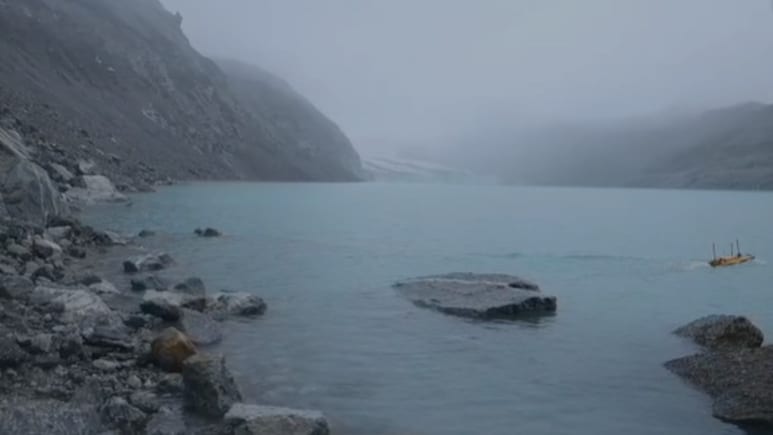
Sikkim has proposed three major engineering interventions to reduce the risk from Glacial Lake Outburst Floods (GLOFs) - solar-powered pumping at Shako Chho, a flood-retention structure at Dolma Sampa in the Lhonak Valley, and a safety wall at the outlet of the Gurudongmar lake complex.
The proposals mark a shift from assessing glacial hazards to exploring concrete measures to reduce the potential impact of a GLOF. Principal Secretary of the Science and Technology Department Sandeep Tambe said the focus was now on mitigation.
"Studying glaciers is one thing, but we are mostly working towards glacial hazard mitigation," Tambe said.
At Shako Chho, located at around 17,000 feet and about 12 km from Thangu on the route to Gurudongmar, the proposal is to lower the lake level through solar-powered pumping. The lake is estimated to hold around 27 million cubic metres of water. Its terminal moraine is high but permeable, and the lake has no natural outlet.
The National Disaster Management Authority (NDMA) has advised against directly disturbing the fragile moraine. The proposal therefore envisages initially pumping out around 8 million cubic metres of water using eight solar-powered pumps, with the possibility of lowering the lake level by about 20-40 metres.
Chief Engineer Ashim Basnett said reducing the lake's volume would reduce the potential force of water released by a future avalanche, landslide or similar event.
"The best way to stop it is at the lake itself," Basnett said, explaining that reducing the depth and volume could lessen the impact of a possible outburst.
Conventional pumping is considered impractical because there is no electricity supply at the site and transporting fuel to such a high altitude would be difficult. A Detailed Project Report (DPR) has been prepared and submitted through the state disaster management authorities, with the proposal being examined at the Government of India level.
The second proposal concerns the Lhonak Complex, comprising South Lhonak, North Lhonak and Changsang lakes. Instead of carrying out an intervention directly at the lakes, Sikkim is studying a retention structure at Dolma Sampa, around 24 km downstream near Muguthang, where the valley widens naturally.
The location is significant because it played a role during the October 2023 South Lhonak GLOF. The outburst released nearly 30 million cubic metres of water and lowered the lake level by around 20-25 metres. The flood reached Dolma Sampa, where the wider valley allowed water, boulders and debris to spread across a large area, naturally reducing the flood's momentum.
The latest assessment found South Lhonak to be presently stable. The lake is currently about 2.70 km long and covers around 148 hectares, compared with about 2.60 km and 155 hectares before the 2023 disaster. The combined water volume of the South and North Lhonak lakes is estimated at around 70-80 million cubic metres.
"We will not do something at the lake level. We will do it at a location called Dolma Sampang where the valley suddenly broadens out and the flood actually slows down there," Tambe said.
The third proposal is for the Gurudongmar Lake complex, which comprises three lakes. While one lake is accessible to tourists and pilgrims, the other two are considerably larger. The complex has also expanded significantly over the past three decades.
Here, the proposed intervention is a moraine-plug safety wall or stone-masonry structure at the lake outlet to regulate the release of water and reduce the force of a possible outburst.
"Once it starts rolling down the valley, it gains momentum and picks up boulders and debris. Then it is almost impossible to do anything about it," S&T Secretary Dhiren Shrestha added.
Of the 40 high-hazard glacial lakes identified by NDMA in Sikkim, 16 have been classified as priority Category-A lakes, with detailed assessments completed for 13 of them. The state is now moving towards determining which engineering interventions are technically viable while continuing monitoring and hazard assessment of the vulnerable lake systems.
Track Latest News Live on NDTV.com and get news updates from India and around the world

