





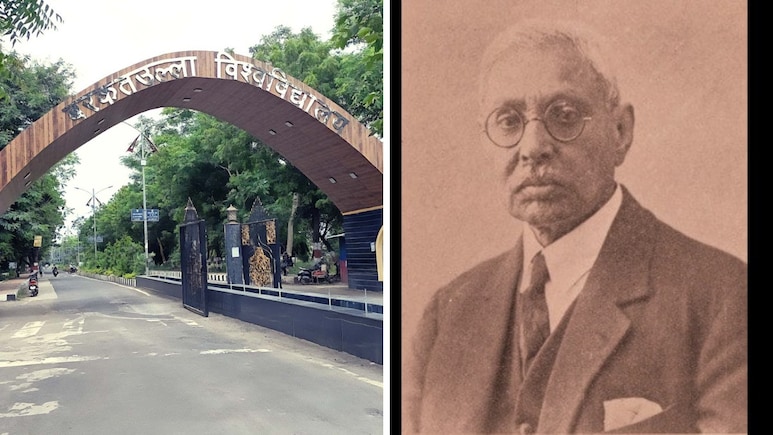
- Barkatullah University may be renamed Vagdevi Bhojpal University, pending approval
- The proposal highlights Raja Bhoj's cultural and intellectual contributions to central India
- It controversially downplays Barkatullah Bhopali's regional contributions compared to Raja Bhoj
A fresh political and cultural debate has erupted in Madhya Pradesh after the Executive Council of Barkatullah University approved a proposal to rename the institution as "Vagdevi Bhojpal University" and forwarded it to Governor and Chancellor Mangubhai Patel for final approval.
The university, established in 1970 as Bhopal University, was renamed Barkatullah University in 1988 in the memory of freedom fighter Maulana Barkatullah Bhopali.
The proposal places strong emphasis on the historical and intellectual legacy of Raja Bhoj, describing him as a ruler whose contributions to literature, science, architecture and education left a lasting mark on central India. It argues that Raja Bhoj's name is deeply connected with Bhopal's identity through Bhojtal, the Bhojpur temple and the region's wider cultural memory.
According to the proposal, Raja Bhoj authored nearly 80 treatises, of which 27 are said to be available today. It also refers to Dhara, present-day Dhar, as a major centre of learning under his rule, and highlights Bhojshala as a temple of Saraswati and an ancient seat of knowledge. The proposal links the name "Vagdevi" to the idol of the Goddess of Speech and Knowledge associated with Bhojshala.
However, the most contentious part of the proposal is its direct comparison between Raja Bhoj and Maulana Barkatullah Bhopali. It reportedly states that, compared to Raja Bhoj, "no significant contribution to this region by Barkatullah Bhopali is evident, other than the fact that he was a resident of Bhopal." On this basis, the proposal recommends that the university's name be changed to reflect Bhopal's historical and cultural heritage.
Who Was Barkatullah Bhopali
The move has triggered questions over whether the legacy of one historical figure is being honoured at the cost of another. Maulana Barkatullah Bhopali was not merely a resident of Bhopal. Born on July 7, 1854, in the Itwara locality of the city, he went on to become one of India's prominent revolutionary figures, campaigning internationally against British rule.
Barkatullah was associated with the Ghadar movement and was part of a global network of Indian revolutionaries. He served as the Prime Minister of India's first provisional government-in-exile, formed in Afghanistan on December 1, 1915, with Raja Mahendra Pratap Singh as its President and Ubaidullah Sindhi as Home Minister.
A scholar, journalist and polyglot, Barkatullah knew several languages, including Arabic, Persian, English and Japanese. He taught in London, Liverpool and Tokyo, remained in contact with revolutionaries at India House, edited the Ghadar Party newspaper, and travelled across the US, Japan, Germany, Turkey, Afghanistan, Soviet Russia, France and Rome as part of his anti-colonial work.
The renaming proposal comes at a time when the university has also approved structural academic changes. Traditional disciplines such as Arabic and Persian are proposed to be reorganised under a new Department of Comparative Languages and Culture.
Track Latest News Live on NDTV.com and get news updates from India and around the world

