





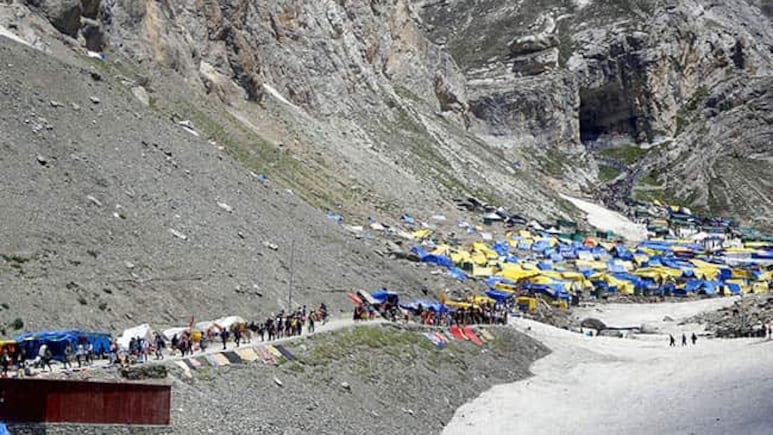
To prevent terrorists from masquerading as pony owners, palanquin bearers or other service providers during the Amarnath Yatra, Jammu and Kashmir Police has introduced QR-code-based, tamper-proof identity cards for all authorised personnel associated with the pilgrimage.
"Scan the card and the complete antecedents of the service provider flash instantly," a senior police officer said, describing the initiative as an important safeguard against attempts by terrorists or anti-social elements to pose as locals.
Pehchaan App To Verify Service Providers
As part of the enhanced security framework, Jammu and Kashmir Police has also launched the Pehchaan mobile application to help pilgrims and security personnel verify the credentials of local service providers in real time.
The app has been designed to register and regulate pony handlers, porters, transport operators, guides and vendors associated with the yatra. It creates a digital database of authorised personnel, enabling police to track individuals operating along the pilgrimage route, identify unverified elements and prevent impersonation or fraud.
Multi-Layered Security Grid
The annual Amarnath Yatra, scheduled to begin on July 3, will be protected by a multi-layered security apparatus that includes no-fly zones, watch towers, electronic surveillance and real-time monitoring of vehicle movement.
The security plan is among the most extensive exercises undertaken in Jammu and Kashmir each year. Director General of Police Nalin Prabhat has emphasised enhanced coordination and intelligence sharing among all security agencies to ensure a safe and smooth pilgrimage.
Mock Drills To Test Preparedness
Security agencies have also intensified preparedness through mock drills.
On Monday, the National Security Guard (NSG), along with other security agencies, conducted a high-intensity exercise at the Bhagwati Nagar base camp in Jammu to simulate a terror attack and hostage situation.
The drill involved a scenario in which terrorists entered a building inside the camp and took pilgrims hostage. Security personnel rehearsed area sanitisation, threat neutralisation and coordinated rescue operations.
"The objective is to assess preparedness, test response time and validate inter-agency coordination before the yatra begins," a senior police officer said.
670 CAPF Companies Deployed
The Ministry of Home Affairs has deployed 670 companies of Central Armed Police Forces across Jammu and Kashmir for the pilgrimage.
The deployment includes personnel from the CRPF, BSF, ITBP, CISF and SSB, working in coordination with the Indian Army and Jammu and Kashmir Police.
A multi-tier security grid has been established from Lakhanpur, the entry point to Jammu and Kashmir, up to the Baltal and Pahalgam base camps.
Security measures include CCTV surveillance, RFID tagging of vehicles and pilgrims, and round-the-clock drone monitoring along the route.
No-Fly Zone Along Yatra Route
The government has declared the entire Amarnath Yatra corridor a no-fly zone, covering both the Pahalgam and Baltal routes to the shrine.
As a result, helicopter services for pilgrims will remain suspended for the second consecutive year.
Security officials said enhanced aerial surveillance and deployment became necessary following last year's terror attack on tourists in the Baisaran area of Kashmir.
Police have also established high-rise watch towers and observation posts at strategic locations along the route to maintain constant vigil.
Traffic Restrictions Announced
Authorities have also issued a traffic advisory for the yatra period.
Pilgrims have been instructed to follow designated travel routes and timings, while restrictions have been imposed on civilian traffic along parts of the Srinagar-Jammu National Highway.
According to the advisory, no civilian traffic heading towards the Valley will be allowed to leave Jammu before 11.30 am. Vehicles travelling towards Srinagar will also not be permitted to cross the Banihal-Qazigund tunnel after 3 pm. Similar restrictions have been imposed on certain routes within the Valley.
Track Latest News Live on NDTV.com and get news updates from India and around the world

