





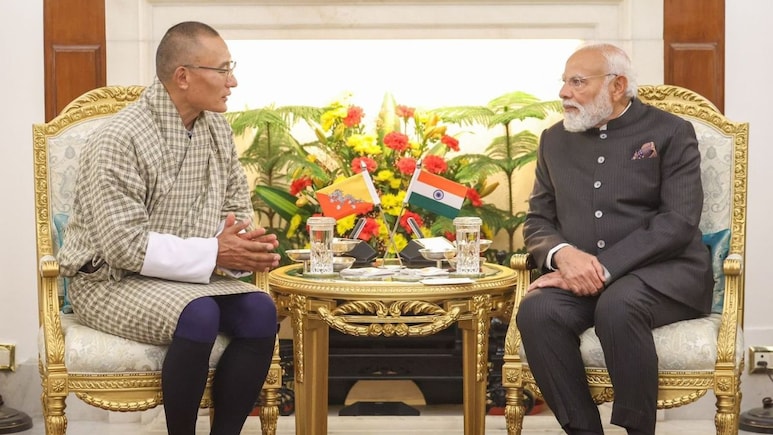
Bhutan's Prime Minister Tshering Tobgay and Prime Minister Narendra Modi on Wednesday reviewed the progress in bilateral cooperation in several key sectors - including energy, connectivity, development partnership and people to people connect - on the sidelines of the India-AI Impact Summit in New Delhi.
According to the Ministry of External Affairs (MEA), the two leaders expressed support for harnessing Artificial Intelligence (AI) for inclusive and human-centric progress and agreed to further strengthen cooperation in AI and digital tech space.
They also reaffirmed their commitment to work closely to further strengthen the India-Bhutan partnership anchored in trust, goodwill and mutual respect.
India and Bhutan share a tradition of regular high-level exchanges and continue to explore new avenues of cooperation, while building on their deep-rooted ties in energy, infrastructure, and cultural exchange.
Last November, PM Modi visited Thimphu on a two-day visit which aimed at deepening India-Bhutan partnership and reinforcing India's commitment to its Neighbourhood First Policy.
PM Modi's visit coincided with the exposition of the Sacred Piprahwa Relics of Lord Buddha from India. He also offered prayers to the Holy Relics at Tashichhodzong in Thimphu and participated in the Global Peace Prayer Festival organised by the Royal Government of Bhutan.
The visit also marked another major milestone in India-Bhutan energy partnership with the inauguration of the Punatsangchhu-II hydropower project.
"The basic framework of India-Bhutan relations is the Treaty of Friendship and Cooperation signed in 1949 between the two countries, which was renewed in February 2007," the MEA has stated before.
The India-Bhutan Agreement on Trade, Commerce and Transit -- which was first signed in 1972 and revised most recently for the fifth time in 2016 -- establishes a free trade regime between the two countries. The Agreement also provides for duty free transit of Bhutanese exports to third countries. Bilateral trade is conducted in Indian Rupees, which is at par with the Bhutanese Ngultrum.
India is Bhutan's top trade partner, both as an import source and as an export destination. Since 2014, India's trade with Bhutan has increased more than three times -- from $484 million in 2014-15 to $1,777.44 million in 2024-25, accounting for over 80 per cent of Bhutan's overall trade. Throughout this period, the balance of trade has consistently remained in India's favour.
India's major exports to Bhutan include petrol and diesel, rice, wood charcoal, coke and semi-coke, ferrous products obtained by direct reduction of iron ore, maize (excluding seed), soya-bean oil, smartphones, and iron or steel structures and parts, among others.
On the other hand, India's key imports from Bhutan consist of electricity, ferro-silicon, dolomite chips, ferro-silico-manganese, Portland pozzolana cement, pebbles and gravel, dolomite slabs, semi-finished iron or non-alloy steel products, beer made from malt, and ordinary Portland cement.
(Except for the headline, this story has not been edited by NDTV staff and is published from a syndicated feed.)
Track Latest News Live on NDTV.com and get news updates from India and around the world

