





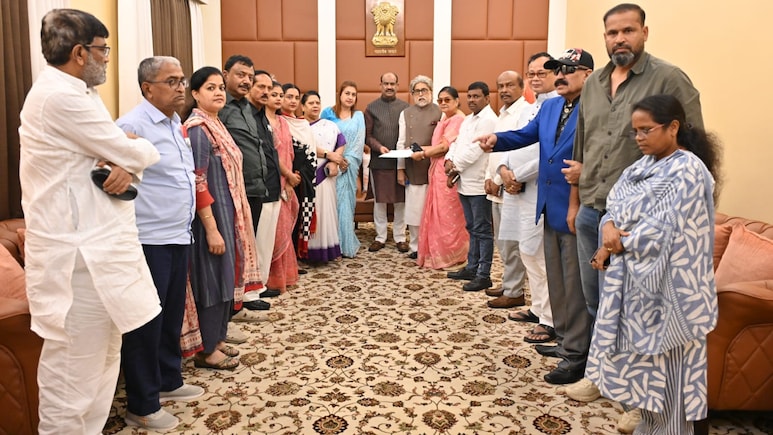
- Twenty TMC MPs merged with the Nationalist Citizens Party of India (NCPI) last week
- NCPI contested only one election in 2023, receiving just 0.047% of votes in Tripura
- The merger avoided disqualification under the Tenth Schedule's anti-defection law
Twenty MPs from the Trinamool Congress - over two-thirds of the party's Lok Sabha members - met Speaker Om Birla last week to merger with the Nationalist Citizens Party of India, a registered but unrecognised political party in Tripura that claims some support among Bengali-speaking voters in that state, as well as Assam, Meghalaya, and Bengal.
But the NCPI has, so far, contested only one election - the 2023 Tripura poll.
In that exercise it fielded three candidates. Two of these candidates contested on the party's name and symbol - from the Chawmanu and Kailashahar constituencies - and managed 536 and 286 votes. The third was an independent candidate from Ambasa and picked up 376 votes. The NCPI polled a combined 1,198 votes - 0.047 per cent of total cast in the election.
Now, howver, the party finds itself with 20 Lok Sabha MPs on its books without even contesting a parliamentary election.
Why did the Trinamool's 20 rebels - intent on forcing their way out after a disastrous April-May Bengal election - link with a political non-entity? Why did they not form a separate group? That was the initial idea.
However, this was not legally possible under the existing constitutional framework. The only route available to protect themselves from disqualification under the Tenth Schedule of the Constitution was a formal merger, not a split.
The reason for this lies in the history of the Tenth Schedule itself.
When it was enacted in 1985, it contained a provision allowing a legislature party to split provided that not less than one-third of its members agreed to said split. But this provision was repeatedly abused. In the 1990s, for example, the Janta Dal witnessed multiple engineered break-ups; in 1990 alone, Chandra Shekhar and 61 other MPs shifted allegiances, claiming protection under that law and thereby avoiding disqualification. The provision became a tool to legitimise defection.
Recognising this, Parliament enacted an amendment in 2003 that deleted this provision.
And so now the only valid exception to disqualification is the merger provision, which requires at least two-thirds of a party to agree to merge with another registered party. This is the provision the rebel MPs invoked by merging with the NCPI.
But why merge with NCPI when discussions were reportedly held with the BJP?
There were reports the MPs were in contact with union minister Bhupender Yadav - the BJP's Bengal in-charge. There was speculation they might merge directly with the BJP but eventually that did not happen. That was a pragmatic move.
Merging with the BJP would have been potential political suicide for the rebel MPs given the extreme rivalry between their two parties, Voters in their constituency might not think too much about joining a smaller party like the NCPI - particularly since it does not have a prominent leadership or organisational structure - but could have baulked at the idea of joining the BJP.
The NCPI's smaller footprint is also an opportunity for the rebels to impose their own political ideology, and still join the BJP-led ruling coalition, the National Demoratic Alliance.
There is, of course, precedence for merging directly with the BJP,
The Congress' Goa legislature party, for example, merged with the BJP in 2022 and, more recently, a faction of the Aam Aadmi Party's Rajya Sabha MPs - led by Raghav Chadha - made the same switch. The Congress disupted the merger in court and lost. The AAP has similarly disputed the Chadha faction joining the BJP.
The BJP has been proactive on this issue as well. In 1997 Uttar Pradesh Chief Minister Kalyan Singh - leading a BJP-BSP coalition - engineered the defections of a third of the BSP's 67 MLAs to save his government after the latter withdrew support.
Why did the BJP hesitate this time?
The NCPI over BJP decision is entirely political in nature.
The BJP and the Trinamool are bitter electoral adversaries. In the 2024 Lok Sabha election, the two contested directly against each other and, in the 2026 Bengal election, the BJP thumped the Trinamool and now governs the state.
A direct absorption of rival MPs could have sent a damaging message to the saffron party's own rank and file, particularly to those who have spent years opposing the same Trinamool leaders. At the same time the BJP would have also been hard-pressed in accommodating the rebel MPs in its own organisational structure, never mind the state cabinet.
The NCPI route offered a politically clean and constitutionally valid alternative.
As a registered party, it satisfies the legal requirement of being "another political party" and, at the same time, it carries no electoral or organisational baggage that could create friction within the BJP's existing structure. And, of course, the rebel MPs can align with the NDA - a political decision outside the scope of the anti-defection law - without becoming BJP members.
The merger also serves a broader strategic purpose for the ruling coalition.
The addition of 20 Lok Sabha MPs substantially increases the NDA's strength in the Lower House and brings it closer to passsing the Delimitation Bill, which failed to secure the requisite majority during the extended budget session in April 2026.
[Ashish Ranjan is an election researcher and a co-founder of Data Action Lab for Emerging Societies (DALES)]
Track Latest News Live on NDTV.com and get news updates from India and around the world

