





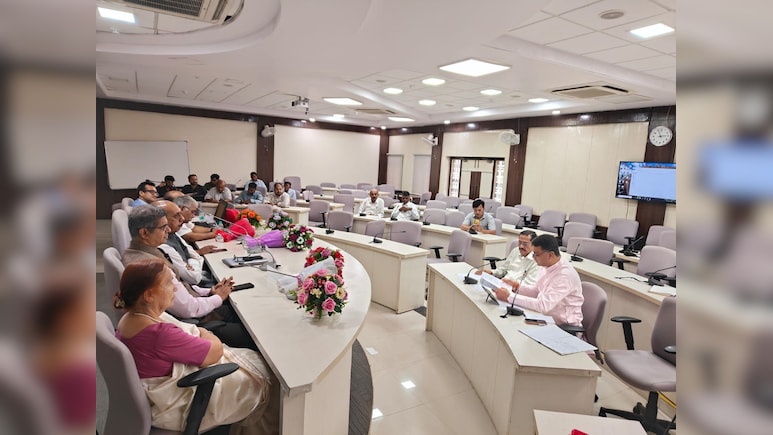
The clock ticking on the Madhya Pradesh government's ambitious Uniform Civil Code exercise, the high-level UCC committee on Monday held a marathon seven-hour consultation with stakeholders in Bhopal, amid notable political absences and sharp opposition voices.
The committee indicated that the much-awaited UCC draft is likely to be ready by the first week of July, if not by the end of June.
The day-long meeting, which began at 10.30 am, saw representatives of government commissions, women's and child rights bodies, bureaucrats, religious leaders, political parties and public
representatives present suggestions before the six-member panel headed by former Uttarakhand Chief Secretary Shatrughan Singh.
In a development that stood out, four major opposition parties - the Congress, Mayawati's Bahujan Samaj Party, Akhilesh Yadav's Samajwadi Party and Arvind Kejriwal's Aam Aadmi Party did not turn up despite being invited.
Of the six national political parties invited, only the BJP and CPM participated. The Congress chose to stay away. State Congress president Jitu Patwari instead released a video on X, calling the UCC push a "diversionary tactic".
"Before holding UCC discussions, kindly hold a discussion on how many guarantees of Prime Minister Narendra Modi have been fulfilled till date. Will the UCC take care of the traditions and other issues pertaining to tribals, who number over 1.60 crore and constitute 21% of MP's population?" Patwari said.
Congress MLA Arif Masood attended a separate interaction involving local public representatives.
The BJP delegation, comprising state general secretary Rahul Kothari and former IAS officer SS Uppal, submitted a detailed nine-point memorandum covering marriage, divorce, succession, adoption, maintenance, guardianship, matrimonial property rights and elderly welfare.
Among the most striking suggestions was a proposal to make registration of marriages involving NRI grooms compulsory and link their passports within a week of marriage.
The BJP argued that such a provision would help prevent cases where NRI husbands abandon Indian brides and leave the country.
The party also sought stronger legal safeguards for elderly parents abandoned by their children, including cancellation of ancestral property transfers and direct deduction of maintenance from the earnings of neglectful children.
Though Chief Minister Dr Mohan Yadav has repeatedly said tribal communities will remain outside the UCC's ambit, several tribal representatives proposed a more flexible approach.
Some suggested that tribals who voluntarily wish to come under the UCC be allowed to do so. Others demanded compulsory marriage registration in tribal communities to ensure women and children are not denied government benefits.
There were also suggestions that tribal women marrying non-tribals be brought under the UCC framework.
One of the most intensely debated issues during the consultations was the regulation of live-in relationships.
Several participants argued that mandatory registration of live-in relationships could help protect women from abandonment, prevent misuse of legal provisions after break-ups and safeguard the rights of children born from such unions.
However, religious leaders from Hindu, Muslim and Christian communities expressed concern over any move that could be seen as granting legal recognition to live-in relationships through the UCC.
Muslim religious leaders emerged as the strongest critics of the proposed law.
"It is being told to us that Article 44 of the Constitution mandates the state to endeavour to secure a UCC. But why is UCC being implemented first at the state level? It should be implemented nationally after a thorough debate in Parliament," said Bhopal's Shahar Qazi Syed Mushtaq Ali and other representatives.
Questioning the very premise of a "uniform" code that excludes tribals, they added: "How can it be termed a Uniform Civil Code when tribals are proposed to be kept outside its ambit? We have compromised on criminal and civil laws, but we will not allow our personal laws to be superseded by UCC."
The leaders issued a strong warning. "We will never accept any UCC. We will violate it through civil disobedience. Instead of bringing UCC, the government should impose total prohibition in Madhya Pradesh and ban cow sale, slaughter and export across the country."
Speaking to reporters after the meeting, committee member and former Uttarakhand Chief Secretary Shatrughan Singh said efforts were being made to submit both the consultation report and draft UCC to the state government by the end of June.
"Efforts are being made to submit reports summing up suggestions of various sections of the public as well as the UCC draft before the state government by June-end. If not June-end, the documents will be submitted by the first week of July," Singh said.
The consultations assume significance as Chief Minister Dr Mohan Yadav recently indicated that if the process remains on schedule, the UCC Bill could be introduced during the upcoming Monsoon Session of the Madhya Pradesh Assembly beginning July 20.
Track Latest News Live on NDTV.com and get news updates from India and around the world

