





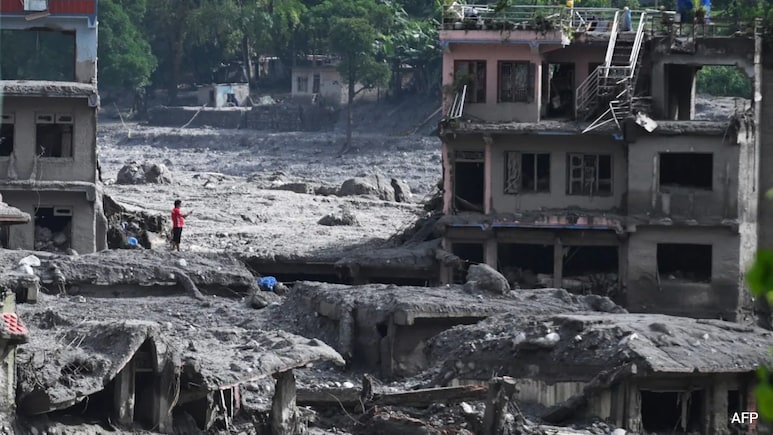
A rock-ice avalanche near the Tibet-Nepal border on the morning of August 26 morning washed away homes, villages, and bridges in three districts of Nepal: Rasuwa, Nuwakot and Lalitpur. The devastating Glacial Lake Outburst Flood (GLOF) claimed around 1,400 lives, with more than 5,500 still missing, including around 800 foreigners. While the exact cause of the glacial collapse is unclear, climate change is accelerating glacial melting globally, increasing the risk of such disasters.
According to a study titled "Glacial Lake Outburst Flood Risks, Response Strategies and Adaptation Gaps in the Hindu Kush Himalaya Region", GLOFs pose a significant and growing threat to the Hindu Kush Himalaya (HKH) region, home to nearly 2.1 billion people living both within the mountains and in downstream communities. The study led by the United Nations University, an academic arm of the UN, analysed 493 GLOF events from the earliest available record up to 2024 and found escalating risks linked to climate change.
"Our analysis of historical GLOF disaster events reveals an increase in such incidents across the Hindu Kush Himalaya region," Dr Dipesh Chapagain, a senior scientist in the Global Mountain Safeguard Research (GLOMOS) programme at the United Nations University Institute for Environment and Human Security (UNU-EHS) in Bonn told NDTV.
Dr Dipesh Chapagain, Glacier Scientists, UN University
"While there was an average of seven GLOF events per decade prior to 1950, this figure rose to 38 per decade after 1950 - a fivefold increase. Our research identified a significant gap between the escalating GLOF threat and the measures being taken to address it, as well as a disparity regarding the technical and financial capacities available at the grassroots level. Recent research indicates that the Hindu Kush Himalaya region is home to over 64,000 glaciers and more than 23,000 glacial lakes. In our study, we examined approximately 500 GLOF disasters that have occurred over the past two centuries."
According to Dr Chapagain, around 407 glacial lakes across the eight countries of the Hindu Kush Himalaya region are at risk of bursting. This figure could be higher, as climate change has accelerated glacial retreat and the melting of ice and snow. New glacial lakes are forming, causing this list to grow longer.
Furthermore, there has been a rapid expansion of infrastructure and settlements along river valleys, placing more people and property within the scope of this escalating threat. Dr Chapagain states that the recent GLOF disaster on the Nepal-Tibet border was not caused by any previously identified hazardous lake; rather, it involved newly formed lakes. This indicates that the true scale of the threat is still not fully understood. It is crucial to recognise that regardless of our current actions, the melting of glaciers and ice will continue for decades. The focus must now shift to the urgent need for robust prevention and adaptation measures.
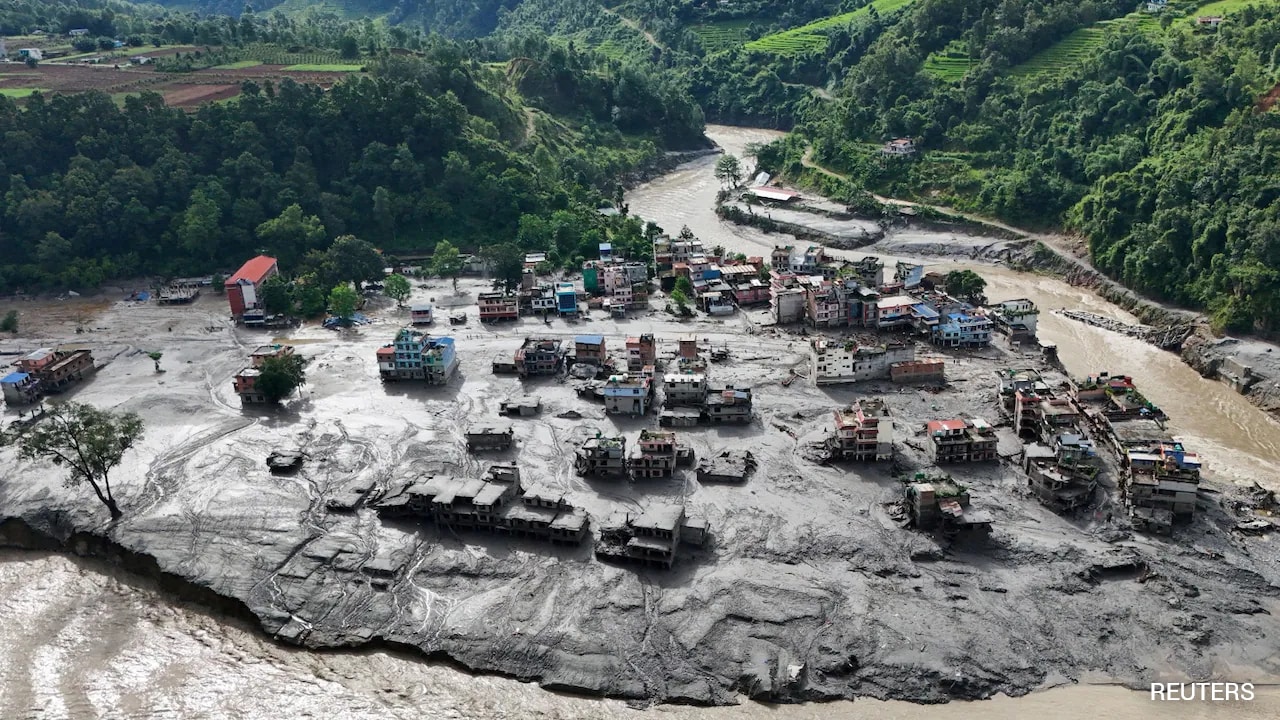
Nepal floods have claimed nearly 1,400 lives.
El Nino And Climate Change Are Raising Risk Of GLOFs
According to scientists at the India Meteorological Department (IMD), the El Nino phenomenon raises air temperatures, a trend compounded by climate change. The combined effect of these two weather phenomena accelerates glacier melting, creating conditions ripe for multi-hazard incidents.
"The Himalayan region is experiencing a significant impact from climate change, with temperatures rising more sharply in these areas. This leads to rapid glacier melting and rising water levels in glacial lakes," Dr Mrutyunjay Mohapatra, Director General of the IMD told NDTV.
"Regarding precipitation, a decline in rainfall and snowfall has been observed in the Himalayan region during the winter months. When below-average rainfall occurs during the monsoon season, either due to El Nino or other factors, monsoon circulation weakens. This intensifies the impact of western disturbances in the Himalayas. Occasionally, increased rainfall intensity leads to cloudbursts or heavy downpours in certain areas, causing glacial lakes to fill up and heightening the risk of GLOF disasters."
This has rung alarm bells in India, where 11 states and two Union Territories lie within the Himalayan region, and has intensified the need for monitoring.
Move Beyond Nowcasting, Strengthen Forecasting
The Ministry of Earth Sciences has allocated a budget of Rs 1,342.29 crore to Mission Mausam for the period of 2026-27. Its primary objective is to strengthen weather forecasting and the early-warning value chain through high-tech modelling and computational techniques.
Major interventions include the application of artificial intelligence or machine learning and hybrid physics-AI techniques for nowcasting, and forecast improvement; the establishment of new weather stations; installation of next-generation Doppler weather radars in sensitive areas, and strengthening early-warning system networks. Doppler weather radars use the Doppler effect to track the movement and velocity of weather systems, enabling accurate and timely forecasts.
Overhaul Land-Use Planning
The Himalayan region in India contains numerous glaciers. Situated at altitudes exceeding 5,000 metres, these glaciers possess immense mass and volume. Should a glacier collapse or a glacial lake burst within India, the resulting devastation would mirror the scale of the disaster in Nepal. In light of this, National Disaster Management Authority (NDMA) member Dr Dinesh Kumar Aswal has proposed a new land-use planning framework for India's Himalayan zone.
"We need to overhaul land-use planning for the Himalayan region in India. We must conduct risk analyses of the 'highest flood-level zones' to determine the maximum river levels recorded over the past 1,000 years. If we map these peak flood levels and ensure construction takes place above them, then even if a glacier collapses or a mountain gives way, there will be no damage."
Not Just Meteorological Monitoring
Beyond meteorological monitoring, systems for hydrological, cryospheric, and geophysical monitoring in the Himalayan region are being strengthened, given the interconnected nature of these four processes in the area.
The number of early warning systems and new weather stations is being increased, with plans for further expansion in the near future. Automated weather stations and automated snow weather stations are also being expanded.
The NDMA recommends enhancing glacial lake monitoring.
"We are assessing the size and structural integrity of the moraines surrounding glacial lakes. If a glacial lake is expanding while the moraine weakens, it indicates that the glacier is unstable. We need to implement systems to monitor this," an NDMA official said.
Disaster Communication
Giving the example of Nepal, Dr Aswal recommends improving disaster communication in Himalayan states and implementing robust communication networks to save people during disasters.
"When the water was surging downstream, it was moving at immense speed. Had there been more robust and effective communication, many people living downstream might have been saved," he said.
Dr Dinesh Kumar Aswal, Member, NDMA
District Disaster Management Plans have been formulated for approximately 777 districts. Under this plan, every district has a Disaster Emergency Operating Centre. The NDMA aims to extend this setup to the block level as well.
Monitoring Of Hanging Glaciers
In collaboration with the Wadia Institute of Himalayan Geology (WIHG), the Uttarakhand State Disaster Management Authority (USDMA) is assessing hazards associated with 13 glacial lakes across the districts of Pithoragarh, Chamoli, Tehri, Uttarkashi, and Bageshwar. The WIHG specifically monitors Vasundhara Tal, located in the Dhauliganga basin of Chamoli district.
This initiative comes at a time when 219 'hanging glaciers' have formed on steep slopes within Uttarakhand's Alaknanda basin, and the risk associated with them is increasing due to climate change.
According to the findings of a research paper titled "Basin-scale Inventory and Exposure Assessment of Hanging Glaciers, Central Himalaya," published in the international journal Natural Hazards in April 2026, rapidly rising temperatures and climate change are increasing instability in Himalayan glaciers. "This instability has led to the formation of 'hanging glaciers' on steep slopes, posing a significant risk of ice collapse and severe consequences for downstream areas. While these glaciers have been extensively studied in the Alps, basin-level assessments in the Himalayas remain limited."
The Sikkim Disaster Management Authority has mapped 85 glacial lakes in Sikkim. Currently, there are seven such glacial lakes in the state that could breach due to a major earthquake or cloudburst, posing a risk of a Glacial Lake Outburst Flood (GLOF) disaster. Dr Vinod Sharma, Vice Chairman of the Sikkim State Disaster Management Authority (SDMA), told NDTV, "We have found that 17 of these 85 glacial lakes are highly vulnerable and are retreating. Seven of these lakes could breach due to a major earthquake or cloudburst, posing a risk of a Glacial Lake Outburst Flood (GLOF) disaster in the state. This is a significant threat, and the SDMA has made preparations to tackle it."
According to the 'Inventory of Himalayan Glaciers, Special Publication Number 34, 2009,' published by the Geological Survey of India (GSI), there are a total of 9,575 glaciers in the country. Over the past 13 years, India has witnessed three major GLOF disasters. These include the 2013 Kedarnath disaster in Uttarakhand, the 2021 Chamoli disaster, and the catastrophic disaster in Sikkim in 2023 caused by the bursting of the South Lhonak glacial lake.
The threat posed by climate change is escalating, and the Government of India must take serious, concerted action in collaboration with all vulnerable states to address this challenge.
Track Latest News Live on NDTV.com and get news updates from India and around the world

