





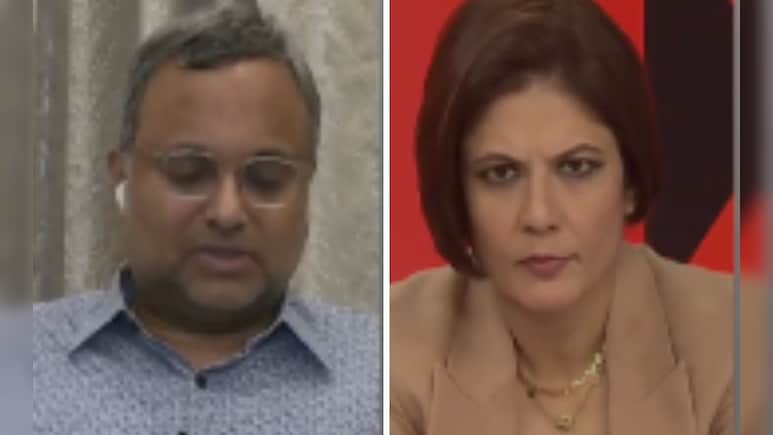
- Congress's Karti Chidambaram opposes increasing Parliament size for women’s quota implementation
- He proposes 30% women reservation within the current 543-seat Parliament using rotation
- Chidambaram suggests considering metrics beyond population for seat allocation in Parliament
A larger parliament is not necessarily a more effective parliament, Congress's Karti Chidambaram argued today, insisting that a 30 per cent reservation for women can be implement in the current house of 543. This, he suggested, should be done with the help of a rotational system, under which every seat goes to a woman every third term. He also suggested that it was time the other metrics besides population be considered to decide on representation in parliament.
Speaking to NDTV's Padmaja Joshi amid talks of implementation of Women's quota, Karti Chidambaram said, "A larger house will be a very ineffective house. We will hardly have any meaningful debate. We will have hardly any opportunity to speak. And in my opinion, it doesn't enhance the quality of the functioning of Parliament".
"We will become like the chamber in North Korea or the People's Congress of China, where we will simply come and thump our desks and go away," he added.
The government had originally intended to introduce the amendment to the Women's Reservation Act in the current session and introduce a bill to delink it from census and delimitation. But after the Opposition's objections, the possibility of introducing it during a short special session after the budget session is being considered.
There is also a plan to increase the number of seats by 50 per cent based on the last census instead of waiting for a delimitation exercise.
The Opposition has been fighting tooth and nail over the possibility of increasing the number of parliamentary seats, contending that it will make the southern states completely irrelevant in terms of power.
"We believe we will be shortchanged for the contribution we do to India in terms of economic progress and in other parameters if we are to be allocated parliamentary seats purely based on population," he said.
When pointed out that a state like Madhya Pradesh, though belonging to the Hindi heartland, has fewer seats than Tamil Nadu despite having almost the same population, he said, "I don't believe that population can be the only metrics in which you should allocate parliamentary seats".
"I don't have a perfect formula. But we look at the Hindi heartland as an electoral bloc and the southern, the non-Hindi speaking southern states as another electoral bloc... When we look at the Hindi speaking area, they have a large number of parliamentary seats," he said.
"If there are regional imbalances in the north, let's try to find solutions to correct them. But by blanket increase of seats by 50 per cent, you are going to have an unwieldy parliament of close to 800 people, which will only be a stamping house and will not be an effective debating house at all," he added.
For the road ahead so far as women's quota is concerned, he said: "I believe it is better to keep parliament at 543, reserve one third of the seats in 543 for women. We should have a rotational system by which for every third term, a seat will become a seat reserved exclusively for women. I'm all for it".
Track Latest News Live on NDTV.com and get news updates from India and around the world

