





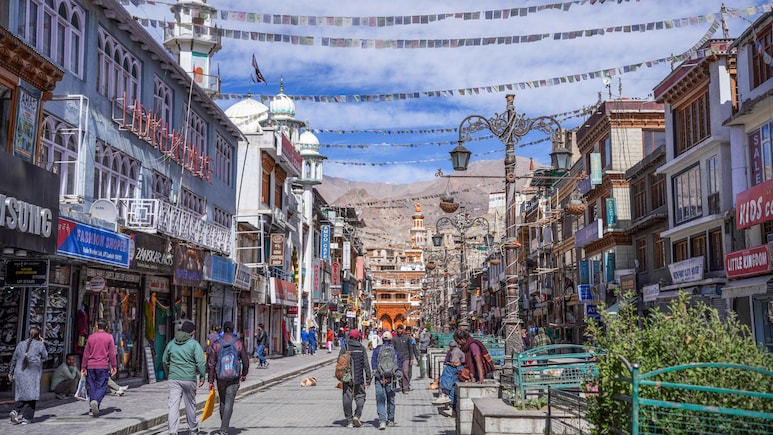
- Ladakh's new policy allows sale of hard liquor through retail outlets, expanding from beer and wine only
- The policy aims to curb narcotics by offering low-alcohol liquor and increasing availability for tourists
- Ladakh MP and social groups oppose the policy, citing concerns over increased alcohol-related harm
Ladakh's new liquor policy, which the administration said aims at curbing narcotics and giving people a wider choice of low-alcoholic-content liquor in the region, has sparked a row, with the union territory's Lok Sabha MP and various social groups demanding its rollback.
Approved by Lieutenant Governor Vinai Kumar Saxena on Sunday, the new policy allows the sale of hard liquor, including foreign liquor and Indian-made foreign liquor (IMFL), through retail vends. Earlier, only beer, wine and ready-to-drink beverages could be sold through retail outlets.
Officials said the existing restrictive regime had led to an artificial scarcity of liquor, encouraging the consumption of smuggled and spurious alcohol as well as narcotic substances.
Ladakh MP Haji Hanifa Jan, however, questioned the rationale behind the new policy.
"It's beyond my comprehension that the administration is trying to wean off people from one bad habit by introducing another bad habit. In states like Bihar and Gujarat, you have banned liquor, and here in Ladakh you are opening liquor shops in the name of fighting drugs," he said.
The Ladakh Buddhist Association (youth wing) termed the policy a "serious threat to the region's social fabric".
"We fail to understand the logic that making alcohol more accessible will reduce drug abuse. Such a move may only worsen the situation by introducing additional social and health problems," the association said.
The association claimed that their inputs during the discussions with administration on the new policy were misrepresented.
"We never stated that increasing alcohol consumption would reduce drug abuse. We never supported expanding hard liquor sales as a solution to the drug problem," the body said.
The Kargil Democratic Front also opposed the policy and criticised the lieutenant governor for opening liquor shops across Ladakh.
"It is difficult to understand the logic of opening liquor shops in the name of combating drug abuse. Alcohol is itself an intoxicant and, in many cases, serves as a gateway to substance dependence rather than a solution to it. Addressing one addiction by promoting another is neither sound public policy nor a credible strategy for safeguarding society," Sajad Kargili, the co-chairman of Kargil Democratic Front, said.
Ladakh's New Liquor Policy
The Ladakh union territory administration has announced liberalising liquor policy, allowing foreign liquor and increasing the liquor outlets from two to 20 in the region.
"A key feature of the new excise policy is the liberalisation of the existing restrictive regime, which had resulted in limited availability of brands and outlets, and thus created an "artificial scarcity" that often deterred the tourists visiting Ladakh," an official communique by the Ladakh administration said.
According to the LG administration, "unavailability of hard liquor in Ladakh was prompting individuals to resort to illegal narcotic substances" and now the sale of hard liquor, including IMFL, is permitted through retail vends.
The administration said the approval by the lieutenant governor was accorded after consultation with civil society groups, religious organisations and public representatives.
"The new policy comes after extensive meetings with civil society organisations, NGOs, religious organisations, public representatives and government officials, in recent months. One of the major concerns raised in these meetings, was the increasing dependence on narcotic substances and psychotropic drugs, particularly due to the unavailability of hard liquor in Ladakh," an official statement read.
The administration said the new policy marked a "significant reform" and introduced "a liberalised, transparent and technology-enabled regulatory framework, aimed at balancing public convenience, tourism promotion, revenue optimisation and effective and efficient regulation of liquor trade"
As per the new policy, the consumption of liquor is now also allowed on the hotel premises, including in rooms. Earlier, liquor consumption was restricted to bars only.
The administration also eased the requirement of documents for obtaining an excise licence and reduced the number of documents to just six against the 16 documents required as per the earlier policy.
As part of the liberalised policy, the mandatory clearance and opinion of district administration for obtaining a liquor licence have been done away with.
According to policy, in order to optimise the excise revenue, the annual fee for a wholesale licence has been increased from Rs 3.5 lakh to Rs 5 lakh.
The base price for retail vends, too, has been revised: the base price for the Leh municipal wards has been fixed at Rs 60 lakh, while in other areas, it is at Rs 30 lakh.
Earlier, a tourism department registration was mandatory for hotels to get a liquor licence. Now, only GST registration will be sufficient for getting an excise licence.
Track Latest News Live on NDTV.com and get news updates from India and around the world

