





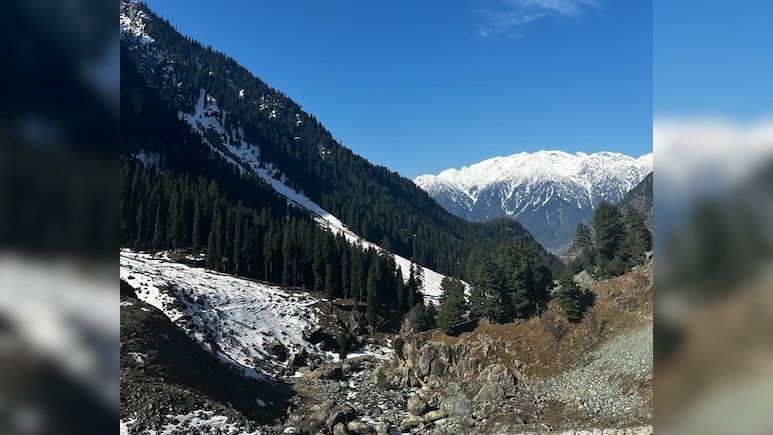
The high-mountain regions of Jammu and Kashmir are warming at an alarming rate, with temperatures at higher altitudes climbing by nearly 1 degree celsius over the last twenty years. A comprehensive climate study tracking data from 1980 to 2024 has revealed that the complex terrain of the Western Himalayas is experiencing highly uneven climate shifts. Conducted by scientists from the Indian Institute of Technology Kharagpur and the Indian Meteorological Department, the research shows that middle and high elevations are bear the brunt of this rapid warming.
The The study, titled "Warming of the high-mountainous climate sensitive Jammu and Kashmir during the period 1980-2024", reveals that the mid-elevation station of Bhaderwah has seen annual average temperatures climb by roughly 0.3 degrees Celsius per decade, meaning a total increase approaching 1 degree celsius since the start of the century. In stark contrast, lower-lying areas have stayed relatively stable, with the plains of Jammu even showing a slight cooling trend of around 0.1 degrees Celsius per decade.
The most dramatic changes are happening after dark. Minimum temperatures, which record the coldest parts of the night, are accelerating much faster than daytime temperatures. At mid-to-high altitudes, nighttime temperatures have jumped between 0.1 and 0.5 degrees Celsius every ten years. During the pre-monsoon season, this nighttime spike reached as high as 0.6 degrees Celsius per decade, comfortably crossing the 1 degree celsius threshold within the last twenty years.
Meanwhile, daytime maximum temperatures across the region have shown only minor, modest increases.
Scientists discovered that this rapid mountain warming is being driven by asymmetrical local factors rather than a uniform global trend. The dramatic rise in night-time heat is closely linked to decreasing local humidity levels and changes in surface albedo, which is the amount of solar radiation reflected by the ground. Because the geography of Jammu and Kashmir varies wildly, ranging from 1 kilometre to over 6 kilometres above sea level, these climate factors react differently at different heights.
The researchers warn that a 1 degree celsius shift in just two decades could have severe consequences for the delicate Himalayan ecosystem, potentially disrupting seasonal water supplies, melting glaciers, and altering local agriculture.
Track Latest News Live on NDTV.com and get news updates from India and around the world

