



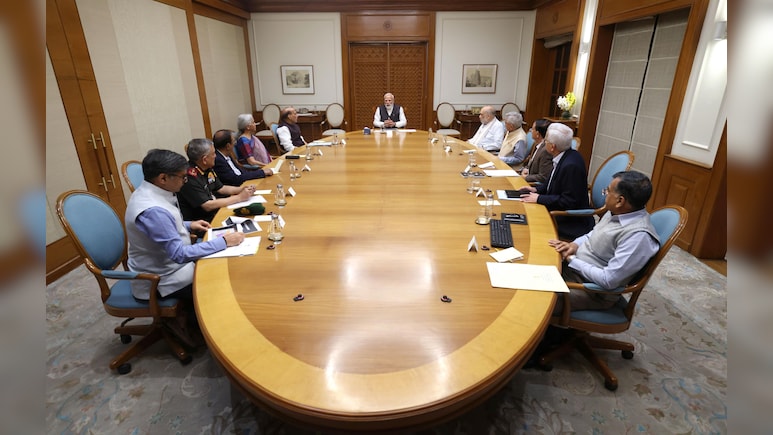
- Prime Minister Modi chaired an emergency meeting on Indian expatriates' safety in the Middle East
- The Cabinet Committee reviewed military escalations and risks to nearly 90 lakh Indians in the region
- Flight cancellations and threats to maritime trade routes raised concerns for Indian logistics and energy
Amid the rapidly escalating conflict in the Middle East, Prime Minister Narendra Modi chaired an emergency meeting of the Cabinet Committee on Security last evening. Central to the discussion was the safety of the nearly 90 lakh Indian expatriates living and working in the Middle East.
The three-hour meeting was held against the backdrop of the significant military escalation after the US and Israel launched coordinated airstrikes against Iran, and Tehran hit back by bombing US allies in the Gulf, including Qatar and Dubai, and widening the conflict.
The Cabinet Committee on Security, India's top decision-making body, was briefed extensively on the military developments that have pushed the region to the brink of a broader conflict.
The Committee expressed serious concern regarding the vulnerability of the Indian community in this situation. Beyond physical safety, it reviewed the logistical nightmares Indian citizens are facing. These challenges include the cancellation of 350 international flights of Indian carriers yesterday due to airspace closures in 11 countries. Concerns were also raised for Indian students in the region scheduled to appear for crucial examinations. The committee assessed the potential disruption of maritime trade routes, specifically the Strait of Hormuz, vital for India's energy security and commercial activities.
Prime Minister Modi spoke with his Israeli counterpart, Benjamin Netanyahu, over the phone and expressed India's concerns. "I spoke by phone with Prime Minister Benjamin Netanyahu to discuss the current regional situation. I expressed India's concern regarding the recent developments, and emphasised that the security of citizens is the utmost priority. India reiterates the need for an early cessation of hostilities," he said in a post on X.
Earlier, he spoke to UAE President Sheikh Mohamed bin Zayed Al Nahyan, whom he referred to as "my brother". UAE's capital, Dubai, has come under attack as Iran sends a strong message to US allies in the region.
"Spoke with President of the UAE, my brother Sheikh Mohamed bin Zayed Al Nahyan. Strongly condemned the attacks on the UAE and condoled the loss of lives in these attacks. India stands in solidarity with the UAE in these difficult times," he said. "Thanked him for taking care of the Indian community living in the UAE. We support de-escalation, regional peace, security and stability."
The Cabinet Committee on Security directed key government departments to use every feasible measure to assist Indian nationals affected by the turmoil. While the government is preparing contingency evacuation plans for any exigency, the official stance remains rooted in a return to dialogue and diplomacy.
The Ministry of External Affairs has already activated 24/7 helplines across missions in Tehran, Tel Aviv, Abu Dhabi, and Dubai. As the region remains on the edge, New Delhi's primary focus remains a delicate balance: protecting its citizens abroad while advocating for regional stability to prevent a global economic shock.
Track Latest News Live on NDTV.com and get news updates from India and around the world

