





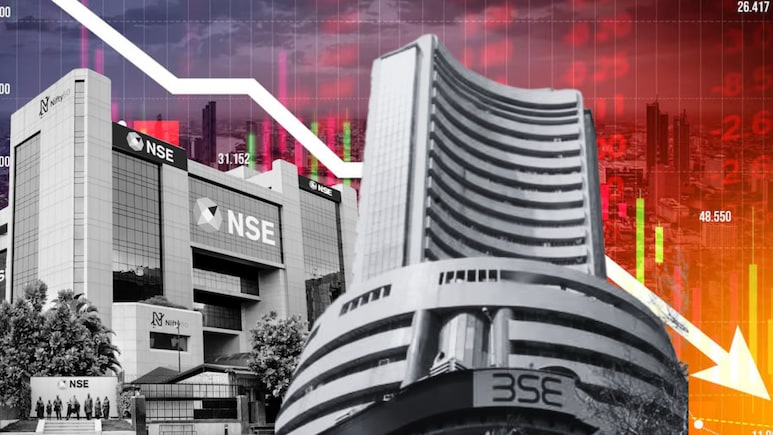
- Investors lost Rs 19 lakh crore as Indian markets saw its worst week in four years
- Sensex dropped 1,442 points to close below 75,000, wiping out Rs 9.8 lakh crore in a day
- Brent crude surged to $102 per barrel amid Middle East conflict, pressuring markets
Investors lost about Rs 19 lakh crore as the Indian markets logged their worst week in four years, struggling amid the Middle East conflict and the oil shock from the closure of the Strait of Hormuz.
Sensex ended in deep red today, losing 1,442 points to settle well below the 75,000-point mark, wiping out about Rs 9.8 lakh crore in a day. Larsen and Toubro, Tata Steel, and SBI, Bharat Electronics, and Maruti were among the major losers that lost a chunk of their valuations. In this pack, Hindustan Unilever and Bharti Airtel were the gainers.
The previous Friday, on March 6, the 30-stock BSE index closed at 78,918, already weighed down by the Middle East concerns. The market valuation stood at Rs 449.35 lakh crore.
This week emerged a nightmare for investors as Brent crude prices soared to $102 per barrel, souring the markets.
Read: Investors Lose Rs 5.87 Trillion In A Day As Markets Tumble. Here's Why
Sensex closed at 74,592 points today as the market valuation dipped to Rs 430 lakh crore, resulting in a loss of Rs 19 lakh crore. The 50-share Nifty tanked 468 points to settle at 23,170 points, threatening to breach the 23,000-pyschological levels. The NSE index is down by 10 percent from its January 5 high of 26,373 points. The last time the Indian markets witnessed losses of this quantum was in June 2022.
Analysts said the uncertainty over the Middle East situation has weakened the global markets, indicating that a recovery may take some time.
The War Impact
The US's and Israel's war against Iran has taken a heavy toll on the global markets. The impact on oil supply has tightened crude prices, escalating demand and its impact on the Indian equities and the currency. Since the war began on February 28, the markets lost a total of Rs 25 lakh crore, as the investors' sentiments remained weak through the two weeks, struggling with continuous foreign fund outflows, heavy selling in global markets, and weakness in the rupee.
The war saw Iran blocking the Strait of Hormuz, a strategic maritime chokepoint that handles one-fifth of the global oil supply. As a result, fuel supply concerns gripped the world.
Read: Gold, Silver Prices Rise Amid War Uncertainity: Check Rates In Your City
In the US, the oil shock sent fuel prices jumping 21 percent to $3.60 a gallon this week, the highest since mid-2024. The US markets ended sharply low last night with S&P500 ending 1.52 percent lower. The tech-heavy Nasdaq Composite lost 1.78 percent while the Dow Jones Industrial Average tanked 1.56 percent.
Amid uncertainty over the Middle East situation, VK Vijayakumar, Chief Investment Strategist, Geojit Investments Limited, is of the view that a rebound in the US markets is some time away.
"The weakness in the US markets indicates that a rebound in the market is some time away. With Brent crude around USD 100, bulls are on the defensive. With the FIIs persisting with their sustained selling strategy, even large-cap blue chips are under pressure," he said.
The situation wasn't any better in Europe. Among major Asian markets, South Korea, Japan, China, and Hong Kong saw their indexes ending lower.
Track Latest News Live on NDTV.com and get news updates from India and around the world

