





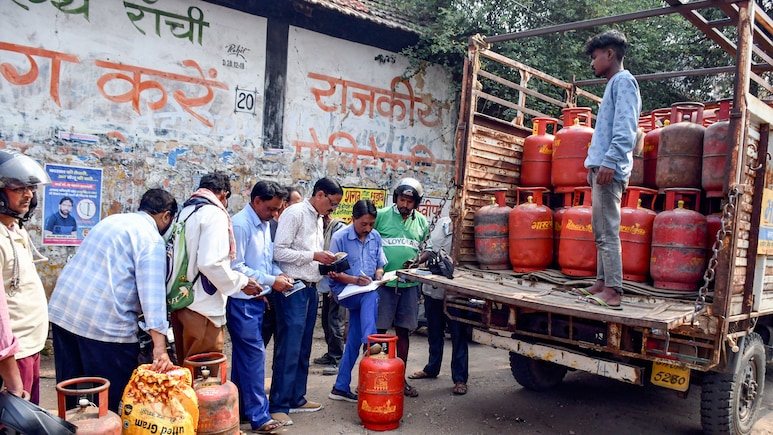
- India faces LPG shortages and price hikes amid West Asia tensions affecting imports
- Domestic LPG price increased by Rs 60; commercial cylinders rose by Rs 114-115 in Delhi
- India imports 60% of LPG, mainly from Gulf countries affected by Strait of Hormuz blockade
As chaos intensifies in West Asia, India is feeling the heat at home. Liquefied petroleum gas (LPG) - the cooking fuel for more than 33 crore households and the backbone of restaurant kitchens - has suddenly become hard to get. Prices have jumped, refills are harder to book, and commercial cylinders are short in key cities.
On March 7, domestic LPG prices were hiked by Rs 60 across cities (Delhi: Rs 913 for a 14.2-kg non-subsidised cylinder), while commercial 19-kg cylinders rose by about Rs 114-115 (Delhi: Rs 1,883).
The National Restaurant Association of India has approached Petroleum and Natural Gas Minister Hardeep Singh Puri, warning that a recent government directive on LPG supply could disrupt the availability of commercial cooking gas for restaurants nationwide.
Why is India squeezed?
India imports around 60 per cent of its total LPG demand, and nearly 80-90 per cent of these imports traditionally come from suppliers in the Middle East such as Qatar, the UAE, Saudi Arabia and Kuwait.
The immediate pinch is logistical: most Gulf-origin LPG sails through the Strait of Hormuz, which is at an almost blockade. With war-risk premiums, diversions and route uncertainties, cargoes have tightened and transit times from alternative sources
LPG consumption and prices
India's domestic LPG consumption has shown a steady upward trajectory over the past decade, rising from 21.61 million tonnes in 2016-17 to a peak of 31.32 million tonnes in FY25, before easing slightly to 30.86 million tonnes in FY26. The data, updated as of February 2026, reflects the growing household dependence on LPG. Overall, India's LPG use has grown by nearly 43 per cent in 10 years.
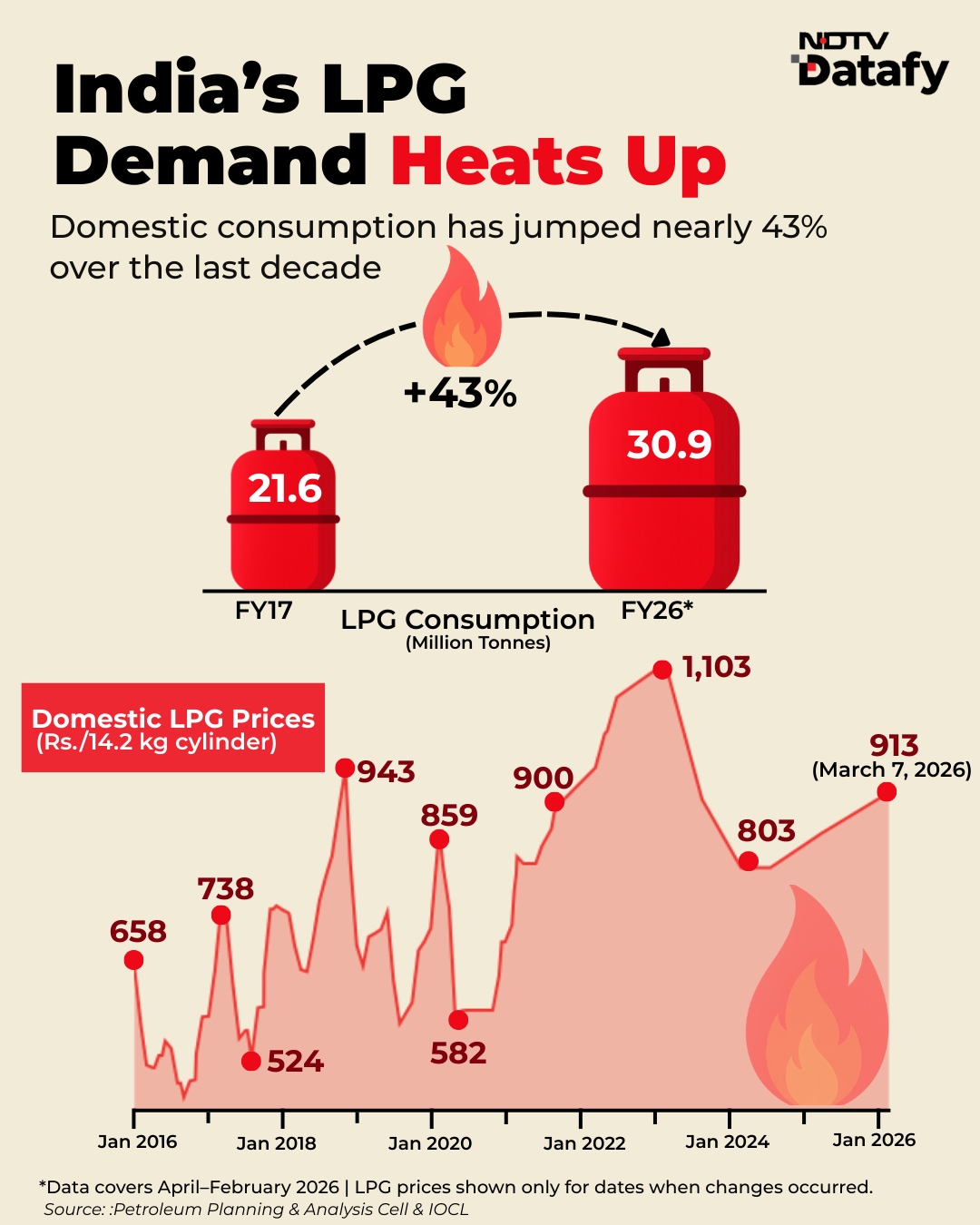
LPG prices in India have seen sharp fluctuations over the past decade. Taking Delhi as a benchmark, LPG price per cylinder rose from Rs 658 in January 2016 to Rs 913 as of March 7, 2026, with dozens of revisions in between. The recent increase is because of the escalating tensions in the Middle East. During the past decade, LPG prices hit a peak of Rs 1,103 in March 2023, easing to Rs 803 in 2024, and then spiking again in 2025 and early 2026. Overall, the pattern reflects the combined impact of global energy volatility, supply chain pressures and changes in government pricing policies.
Who burns oil the most?
The distribution of refined petroleum product consumption in 2023 shows that the United States accounts for 19.9 per cent of global use, followed by China at 15.9 per cent and India at 5.2 per cent.
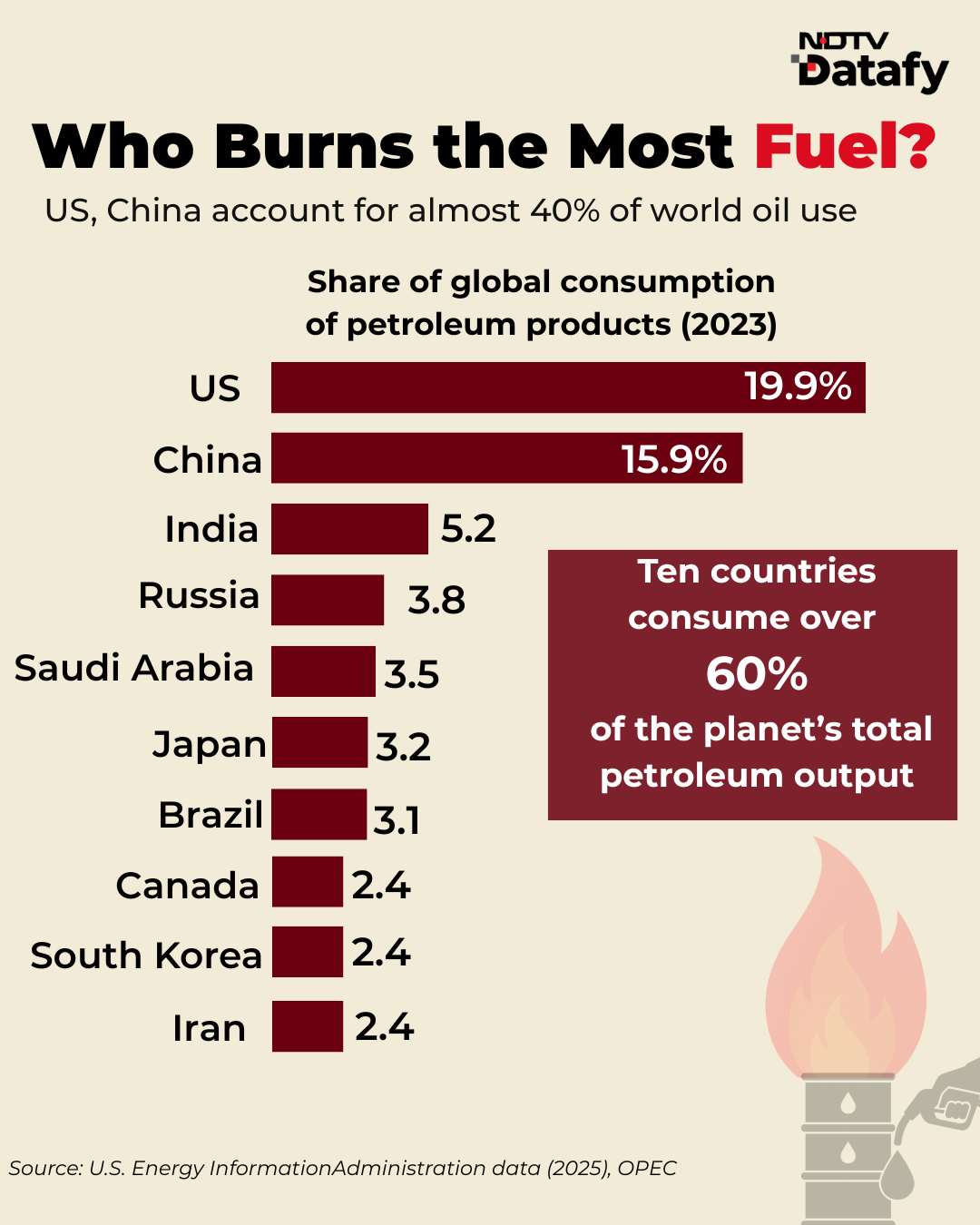
Other major consumers include Russia with 3.8 per cent, Saudi Arabia at 3.5 per cent, Japan at 3.2 per cent, and Brazil at 3.1 per cent. Three countries - Canada, South Korea, and Iran - each contribute 2.4 per cent to global refined petroleum consumption. These top 10 countries consume about 62 per cent of global petroleum products.
Transport fuels dominate oil demand
Global crude oil consumption in 2023 is distributed across a range of refined products, with gas/diesel (used for large commercial vehicles, heating) making up 31.9 per cent, followed by motor gasoline (for 4-wheelers, 2-wheelers, etc) at 27.2 per cent. Together, these two transport-focused fuels account for more than half of petroleum usage.
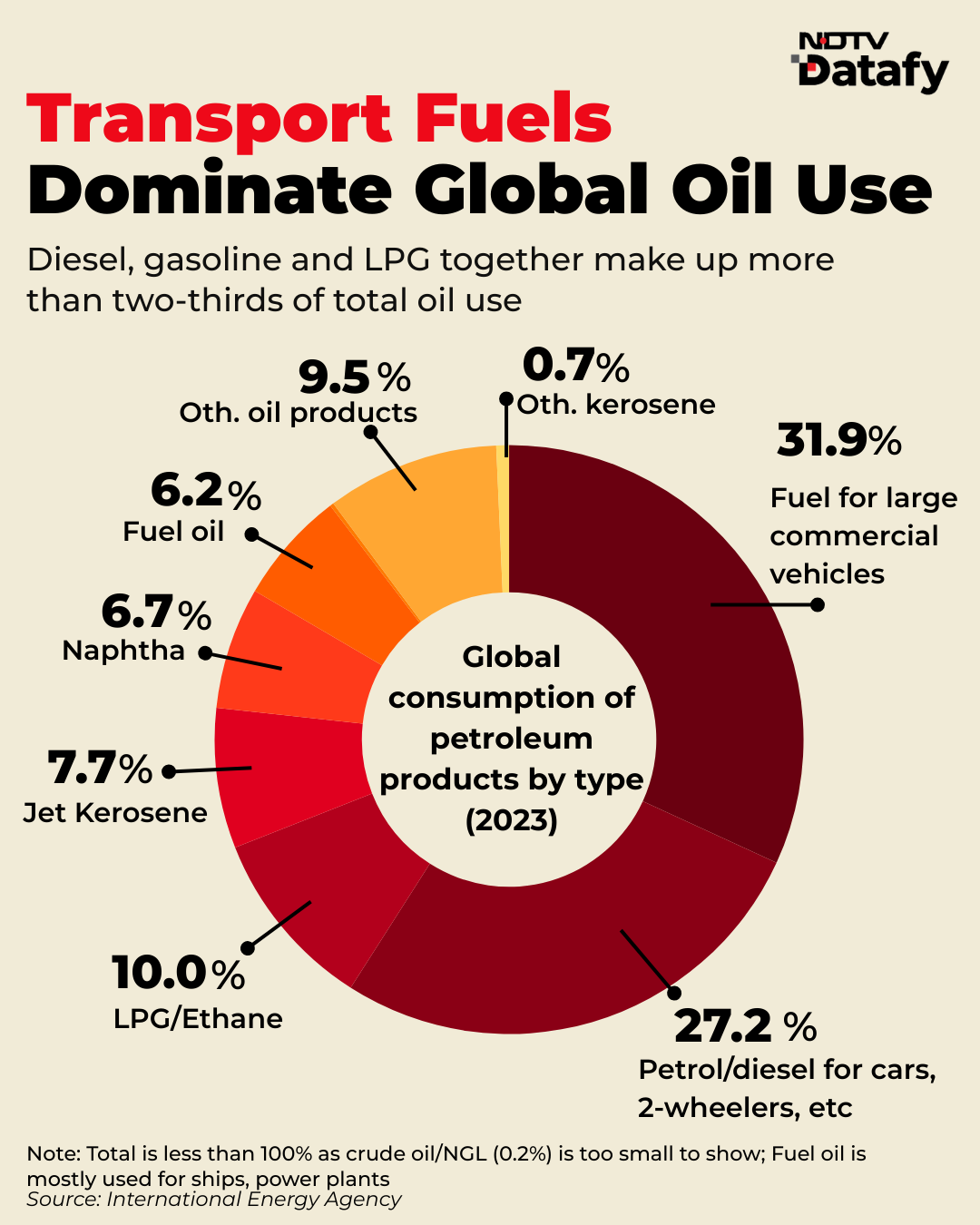
Other significant components include LPG/Ethane at 10 per cent, jet kerosene (used primarily for aircraft) at 7.7 per cent, and naphtha at 6.7 per cent, reflecting the role of aviation and petrochemical demand in the overall consumption mix. Fuel oil (used for ships, power plants) contributes 6.2 per cent, while other oil products add 9.5 per cent, covering a variety of industrial and commercial applications.
Smaller categories form the remaining share, including other kerosene at 0.7 per cent and crude oil/NGL at 0.2 per cent, which appear marginal in the overall breakdown. This structure highlights how global oil use is concentrated in a few dominant product groups, with transport and petrochemical fuels forming the bulk of total consumption in 2023.

